Saturday, April 29, 2006


Smoke and Mirrors

American society has always had a rocky relationship with French culture. This is partly rooted in history, partly in ephemeral atittudes – could two nations be more proud of their independence?

Joan DeJean’s The Essence of Style: How the French Invented High Fashion, Fine Food, Chic Cafés, Style, Sophistication, and Glamour (N.Y.: Free Press, 2005) provides an entertaining look at French innovations emanating from the era of King Louis XIV that provides plenty of grist for Francophiles, Francophobes, and everyone in between. In it, there are chapters devoted to the urban good life: cafés, night life, mirrors, interior decorating, clothes and appearance, hairdressers, perfume and cosmetics, haute cuisine, and champagne. The shockwaves of these innovations have been felt around the world for nearly five hundred years and are as modern today as they were at first blush.

Many Americans have mixed feelings about France, especially those who abhor sophistication and the cosmopolitan outlook. But I salute France and French culture. Despite my last name, I am only partly of French blood and have enough Swedish, Walloon, German and British to make me more “Western European” than anything else. Still, I love French history, literature, architecture, and stubborn French hutzpah.

Furthermore, France is a beautiful country. Paris and Marseilles are challenging and wild cities, but places like Toulouse and Lyons are more laid back and relaxing. I have always had a good time in France, and learn something major and new every time I visit.

Geopolitically, the USA can learn something from French overseas policies. Americans have, repeatedly, been linked with French foreign policy, not always understanding the implications. The longstanding Anglo-French rivalry spilled onto the North American continent during the Seven Years War, giving the British the political uphand; but French language and culture continue to survive in Montreal, Quebec, and in other pockets such as Martinique and New Orleans. The French alliance with the fledgling United States proved essential in the defeat of the British at Yorktown in 1781. Napoleon I sold the Louisiana Territory to Thomas Jefferson’s administration in 1803. The 1862 defeat of French troops in Mexico at the Battle of Puebla led to today's Cinco de Mayo festivities and to the more immediate securing of the Texas border by Union troops in 1865. France bestowed the Statue of Liberty to the USA as a centennial gift. The US and France again became military allies in the First World War, and again during the Second World War. The US followed France into Vietnam, thinking it could be more successful even after observing the French defeat at Dienbienphu in 1954. And, for anyone who has seen The Battle of Algiers (1967) -- in which urban Muslim guerillas and their successors eventually defeat French policies -- they must undoubtedly see the similarities with the Anglo-US occupation of Iraq and other Islamic areas. The French were smart not to get involved in the latest foreign adventure – they know better. Hopefully, some day, we will catch up. And perhaps the British will finally get up the nerve to cast off their own monarchy and become a tumultuous republic, too. Meanwhile, the champagne is chilling. . . . .

Vive La France!

Friday, April 28, 2006


More Fun in the New World

The latest Economist (April 22-28, 2006) has a lot of good stuff behind its droll cover, prompting me to make another brief foray into the political world. The Republicans are now in disarray, but that only levels the playing field since the Democrats are always in disarray. As "Happy days are here again -- or are they?" puts it, "The Republicans are so unpopular that any semi-competent opposition party should be sauntering to victory in the mid-term elections in November." Exactly.

In reality, the USA is closely divided, akin to Italy, where the recent national election results finally displaced Bush's ally, Prime Minister Silvio Berlusconi (who is quite a character) via a marginal victory by Romano Prodi's coalition. Today the headlines read "Italy's Parliament Reopens Amid Chaos." It's difficult to effectively govern amid chaos, to say the least. Yet that's where the USA is and that's where it will continue to stay, at least until the end of G.W. Bush's natural term. We can only dream of something better coming along to clean up the mess the American Republicans have bestowed to the world since the 2000 elections.

One problem for the American Democrats is that they have no FDR-like leader to rally behind. Just look at the faces on the cover of The Economist! Jesus! Will no one more electable step forward for the leadership post? No more senators, please. We need someone who seems like an outsider, like a tough governor. As "Dumb and Dumber," another Economist article, suggests, a few moronic but well-timed attack messages like the anti-Kerry "flip-flopper" adverts could be enough to defeat someone like Kerry again -- and again and again and again. It's that dumb in the political world. No wonder the world's in such a mess!

The latest Economist also has a nifty pullout section that explores the burgeoning internet and its revolutionary/evolutionary implications. This is a boon for the movement and exchange of ideas and social interaction. Though (as I'm finding out communicating with Luma, a fun blogger emanating from Brazil and writing in Portugese) free machine translation is not much better than guessing as to context and content. Here's a link:
http://luzdeluma.blogspot.com/
It's got terrific visual style and it's fun communicating with her, even if I barely understand a single sentence yet.

"What sort of revolution?" is a good question to ponder. I am fascinated by the implications of electronic publishing where individuals can take it to the people for a very low cost, bypassing the antiquated paper publishing system. The human and monetary costs of traditional publishing and old mail delivery systems makes it all seem quaint already, when not also an annoying obstacle to getting things published. And let's not forget that even traditional printing is barely 600 hundred years or so old. Furthermore, most people were illiterate until the last century. The internet will boost literacy of all kinds, and that's a good thing for writers. Hierarchies can be bypassed, and that's not such a bad thing, either. Besides, like Protestants and Catholics, it's not as if one way will entirely destroy the other. People are free to use papyrus, fountain pens and manual typewriters to their heart's content. Good luck to them on the internet!

Easy link to The Economist:
www.economist.com

Ciao!

Thursday, April 27, 2006


Back to Archer City

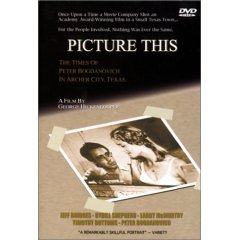
Continuing with Picture This, the documentary set in Archer City introduced two days ago, it was noted that The Last Picture Show was hard to make for many reasons, not least of which was the Cybill Shepherd-Peter Bogdanovich romance. As the latter notes on camera, “Everything was different by the time we left.” His father had a sudden stroke and died. His marriage with Polly Pratt was disintegrating, and they all had to carry on despite their losses. Jeff Bridges had just broken up with a true fine love, Cloris Leachman and Ellen Burstyn were in the middle of simultaneous divorces, and Timothy Bottoms’ parents separated. The latter development led to Timothy's brother Sam’s joining the cast. As Leachman observes: “We brought it all with us and put in all in our work.” No wonder it’s such a poignant picture show!

Timothy Bottoms was particularly disturbed during the production. “Sure, we were acting, but we weren’t,” he notes, seeming still depressed and lost during the shooting of Texasville twenty years later. He fell hard for Cybill Shepherd during a scene in which they kissed, and apparently never recovered. “The future came so quick. . . twenty years went by like a bang,” he says at one point during the production of Texasville. When Shepherd was informed of his feelings for her, she finally chatted with him about it, saying she never knew. “Is it too late?” he asks her on camera. “It’s never too late, baby,” she quips back. Bottoms also projected angry feelings about his father onto Bogdanovich because of his leaving his wife for Shepherd, and it all channeled into his performance. Since 9/11/01, he has played G.W. Bush in three productions.

“All you can say is let’s not make the next twenty years like the last twenty,” Peter Bogdanovich says wistfully, and at another point notes: “Life has a way of getting out of hand when you’re in the fast lane.” His career as a director more or less peaked with The Last Picture Show, when he was only in his early thirties. His marriage dissolved, Sybill broke things off with him, and he became involved with Dorothy Stratten, who was brutally murdered by another man. “Murder is different from somebody just dying. . . some small part of you continues to reverberate” he notes. “People who say they have no regrets, I don’t know what they’re talking about.” Polly Pratt was back for Texasville, and she wondered whether her ex-husband had recovered from the past twenty years. "No," he says, "I think about it every day.”

Picture This: The Times of Peter Bogdanovich in Archer City, Texas is great for fans of any of the people involved with the two Larry McMurtry adaptions. Texasville is elegiac and fun, too. I’ll pick up the Dorothy Stratten story with thoughts about Bob Fosse’s Star 80 (1983), a fictionalized version of her life and death, at some point. Peter Bogdanovich has written many critically acclaimed books, nost notably film criticism. He is now a working member of HBO’s Sopranos team.
Does everything about everybody always come back to The Sopranos?

For admirers of the always lovely Cybill Shepherd, she has a website: http://www.cybill.com/

Ciao!

Wednesday, April 26, 2006

Chernobyl


Twenty Years
I remember the Chernobyl nuclear disaster very well because it began in the Soviet Union the same day as my first wedding took place back in the USA. The exact date it started was worse than an omen, because we flew to Europe that evening and arrived in London -- just as the first rumors of the accident were making their rounds. This was before ubiquitous internet access and 24 hour news, so it was hard to get any facts. But we knew about it immediately.

Many Londoners, however, seemed oblivious during the first few days of the “toxic event,” even while radiation continued spewing out of the burning reactor number four. Someone or some article from the International Herald Tribune suggested swabbing iodine above one’s knees and one’s wrists as a block against fallout. Don’t drink milk, avoid rain, and wait for news updates. Some honeymoon!

Wild rumors began flying: Kiev was under martial law. Thousands of Soviets were poisoned and dying. The Red Army had sealed off dead zones. Warsaw was in the path of a large plume; Sweden would be next, then Scotland.

My first wife Liz Pauk and I warily proceeded and next made our way to Paris. Since we had unlimited Eurail passes, we could hop most trains and go just about anywhere in Western Europe. We headed for the south of France, where Liz became ill, but recovered enough that we pushed on to Italy via Pisa, and eventually we made it as far east as Vienna before heading back west via Germany. By that time, a clearer picture was emerging. Yes, the Iron Curtain borders were being sealed as a safety and security precaution by the Warsaw Pact countries. Yes, radiation was a real danger, but there wasn’t much anyone could do about it. We flew back to the States from Paris.

The Soviets lost something like thirty-one killed either in the initial accident or trying to contain it. Twenty years later, we still don’t know how many have died or suffered as a result of the disaster. Estimates range from 9,000 to over 90,000 dead or dying from radiation poisoning.

The timing for us personally was so bizarre it still makes me wonder. What are the chances of getting married on such a day? We chose that date out of convenience, having been just laid off by Algonquin Books of Chapel Hill as they transferred their business operations out of North Carolina and therefore had a block of time before starting new jobs at Duke University.

All in all, 1986 was a rough year. The space shuttle Challenger blew up in January, and Ronald Reagan and his crew of yahoos were acting like scary war mongerers, supporting Islamic extremists against the Soviets in Afghanistan and fighting a series of clandestine guerilla wars in Latin America. The Reagan administration funnelled weapons to Saddam Hussein in his war against Iran, even while it also supplied weapons to Iran and propped up the Panamanian dictator Manuel Noriega. All in keeping with George Orwell's dystopian 1948 vision for 1984.
Oh, the ironies abound for today, exactly twenty years later. A salute to the rescue teams and all those who died.

Tuesday, April 25, 2006


Filmed in Archer City, Texas

Before director George Hickenlooper completes production of the new Edie Sedgwick biop, it’s worth revisiting his earlier work. For now, I’ll focus on his touching and insightful documentary shot on location during the filming of Texasville (1990) -- which was itself a sequel to The Last Picture Show (1971), and based, like the earlier film, on a Larry McMurtry novel of the same name.

Picture This: The Times of Peter Bogdanovich in Archer City, Texas (1991) was produced by Timothy Bottoms and co-produced by Sam Bottoms, his brother.

The viewer quickly gets a feel for Archer City in any of these three films. In Hickenlooper’s work, the people from the community who were willing to talk are fascinating – defiantly rural in outlook but quite cognizant of pop culture. They are quite happy to make their attitudes known on film.

In Picture This, we learn a lot about the making of The Last Picture Show, directed (as was Texasville) by Bogdanovich. Production designer Polly Pratt, his wife at the time, had recommended making the book into a movie. Once they decided to do it in collaboration with Larry McMurtry, they flew to Dallas-Fort Worth and drove with him for two hours scouting locations before arriving in Archer City. Seeing the swinging traffic light there, the out of towners concluded, “This is the town,” to which McMurtry responded, “It ought to be: this is the town I wrote about.” Apparently, the author wanted to change some of the original content, but the director and Pratt decided to stay true to the book, with only minor changes. (And they succeeded brilliantly).

We get to see Larry’s mother Hazel interviewed, and she’s quite entertaining. She recalls challenging The Last Picture Show novel as scandalous, to which her son responded pragmatically and unflinchingly, “I want my books to sell.”

Pratt was taken with McMurtry’s talent as a writer, and was awed by his making it despite the poverty of his surroundings. “Of course,” she concludes, “it was that town that incubated that talent to grow – what else was there to do?”

There is much speculation about what character is based on what real person. And though McMurtry at one point says bluntly “I’m not a journalist -- I’m a fiction writer,” actual people did make their way into composite major characters. We learn, for instance, that Archer City’s “Most Beautiful Girl” in a long ago yearbook is Celie Slack (Ceil Cleveland, who wrote a memoir about this in 1997), that she did inspire elements of Jacy Farrow (played by Cybill Shepherd in her first acting role). Bobby Stubbs formed at least the rough model for Sonny (played by Timothy Bottoms), down to havng had his eye gouged in a fight with Celie’s other boyfriend. Celie puts it rather sweetly: “Bobby and I were very good friends.” Indeed.

One of the best aspects of Picture This is the interwoven series of personal recollections about production decisions and processes. The viewer also gets to see brief screen tests, including one for Randy Quaid. What strikes me about all the actors is how similar they seem in real life to their on screen personas. One of them, Ben Johnson, initially turned down the role of Sam the Lion because of “bad language,” and had to be persuaded by director John Ford to play the part, which eventually earned him an Academy Award.

For all sorts of reasons, it was a tough film to make for most of the cast and crew. One reason was the love affair that developed between Bogdanovich and Shepherd. The director discovered his Jacy on the cover of Glamour Magazine and immediately fell for her “insouciant, slightly sardonic smile. . .” When they met, Shepherd appreciated that he treated her “equally.” According to PB: “We just talked and she was sort of offhand. . .” and sometime during the course of film making, they hooked up. Pratt, the displaced wife, observed of the newcomer: “She is that girl who seems to have it all” – the perfect person to play Jacy Farrow. As one of the crew members recalls: “All of a sudden one day Polly was not staying in Peter’s suite.” But Polly made a truce with reality and completed the project, even having to do Cybill’s hair each day before filming. Pratt merely observes: “I really believed that every director would have an affair with their leading lady.”

Shepherd characterizes her hookup with the director as the beginning of a “major relationship” with Bogdanovich – and indeed, they did not end their romance until 1978 when, "fed up with Hollywood," she returned to her hometown of Memphis and married an auto-parts dealer.

To be continued . . . . .

Monday, April 24, 2006


Detroit in Play

Three Metro pro teams are all vying for glory at once. The Tigers, the Red Wings, and the Pistons are giving Detroit something to cheer about, certainly. Of the three sports, only pro basketball really provides the firepower and fast pace that can keep me riveted, and the Pistons are at the top of their game this year, give or take a few slumps. Of the three teams, the Pistons also have the best and clearest shot at winning another championship.

For me, baseball and hockey are more suitable as background to other tasks or socializing, but basketball when done right requires fuller engagement. Call me biased, but that's my choice. Still, for the sake of the Metro area, I hope all three teams continue to do well.

Last night, the Pistons fired up to defeat the Milwaukee Bucks, winning the first game of the playoffs 92-74. Rasheed Wallace was totally on and scored 22 points; Rip Hamilton followed closely with 21. Ben Wallace muscled 17 rebounds and overall, the Pistons contained the Bucks' offense very nicely by game's end. Second game picks up on Wednesday at the Palace. The Tigers and Red Wings both play tonight, but I'll leave those games for others to enjoy at their own pace.

Besides the Pistons, of course, The Sopranos and Big Love were fabulous -- and thank God for HBO on demand. So many good lines, such great stories! Tony's quip still has me cracking up because it applies to so many: "It's common knowledge the guy's retarded."

And always with the cautionary tale, I'm reminded to keep quiet in any situation that holds the danger of escalating, especially if the other person has impulse control problems and a violent nature. Always with the mouth! Even understanding the wisdom of holding back and choosing battles carefully, though, I still find myself acting out from time to time. Bad me! And far more so for many of The Sopranos guys -- which is one of the elements that makes it so entertaining. Tony has his hands full constantly reminding everybody this is a business. Let's hope Artie Bucco can see the light before something worse happens to him. I'm just saying. . . . .

Finally, let's note that Italy seems to have just barely gotten rid of Bush's little buddy Berlusconi. He and Blair may not be far behind in this evenly divided political world.

Arrivederci!

Sunday, April 23, 2006


Edie Sedgwick in Ciao! Manhattan

A smart, talented and charismatic beauty, Edie Sedwick is one of those people who decided early on to set her controls for the heart of the sun. Why she chose this suicidal course is unknowable, but it is true that her family milieu was a contributing factor. Still, if everyone who came from a twisted background killed themselves, half the younger people we know would be dead already.

Edie (4/20/43-11/15/71) came East from California for college, but quickly became a "Youthquake" model for Vogue and other high-circulation magazines, making her an instant celebrity. She gravitated to Andy Warhol and was soon elevated by him to the status of Superstar. 1965 was her year, and she intermingled with numerous artists ranging from Warhol to Lou Reed and the Velvet Underground, Bob Dylan, and any number of denizens of the Hotel Chelsea. Already troubled when she came to this scene, she plunged into amphetamine use with wild abandon. Speed was everywhere -- the silvery Factory walls and clothes designed by Betsey Johnson, images of flying saucers, all seemed to reflect this prevalence. Edie and Warhol dressed alike in androgynous and eccentric poses, and Warhol captured her on film: in classic Screen Tests and in Poor Little Rich Girl (1965). The latter, a short movie focusing on Edie's daily lifestyle, has yet to be released on DVD or as part of a larger Warhol package. The second photo above is a representative still. If Factory Girl is successful, we will undoubtedly be seeing much more of Edie Sedgwick in and about the Factory.

Next, Edie played in Chelsea Girls (1966) and became involved with a wide array of drugs that tipped her into semi-incoherence. In 1967, she began working on the first incarnation of Ciao! Manhattan, but due to its disintegrating cast, this film was not completed until 1971 -- soon after Edie's death by overdose. Paul America, another cast member, was jailed in northern Michigan for possession of illegal substances. At one point in the final version, Edie notes Paul and his speed freak friends stole my passport and my leopard skin coat while we were living at the Chelsea.

The creation of Ciao! Manhattan is a fascinating story in its own right. The revised crew had to relocate to California to work with Edie in her decline. Filmmakers John Palmer and David Weisman managed to salvage a work that gives a clear glimpse into the times and lifestyles of the Warhol revolution. The viewer can actually create some narrative sense out of flashbacks and voice-overs, even from the bumbling mutterings of the secondary male characters.

Edie Sedgwick steals every scene (and one wishes there were far more of her and fewer of everyone else); even with her brain fried, she comes off more coherently than Jackie Kennedy (they speak in the same distinctive way). And though soon to be dead, Edie retains her essential beauty.

At the beginning of the film, we see her as Susan Superstar, living in a drained swimming pool at the back of her mother's California mansion, under a large canopy tent, surrounded by images of her mid-60s days. She launches the show in earnest with her statement of purpose to Butch, a callow wanderer from Houston: I'm preparing a portfolio of friends and aquaintances I knew in New York during my modeling career. At which point the music kicks into a sort of Liquid Sky tempo, with a psychedelic map of Manhattan flashed to the screen. Love it!

Edie has any number of great lines, delivered with a voice that reveals a strong jaded intelligence, petulance ("Not the lipstick -- lip gloss!"), gallows humor, and tragic beauty.

Her early declarations include simple things like I'm gonna get drunk! and, while drinking Smirnoff vodka and breaking glass that cuts her foot, Oh God, another scar. That line pretty much says it all. But she also gives a moving soliloquy to the powerful hold of amphetemine on her system: When I was a child, I was very hyper. . . I got hooked on speed at the Factory. . . Speed is the ultimate all-time high. That first rush, wow, like a 24-hour climax that can go on for days. . . There's nothing to explain it unless you've been through it. . . I'd like to turn the whole world on just for a moment, just for a moment. . .

The scenes with Edie are endlessly fascinating, and overall Ciao! Manhattan is worth checking out for the black and white shots of New York City in the late 1960s, and the Wizard of Oz color contrast with early 70s California. There is a lot of nudity and drug use, as one might expect with anything that emerged from Warholia. The surrealistic scenes of clients getting their "vitamin shots" from Dr. Roberts tell more about "normalized" drug use than the whole of Valley of the Dolls (1967).

A salute to Edie Sedgwick, R.I.P.