Sunday, November 07, 2010

The Howlin' Wolf Story, Part 2


Picking up from Part 1 of The Howlin' Wolf Story, it's worth noting here (as Walking Man commented in the previous post) that Wolf was a big man, around three hundred pounds, and yet -- as someone else quipped (I don't remember who or where), on stage he was like a force of nature, fusing Jimi Hendrix's antics (learned from Charley Patton) with the gymnastics of Mick Jagger and Iggy Pop.

In any case, not too long after his early Memphis hit singles, he drove with four thousand bucks in hand to Chicago, developing a strong musical presence there, teaming up with Chess records. He eventually added to his band Hubert Sumlin from Wast Memphis days; in Chicago, Sumlin developed into a fantastic and highly influential electric guitar player. By the end of the 1950s, Wolf got married and adopted two daughters. A thorough professional, he took care of both his family (his wife became his business manager) and band members, though his "Christian" mother down South still never forgave him for his choice of career; in fact, she refused to take the money he offered. When the Wolf sang "Goin' Down Slow," he probably meant it when he came to these lines:

Please write my mother, tell her the shape I'm in
Tell her to pray for me, forgive me for my sin . . .

By the early 1960s, black music audiences had shifted away from the blues, but after a rough few years, white audiences -- particularly in Europe -- took to the style in a big way. Enter the Rolling Stones. Already major stars, they covered the Wolf's "Little Red Rooster" (pretty surrealistically if you compare the two, notably recorded in Chicago) in 1964; after it became a number one hit in the UK, the Stones created a space for the American, a hero to them, on Shindig (#37, 1965).

Wolf was treated like royalty while on tour in Europe. By the end of the 60s, though, his health deteriorated (kidneys, heart); nonetheless, he agreed to work on The London Howlin' Wolf Sessions in 1970, which after its release in 1971 sold more than 900,000 copies according to the documentary.

Howlin' Wolf's great sideman Hubert Sumlin observes long after Wolfs death in 1976, "He was on it. I still think he's here right now . . ."  Throughout The Howlin' Wolf Story, Sumlin comes across as a vibrant, joyous person.  I'd really love to see the 78-year old guitar hero in person  -- he represents a living link to the beginning of recorded blues music. His website:
http://www.hubertsumlinblues.com/index.html


Today's Rune: Defense.  Photo: Howlin' Wolf at Silvio's, Chicago. Credit: http://thehoundblog.blogspot.com/2010/06/howlin-wolf.html

Saturday, November 06, 2010

The Howlin' Wolf Story, Part 1


Don McGlynn's Howlin' Wolf Story -- The Secret History of Rock & Roll (2003) provides an excellent overview of the life and times of Chester Arthur Burnett (6/10/1910-1/10/1976). The highlight for me -- home movie footage shot by drummer Sam Lay in Chicago -- fantastic!

The Wolf's arc from a rough Mississippi childhood to self-sustaining Chicago-based career is well-traced, as is his tragic relationship with his mother, a spiteful woman who hid behind Christianity and castigated the blues as Devil's music (and she wasn't kidding). Along the way to Memphis and his first recording sessions at Sun Studios (when in his early forties), Wolf plays alongside such blues luminaries as Charley Patton, Son House and Robert Johnson; he does two years of Army service during WWII; has steady success in West Memphis, Arkansas, and even a half-hour radio show. "And the peoples went for what I was puttin' down," Wolf observes earlier. In 1951, when he cuts "Moanin' at Midnight" and "How Many More Years," his life experiences fuel his artistry. He notes of the blues at one point, "A person hever had a hard time, they never will know what the blues are anyway." The 50s cuts endure as powerful avatars of electric blues. From the first recordings to his death, he's got twenty-five more years to go.

To be continued . . .


Today's Rune: Wholeness.

Friday, November 05, 2010

Howlin' Wolf in London


Here's a pretty laid back Anglo-American effort.  The Wolf (Chester Arthur Burnett) died in 1976. Warren Zevon's "Werewolves of London" came out in 1978.

The London Howlin' Wolf Sessions players:

Howlin' Wolf -- vocals, harmonica, guitar.
Eric Clapton -- guitar.
Hubert Sumlin - guitar.
Jeffrey M. Carp -- harmonica.
Ian Stewart -- keyboards/piano.
Bill Wyman -- bass.
Charlie Watts -- drums, conga, percussion.

Additional:
Steve Winwood -- keyboards/piano and organ.
Phil Upchurch -- bass.
Klaus Voormann and Ringo Starr (aka "Ritchie") -- drums.

Recorded: May 1970.
Released: 1971, 1974, 2004.


"Wang Dang Doodle" from the 1970 sessions -- lyrics included!

Today's Rune: Fertility.

Thursday, November 04, 2010

Rip This Joint


Through their song-writing skills, Mick Jagger and Keith Richards show a deep appreciation for American music and culture. Let's take a quick look at one song, "Rip This Joint," as an example. It was recorded in 1971/1972 and released on Exile on Main St (1972), a very American title in its own right (the British equivalent is High Street). This song has at least one strand that can be traced via Howlin' Wolf to levee camp songs and "Lookin' for the Bully" ditties that go back at least into the early 1890s.*

Mama says yes, Papa says no
Make up your mind 'cause I gotta go
I'm gonna raise hell at the union hall
drive myself right over the wall!

Take a thread from "Wang Dang Doodle," a song Willie Dixon wrote for Howlin' Wolf that was recorded and released fifty years ago (twenty plus years before "Rip This Joint"):

. . . we gonna pitch a ball
down at the union hall
We gonna romp and stomp till midnight . . .

Stones: Short Fat Fannie is on the loose
Wolf: . . .tell Fast Talking Fannie . . .

Stones: Yin yang, you're my thing
Wolf: . . . wang dang doodle all night long

Stones: Down to New Orleans with the Dixie Dean
'cross to Dallas, Texas and the Butter Bean
Wolf: equal littany of funny-sounding names


"Rip This Joint" also pokes a little fun at the Nixon White House:

Dick and Pat in ole D.C.
well they're gonna hold some shit for me

. . . giving the "Joint" in the title a second twist, tapping into another history that goes back to the early 20th century.

You can bounce all sorts of lyrics through the mix.

Throw in the ranch
And sell the damned farm
Go now baby and
Kill 'em with charm!

Music is always like that: microcosmic cultural telegrams, living artifacts that keep giving little presents to the always roving present. It's also as good a way as any to get a real feel for the historical record and cultural transmission down through the ages.

*Paul Oliver traces the bully song in "LOOKIN' FOR THE BULLY: An Enquiry into a Song and Its Story," in Nobody Knows Where the Blues Come From: Lyrics and History edited by Robert Springer (University Press of Mississippi, 2006).  

Photo Source for Philadelphia Union Hall sign above: Brownstoner.com (May 2008).

Today's Rune: Fertility.

Wednesday, November 03, 2010

A True Tale of Twin Obsessions: Marco Bellocchio's "Vincere"


This one packs a wallop: Marco Bellocchio's Vincere (2009) follows the arc of two fiery obsessions in the first decades of the 20th century:  Ida Dalser's (Giovanna Mezzogiorno) with Benito Mussolini (Filippo Timi) and Mussolini's with power. The wild beginning of this arc prefigures its ending.

Vincere ("WIN" / Victory!) is a beautifully shot film, making maximum use of period techniques almost like a John Dos Passos novel, with newsreels and dizzying montages. Throw in shadows, light, snow falling as seen through the bars of an asylum, Futurism, dramatic music and an operatic scale with two impressive leads, and you've got yourself quite a picture show.

Timi is completely convincing as Mussolini, who comes across as magnetic and, by the way, deranged.  Mezzogiorno is a joy to watch, like an Italian cousin of Marion Cotillard, and just as convincing as Ida. 

The Italian fascists are like gangsters with uniforms (actual gangsters were expanding in the USA at the exact same time, and many of them were Italian, too). Sometimes the way things play out reminded me of ancient Roman families in an aristocratic power play, other times Dalser seemed like one of the wives of Henry VIII. In the end, the brutality of power has no essence, but is merely situationally operational (to borrow from Michel Foucault).  One year, a fascist dictator, another year a bloody corpse hanging on a meat hook.


Benito Mussolini (Timi) and his Ida, Special Lady Friend -- or first wife (Mezzogiorno) -- watch a picture show.

Today's Rune: Harvest.

Tuesday, November 02, 2010

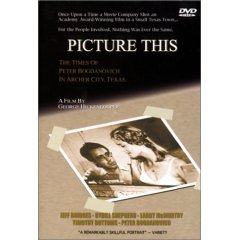
George Hickenlooper: Picture This


In tribute to George Hickenlooper (5/25/1963-10/29/2010), here is an entry originally posted in 2006, with a few slight changes.

Before director George Hickenlooper completes production of the new Edie Sedgwick biop, it’s worth revisiting his earlier work. For now, I’ll focus on his touching and insightful documentary shot on location during the filming of Texasville (1990) -- which was itself a sequel to The Last Picture Show (1971), and based, like the earlier film, on a Larry McMurtry novel of the same name.

Picture This: The Times of Peter Bogdanovich in Archer City, Texas (1991) was produced by Timothy Bottoms and co-produced by Sam Bottoms, his brother.

The viewer quickly gets a feel for Archer City in any of these three films. In Hickenlooper’s work, the people from the community who were willing to talk are fascinating – defiantly rural in outlook but quite cognizant of pop culture. They are quite happy to make their attitudes known on film.

In Picture This, we learn a lot about the making of The Last Picture Show, directed (as was Texasville) by Bogdanovich. Production designer Polly Pratt, his wife at the time, had recommended making the book into a movie. Once they decided to do it in collaboration with Larry McMurtry, they flew to Dallas-Fort Worth and drove with him for two hours scouting locations before arriving in Archer City. Seeing the swinging traffic light there, the out of towners concluded, “This is the town,” to which McMurtry responded, “It ought to be: this is the town I wrote about.” Apparently, the author wanted to change some of the original content, but the director and Pratt decided to stay true to the book, with only minor changes. (And they succeeded brilliantly).

We get to see Larry’s mother Hazel interviewed, and she’s quite entertaining. She recalls challenging The Last Picture Show novel as scandalous, to which her son responded pragmatically and unflinchingly, “I want my books to sell.”

Pratt was taken with McMurtry’s talent as a writer, and was awed by his making it despite the poverty of his surroundings. “Of course,” she concludes, “it was that town that incubated that talent to grow – what else was there to do?”

There is much speculation about what character is based on what real person. And though McMurtry at one point says bluntly “I’m not a journalist -- I’m a fiction writer,” actual people did make their way into composite major characters. We learn, for instance, that Archer City’s “Most Beautiful Girl” in a long ago yearbook is Celie Slack (Ceil Cleveland, who wrote a memoir about this in 1997), that she did inspire elements of Jacy Farrow (played by Cybill Shepherd in her first acting role). Bobby Stubbs formed at least the rough model for Sonny (played by Timothy Bottoms), down to havng had his eye gouged in a fight with Celie’s other boyfriend. Celie puts it rather sweetly: “Bobby and I were very good friends.” Indeed.

One of the best aspects of Picture This is the interwoven series of personal recollections about production decisions and processes. The viewer also gets to see brief screen tests, including one for Randy Quaid. What strikes me about all the actors is how similar they seem in real life to their on screen personas. One of them, Ben Johnson, initially turned down the role of Sam the Lion because of “bad language,” and had to be persuaded by director John Ford to play the part, which eventually earned him an Academy Award.

For all sorts of reasons, it was a tough film to make for most of the cast and crew. One reason was the love affair that developed between Bogdanovich and Shepherd. The director discovered his Jacy on the cover of Glamour Magazine and immediately fell for her “insouciant, slightly sardonic smile. . .” When they met, Shepherd appreciated that he treated her “equally.” According to PB: “We just talked and she was sort of offhand. . .” and sometime during the course of film making, they hooked up. Pratt, the displaced wife, observed of the newcomer: “She is that girl who seems to have it all” – the perfect person to play Jacy Farrow. As one of the crew members recalls: “All of a sudden one day Polly was not staying in Peter’s suite.” But Polly made a truce with reality and completed the project, even having to do Cybill’s hair each day before filming. Pratt merely observes: “I really believed that every director would have an affair with their leading lady.”

Shepherd characterizes her hookup with the director as the beginning of a “major relationship” with Bogdanovich – and indeed, they did not end their romance until 1978 when, "fed up with Hollywood," she returned to her hometown of Memphis and married an auto-parts dealer.

Today's Rune: Fertility.

Monday, November 01, 2010

All Hallows: First Day of the Dead, Reprised


To the departed and the fallen: Gone but not forgotten.

Last year at this time, I saw Florian Henckel von Donnersmarck's The Lives of Others / Das Leben der Anderen (2006), about life in the DDR (East Germany) in the mid-1980s, and ending in the 1990s, after reunification. I liked it.

In the 1980s, participating in an undergraduate history trip led by Jim Leutze (who is currently running for state office in North Carolina, as a Democrat), I ventured behind the Iron Curtain (around the time the movie begins) and checked out East Berlin and Dresden in person. Nothing quite like seeing things for yourself!  This allows you to cut through a great deal of media smoke and propaganda bullshit generated by all sides at all times.

Strange to think how much has happened regarding that area since then: Gorbachev, Chernobyl, Glasnost, Perestroika, the Soviet pullout of Afghanistan, fall of the Wall, Der Deutsche Einheit, and now German units participating in Afghanistan, fighting some of the same people the Soviets did. Who would've dreamt how things have turned out? Sometimes we forget how much things can change -- for good and for bad. We mustn't. Cultural amnesia is not healthy, but when I look around today, it explains a lot.

Today's Rune: Defense.