Sunday, August 07, 2011

Jean-Luc Godard: La chinoise, Part 1


Jean-Luc Godard's La chinoise (1967) beautifully presages the worldwide socio-political upheaval of 1968 and the subsequent havoc caused by radical splinter groups in the 1970s. It follows the French Aden Arabia cell, a Maoist group, as it moves from theoretical discussions to acts of violence. Not quite "radical chic" in the way Tom Wolfe would deride wealthy patrons of radical causes in 1970, nonetheless the cell members seem half-baked in their ideas (they barely have any understanding of what they're doing), and are presented at times as unintentionally naive and comical. "What's for Monday?" "Crime and politics."

The cell's name derives from the British-Yemen War or "Aden Insurgency" of the 1960s and a Paul Nizan novel. The US-Vietnam War is also prominent in their discussions. Group members are pro-Chinese because they feel the Soviets have become too "revisionist," whereas Mao and his regime have remained "pure" to their Marxist-Leninist ideals. "There are two communisms." Only China's version is worth espousing. They form a "combat group" and determine to either attack the university with bombs to force its shutdown (aiming to kill professors and students) or assassinate a visiting Russian official. One member is expelled from the group for advocating peaceful co-existence. 


Godard's ubiquitous placement of Mao's Little Red Book (Quotations from Chairman Mao Tse-Tung) is really inspired (dare I see genius?) Cell members randomly quote from copies of it, carry them around, pass them out like Bibles, create symbolic barricades out of stacks of them (used memorably in a mini-play about the US-Vietnam War), and so on. Overall, the riot of red and other basic colors is impressive, and it's difficult to refrain from smiling at the absurd accompanying "Mao Mao" ditty. With La chinoise, Godard scores again.

Today's Rune: Gateway.   

Saturday, August 06, 2011

Ten Year War to Nowhere


Chinook Down: Earlier today, guerillas shot down a US helicopter in Afghanistan, killing thirty-one Americans and seven Afghan government soldiers. Eight insurgents were also killed in related fighting, according to a Taliban press report. Other guerillas attacked and destroyed sixteen NATO fuel tankers near the Khyber Pass. These incidents are nearly identical to ones reported thirty years ago, only they were Soviets who were killed in the previous incidents, and the insurgents then were more commonly called "freedom fighters" and Mujahideen in Western press reports.

Consider this: In the Soviet War that lasted from 1979 to 1989, Afghan guerillas suffered more than 150,000 killed; civilian losses topped that by several times. The Red Army lost more than 14,000 killed and 50,000+ wounded. That war (or that phase of the meta-war) helped bankrupt the Soviet Empire, leading to its collapse.

The Soviet Union's Afghan allies lost approximately 20,000 killed in the first ten year cycle -- then many thousands more in the Afghan Civil War (Phase I) of 1989 to 1992. The 1992-1996 Afghan Civil War (Phase II) brought the Taliban into power. More fighting continued into 2001; then began the US/NATO phase that has lasted from October 7, 2001 through this very August 6, 2011 post -- and off into the future. Note: Osama bin Laden was killed on May 1, 2011 in neighboring Pakistan. US/NATO killed to date exceed 2,600, with 13,000 plus Americans wounded (the highest in the NATO group).

Finally: The only forces who can/will keep fighting at this cost in terms of casualties and finances are the guerillas. For them it is a cheap war, and there are plenty of recklessly macho volunteers in a permanent pipeline that cost little to train and maintain on the job. The population of Afghanistan is too large to "pacify." It's now pushing close to thirty million -- nearly double the population since 1979, when the Soviets moved in for their long shot at pacification.

Like its predecessors, the 2001-2011 conflict has been a long road to nowhere for all parties involved, but only the Afghans themselves, in all their factions, will decide if and when to end the fighting. I am dubious of a peaceful settlement, let alone a "successful" one. How about you?

Today's Rune: Fertility.

Friday, August 05, 2011

High and Dry in the Lone Star Republic


Hottest driest summer in a lifetime. Dust Bowl Super Bowl. The black flags have been hoisted for two things: extreme drought and threat of more fires. Two lifesavers are: municipal water and a still-functioning electric grid, meaning air conditioning.

How are things in your ballpark? 

Today's Rune: Warrior.

Thursday, August 04, 2011

Jean-Luc Godard: Masculin féminin, Part 2


A little more on Godard's Masculin féminin: 15 faits précis (1966). I watched the Criterion version, which includes additional material such as two interviews with Chantal Goya, who is probably right when she observes, "You either love Godard or you hate him."
(A third option on Godard: indifference. Personally, I find Godard's films difficult and challenging but also quite impressive and inspiring.)

Godard apparently enjoys dividing his films into titled sections. Here we have one that reverberates: "This film could be called 'The children of Marx and Coca-Cola.'"

At one point in Masculin féminin, Madeleine Zimmer (Goya) encounters a radio interviewer. "I noticed huge billboards along American highways saying 'Join the Pepsi Generation,'" he says. "Have you joined?"
Madeleine: "I adore Pepsi-Cola."
Interviewer: "Is that so?"
Madeleine: "Yes, it is."

In another section, Paul (Jean-Pierre Léaud) asks, "Did you know there's an Iraqi-Kurd war on?"

And in another, he asks the winner of Miss 19 "Mademoiselle Age Tendre 1965" (Elsa Leroy), "Can you tell me where there are wars going on now?"
Miss 19: "Ah, no."
Paul: "No?"
Miss 19: "No. I thought about it, but I don't care."
Paul: "You don't know where there are wars going on?"
Miss 19: "No, no I don't."


From one of Chantal Goya's interview segments, we learn about a scene in which one of her hit singles comes in at Number 3: after Elvis Presley and The Rolling Stones.

There's also an intense scene on the Métro de Paris involving sharp quips about Bessie Smith and Charlie Parker, and a gunshot. And eslewhere there's another specific date: November 25, 1965. Let's not forget more Vietnam War intrusions and a bistro scene with Brigitte Bardot, luminous even in black and white.

Today's Rune: Journey.

Jean-Luc Godard: Masculin féminin, Part 1


Godard's Masculin féminin: 15 faits précis (1966) observes life among Parisian youth (mostly twenty somethings) in 1965, just as some things are starting to go swinging electric. More than one actual date is shown in the movie: December 5, 1965, for instance. 

Shot in grainy black and white, Masculin féminin feels like a mix of documentary, journaling and comedy-drama of manners. I find it helpful as a window into the relatively near-past. "Times had changed. It was the age of James Bond and Vietnam." 


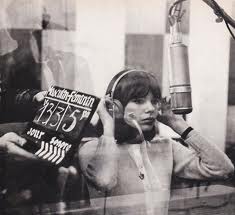
Pictured here: Saigon-born Chantal Goya as the mercurial chanteuse Madeleine Zimmer.

In Masculin féminin, we see people playing pinball, drinking coffee and wine, smoking, reading newspapers and magazines, listening to music, watching movies, talking and otherwise interacting. In one scene, two friends discuss Bob Dylan.

What are you reading?
An article on Bob Dylan.
Who's he?
He's a Vietnik, you know.
What's that?
It's an American word, a cross between "beatnik" and "Vietnam."
Who are you, Mr. Bob Dylan?
Madeleine never mentioned him? He sells 10,000 records a day!

Later, Madeleine pops in to tell friends, "I'm Number 6 in Japan with 'Pinball Champ.'"  Who's ahead of her in the game? The Beatles, yé-yé singer France Gall -- and Bob Dylan. 

[To be continued].   

Today's Rune: Partnership.

Tuesday, August 02, 2011

Chapel Hill in the 1980s, Part 2


Drawing a little more from a 1984 journal with entries mostly written just before or after an art history class, here's a little about hanging around Franklin Street and the Ackland in Chapel Hill, and something about an apparently homeless dude I nicknamed Zuccone, after Donatello's eerie statue of the prophet Habakkuk pictured below -- there was a resemblance in demeanor and I was, after all, taking an art history class.

July 31st Tuesday [1984]. Still raining, still dreaming. "Can I borrow six cents?" Zuccone asks in a friendly, leisurely Western manner. I offer him thirty-five cents, all the money I have on me, but he declines it politely, counting out four pennies in exchange for two nickels. His weird gray eyes are friendly, respectful. "That's all I need," he says, "Thanks." He huddles within a gray blanket wrapped around his shoulders. We go in opposite directions: he goes down the street, I go up the street.


Now I am just walking around, having finished at the Ackland looking at Rodin's Head of Balzac and two other bronzes for art history. I like the Balzac, it captures his little rat head well. Balzac. I like his novel The Wild Ass's Skin [La Peau de chagrin, 1831], on the whole, better than [Le] Père Goriot [1835], although Goriot has the young Rastignac & villain Vautrin -- what a villain! Rastignac is a cool anti-hero, but he gets his in the end of Chagrin.


I probably didn't know it at the time, but this particular journal was nearly done for. There are two more entries, one a sort of existentialist treatise and the other, setting goals for the future -- some kept, some discarded. The existentialist outlook remains. 

Today's Rune Fertility.

Monday, August 01, 2011

Chapel Hill in the 1980s


Going through journals for material, came across this scattershot entry dated July 10, 1984, Chapel Hill, North Carolina, USA.

Waiting for art class outside the air conditioned Scuttlebutt as it's humid and warmer out. A long walk around the campus underneath the tall trees was refreshing, though. Just passed the crazy guy with black and orange toboggan, the rasta-hatted man. Waved and he waved back. In front of the Ackland. This reminds me of the guy we saw playing a lute on a rock in front of the fire department the other day.

Finished [André] Gide's Strait is the Gate and bought a thin volume of Bashō's travel sketches at 1/2 Price yesterday. Was reading the latter when I heard a commotion & subsequently ran to get sugar for the collapsed girl with diabetes. Everyone who was around helped in this little drama.

Dont forget: The dog on Walnut Grove Church Road with a block of wood tied around his head so he won't get run over by a car.
The people who root around in the dumpsters on 86 North and I-70.
The midgets at the little store.
The bizarre local rural people in general.
The cactus our neighbors planted behind the white rock on the edge of the pines.
The nitwit at the entrance to the driveway and his new Toyota truck, fire engine red.
The old Greek lady at Continental Café.

After Bashō:
With the acid sting
Of sudden bites
I run down a path
On half-cut brambles.

Today's Rune: Mystery.