skip to main |
skip to sidebar
If you're feeling time move too fast and want to slow things down for a while, watching this will do the trick: Krzysztof Kieślowski's La double vie de Véronique / Podwójne życie Weroniki / The Double Life of Véronique (1991).
The lush, gorgeous and reflective cinematography by Sławomir Idziak is worth the whole shebang. The film's dazzling consideration of color and light, translucent and transparent surfaces, distortion and shadow is central to the story of two women who could be identical twins, one Polish (Weroniki), the other French (Véronique). So is the ethereal soundtrack, puppetry and various memorable inside/outside settings. All done at a s-l-o-w pace.
If identical twins are separated at birth, how might their lives be similar and how will they be different? And more eerily, why (and how) are certain people (not just twins) deeply connected in ways we can't really understand?
Today's Rune: The Self.
Venus, as painted by Sandro Botticelli seven to ten years before Colombo/Columbus made it to the "New World," could step into this new world of 2011 and walk down a Manhattan sidewalk with ease. Despite hundreds of changes in style and fashion through the intervening years, why is that? And how can an image created more than 500 years ago retain its potency?
Botticelli's La nascita di Venere/The Birth of Venus looks almost like Pop Art, as many others, including artists (see Andy Warhol's remake), have noticed for quite a little while.
Here's a snippet from Roger Scruton's observations in Beauty: A Very Short Introduction (Oxford University Press, 2011, page 127): "Botticelli's Venus is, from an anatomical point of view, a mishapen caricature, held together by no skeletal structure or muscular tension, a helpless apendage to the face that looks out so wistfully, not at the viewer but past him -- and yet who cares?"
The original is in Florence -- I've seen her with my own eyes.
Today's Rune: Partnership.
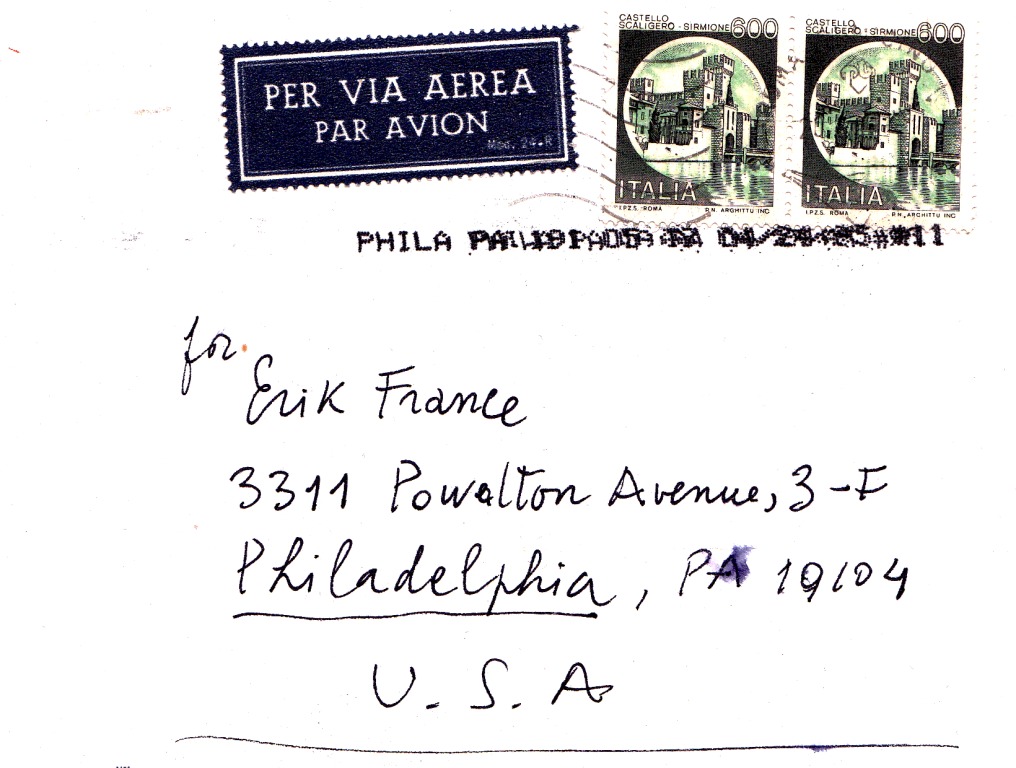
International mail, interstate mail, local mail: I love it all when it's personal. Technology is forcing change, however. The basic idea -- inscribed paper sealed in a stamped envelope -- has persisted for centuries. The digital age, though, makes other means of communication easier, faster and cheaper.
From time to time over the years, I've polled various people as to approximately how many letters they've sent or received in a given time slot vs. using alternatives like text messaging, email, phone calls, tweets, etc. Since about the year 2000, most people I've asked have switched heavily to almost exclusively digital formats. Written letters permit a bit more reflection, but they take longer to get there.
As long as there still is an international postal service, why not utilize it? Surely there are people who would enjoy a letter from time to time?
Another thing to consider: university manuscript collections and archives may treasure some of your letters, even choice ones from the relatively near past. I've already got one set being catalogued in North Carolina. Institutional archives are a good place to send letters because they have professionals who can preserve fragile items far better than most individuals. A backup method is to scan at least samples of letters and notes, or do both. That's my stamp for the day . . .
P.S. I haven't lived at the above address since the mid-1990s, but if you'd like to send old school mail via a current postal address, contact me by (yes, you guessed it) email and I'll give it to you.
Today's Rune: Defense.
I. Greetings from 1911 to 2011! Have you made great advances in the way we live? Are the zeppelins and heavier-than-air-ships still zipping around the skies? Was the RMS Titanic a hit? Are the masses and classes treated equally now? Can women vote, too? Has humanity become more enlightened, if not perfected? Has peace broken out all over?
II. Greetings from 2011 to 2111! Has climate change forced people underground like moles? Have we replanted the world like Johnny Appleseed gone global? How's that Martian colony coming along? Did we make it without a Third World War? Has the world population exceeded eleven billion and counting? Has veganism taken hold as the preferred diet? Do bees still exist in the wild?
Today's Rune: Journey.
Arne Glimcher's Picasso and Braque Go to the Movies (2008) has been assailed by critics from various angles, but I disagree with their spirit. This film brings back the time, barely a century old yet gone forever, right before the first of the first two world wars. There is a lot of footage from early silent pioneers such as the Lumière brothers, and it's wonderful, short enough even for an ADHD attention span.
Of course Picasso and Braque were influenced by the movies -- their exhuberance about everything around them, including the first successful attempts to represent time in motion through moving pictures -- must have felt impossible to contain. These were people fully alive and very observant and on the move all at once.
Moving pictures transformed the way we as human beings can reflect about ourselves -- before photography and movies, one had to rely on paintings, etchings, sketches or verbal descriptions, at best, to "see" a subject beyond the imaginary projections of written description.
Today's Rune: Defense.
Gaston Bachelard's La poétique de l'espace (1958) / The Poetics of Space (1964, 1994, translated by Maria Jolas). Here's a book that probably cannot be fully absorbed but rather acts as a touchstone into other ways of perceiving. For me, it's a textual equivalent corresponding to the Rolling Stones' Exile on Main St (1972), Led Zeppelin's Physical Graffiti (1975) and John Coltrane's A Love Supreme (1964-1965). Perpetually mindblowing and otherworldly, yet grounded in this world.
Bachelard roams through architecture small and large via the scrim of poetry, fiction, daydreams, memories, dreams, light, shadow, color, sound and touch, scent and imagination. Our abode, if we are lucky enough to dwell in one, "shelters day-dreaming, the house protects the dreamer, the house allows one to dream in peace." "Imagination augments the values of reality."
The English version I picked up in Philadelphia was published by Beacon Press, "under the auspices of the Unitarian Universalist Association of Congregations."
Bachelard's poetics dovetail nicely with feng shui ("wind-water"), another way of considering the harmonics of space.
Do you have favorite nooks and crannies?
Today's Rune: Wholeness.
Casino Jack (2010), George Hickenlooper's final film, with Oliver Stone-like glee details the shenanigans of numerous real people including Jack Abramoff, money-grubbing greedmeisters who, up until the very near past, operated like clones of Spiro Agnew in the corridors of American power. Some will recall that Agnew, Richard Nixon's Vice President, took cash bribes for years while castigating his enemies as "pusillanimous pussyfooters" and "nattering nabobs of negativism" -- until he was finally caught and brought low and later finally departed this world for good. As for Casino Jack Abramoff, he is played like a partly sympathetic villain by Kevin Spacey, much as Oliver Stone projected some humanity onto Nixon (in Nixon) and George Bush (in W.). The system, however, reeked in Nixon's day and reeked again among Abramoff and his numerous cronies and allies, people like Tom "Dancing with the Stars" Delay, Grover "No New Taxes" Norquist and John "Panama Jack" McCain.
Though convicted in 2006 for fraud and various other public misdeeds, the real Casino Jack is already on the loose again in 2011, supposedly wanting to "clean up" the system now that he can directly suck its blood no longer. Not to say he won't be cruising for payola in other ways. It may only be a matter of time before he, too, Dances with the Stars. The only thing that astonishes me about Abramoff is that he is still only 53 years old.
Today's Rune: Protection.