Saturday, July 16, 2011

Southern Gothic Revisited: Get Low vs. Chrystal


Two Southern Gothic Tales: Aaron Schneider's Get Low (2010), set in Tennessee by way of Georgia during the Great Depression, and Ray McKinnon's Chrystal (2005), set in more contemporary backwoods Arkansas. Get Low provides a comfortable vehicle for Robert Duvall, Sissy Spacek, Bill Murray and company to do their thing, though the backstory isn't strong enough to support the front story. Chrystal provides a much sharper, darker tale, peppered with mordant humor and with a superb ensemble cast including Lisa Blount (now deceased), Ray McKinnon (the writer-director), Billy Bob Thornton and Grace Zabriskie.

In brief, Get Low can be seen by a wider audience without squirming, but Chrystal is the better (and edgier) movie. With Chrystal, beware of foul language and chillingly dubious situations.


At one point in Chrystal, Billy Bob Thornton sports an enormous beard, as does Robert Duvall in Get Low.

Today's Rune: Initiation.

Friday, July 15, 2011

Jean-Luc Godard: Le Mépris / Contempt


Godard does it all. In Le Mépris / Contempt (1963), Fritz Lang (Metropolis, 1927, M, 1931) is making a full color movie version of Homer's Odyssey, but Jeremy Prokosch, Lang's brash American producer (played by Jack Palance, the towering Ukrainian American from Pennsylvania) wants a rewite, so he seeks to hire Paul Javal (Michel Piccoli) to do it; Prokosch also has a strong attraction to Paul's wife Camille (Brigitte Bardot); Giorgia Moll plays Francesca Vanini, Prokosch's lively assistant, with whom Paul flirts. 


Contempt gets at the nuances and challenges of marriage and art and other relationships, not to mention aspects of the Homeric world and, specifically, the story of Odysseus (Ulysses), Penelope and her suitors. In one scene with Fritz Lang, Paul speculates about Odysseus' original motive: "He used the Trojan War to get away from his wife." But what about the suitors? 

Visually, Le Mépris is pleasing to the eyes -- very colorful. Brigitte Bardot's Camille is brooding and weird but . . . so what, who cares? 

Today's Rune: Breakthrough.     

Thursday, July 14, 2011

Bastille Day: Les Carabiniers


War is a trick on most of its participants.

Et le printemps m'a apporté l'affreux rire de l'idiot / And Spring brought to me the dreadful laughter of an idiot. -- Arthur Rimbaud, Une Saison en enfer / A Season in Hell (1873).

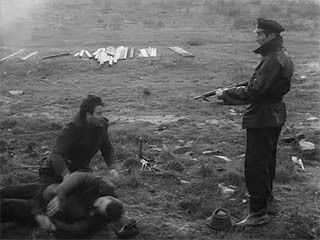
In Jean-Luc Godard's Les Carabiniers / The Riflemen (1963), two recruited volunteer soldiers send postcards back to the home front; later, they bring back a stash of them in person, sorted and bundled by genre. One veteran is missing an eye, and they have no money. 

What had they been promised going in?

"Each soldier can do as he wants in the name of the King."

"If we want, can we massacre innocent folks?"

"Yes, that's war." 

Postcards in the film carry the text of actual soldierly correspondence going back hundreds of years.

"We landed in Italy and lined our path with a thousand bodies."

"The day of glory is at hand!"

"We're sowing death in the families and fulfilling our bloody mission."

"We were trucked into Silesia to be firing squads and check on hangings."

"Ten hostages were shot today."

The Balkans, Chad, Congo, Somalia, Libya, Syria, Iraq, Afghanistan: sequel scenes from Flannery O'Connor's "A Good Man Is Hard to Find" . . . and that's just some of the wars of the last twenty years . . .

"The King and his people commemorate forever our sons' heroic combat in Europe and Oceania."

"There is no victory . . . only flags and fallen . . ."

And so the movie ends fittingly. Consider the following statements:

War is a quarrel between . . . thieves too cowardly to fight their own battle; therefore they take boys from one village and another village, stick them into uniforms, equip them with guns, and let them loose like wild beasts against each other. -- Thomas Carlyle, as quoted in 1911 by Emma Goldman.

"Only the dead have seen the end of war." -- George Santayana, 1922.

Today's Rune: The Mystery.

Wednesday, July 13, 2011

Jean-Luc Godard: Les Carabiniers


The Godard fest continues. The pointedness of Les Carabiniers [The Riflemen] (1963) in dealing with humanity's insanely delirious propensity for war-making is both shocking and refreshing. I can only think of two other movies like it in tone and spirit: Leo McCarey and the Marx Brothers' Duck Soup (1933) and Fernando de Fuentes' ¡Vámonos con Pancho Villa! / Let's Go with Pancho Villa! (1936). Another approximation might be if Euripides' The Trojan Women (415 B.C.) was woven into Stanley Kubrick's Dr. Strangelove or: How I Learned to Stop Worrying and Love the Bomb (1963/1964). No matter how you shuffle the cards -- and like its illustrious peers -- Les Carabiniers remains subversive and pertinent. 


Take surrealism and theatre of the absurd, Bertolt Brecht and grainy black and white cinéma vérité visuals and blend together with modern day characters in a primal, ageless story of war's impact and voilà. As the recruiting Riflemen say to Ulysses and Michelangelo (and Cleopatra and Venus): "You'll enrich your minds by visiting foreign countries. Then you'll become very rich. You'll be able to have whatever you want . . . You take it from the enemy . . ."


More soon on the "letter from the King" that starts it all and beyond.

Today's Rune: Breakthrough.

Tuesday, July 12, 2011

Tomorrow Show with Tom Snyder: Once More Into the Mix


Ah, what a treat! Joan Jett, then of the Runaways, sparkles among the talking heads (though Kim Fowley is sharp, as well) during a fraught 1977 discussion about how to receive "Punk and New Wave." In shows from 1981, these three guests come off as erudite and charming: Elvis Costello, Iggy Pop and Wendy O. Williams (Plasmatics). Tom, despite his hangups and preconceptions, gives them their due, and all perform live. Elvis' appearance comes just a couple of weeks after he played in Chapel Hill. Iggy has a tooth missing and a cut lip, drinks a little wine and schools Tom about Apollonian and Dionysian energies. That is, in between frenetic performances of "Dog Food" and "Five Foot One." The show ends with "TV Eye."

Today's Rune: Strength.  

Monday, July 11, 2011

Yesterday's Tomorrow Show with Tom Snyder


Especially since a teen and starting with Johnny Carson, I've occasionally watched late night talk shows most of my life. In the late 1970s and early 80s, I'd come across Tom Snyder's Tomorrow. Now as a little treat, I've been catching some of his interviews with musicians from those years compiled on a two-disc set released in 2006. Snyder sits back with his seventies' vibe, smoking cigarettes and coaxing his guests. The set is intimate, cameras drawn close and tight -- nothing like the glitz of the bigger programs then or now; Shatner's Raw Nerve is the only really comparable venue like it that I can think of, though Charlie Rose and Tavis Smiley take a similar approach. 

So far, Patti Smith (in 1978) has described Johnny Carson as a "human parachute," landing safely on his feet after gaffes and missteps. She is strange and adorable with Tom, who likes her. Then on another night, in an interview I remember having seen at the time in Chapel Hill: Snyder in 1980 sparring with John Lydon (Johnny Rotten) and Keith Levene of Public Image Ltd., which they describe as "a company," not a band. Finally, guest host Kelly Lange (now a novelist) interviews the Ramones -- and they also play a few songs. Great stuff -- raw and entertaining. Iggy Pop and more still to watch. 

Today's Rune: Joy.    

Sunday, July 10, 2011

Jean-Luc Godard: 2 ou 3 choses que je sais d'elle


A few things about 2 Or 3 Things I Know About Her (1967). Godard whispers ideas and observations, people think and say things. "Language is the house man lives in . . . a landscape is like a face . . ." For modern people, it's like "living in a giant comic
strip . . ." Pop Art, pop culture abounds. But despite colorful advertising and tantalizing travel posters, life is deadening to many, and the real story includes construction cranes, dump trucks, bridge maintainence, pinball machines, traffic noises, prostitution. Unlike typical films, Godard incorporates the real world into his visuals and soundtrack. Some things have changed since 1966-1967: then, everyone seems to be smoking cigarettes like a nervous habit; there are full service gas stations; one can manually roll up a car window; instead of Iraq, Afghanistan and Libya, there's the US-Vietnam War to contend with.


Chapter headings give an idea of setting: Terrace; Kitchen Table; Bed; Gérard's Apartment; Clothes Shop; Café; Room; Salon; Garage; Hotel Room; Café; High-Rise; Stairwell; Apartment.


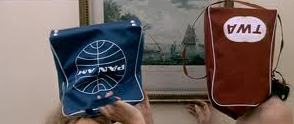
I remember these style travel bags, from airlines no longer around: Pan Am (defunct since 1991) and TWA (merged with American in 2001).


Let's not forget the coffee and how its market price is rising. 

Before fading out to colorful commodities, in a whisper toward FIN: "I listen to commercials on my transistor [radio]. Thanks to ESSO, I serenely take the road to dreams and forget all else. I forget Hiroshima and Auschwitz . . . I forget Vietnam and minimum wages. I forget the housing crisis. I forget the famine in India. I've forgotten it all, except that it takes me back to zero, I have to start over from there."

Today's Rune: The Warrior.