Showing posts with label Algonquin Books. Show all posts

Wednesday, August 08, 2018

Chapel Hill Daze: Pictures of Another Gone World: West Franklin Street, 1968-2018

Along West Franklin Street, starting at the Columbia Street intersection and heading toward Carrboro, there are still some vestiges of the Chapel Hill of 1968. There were more when I was a student at the University of North Carolina.

Of the "south" side of West Franklin, I've previously discussed University Square in another post. Next was Hardee's at 213 West Franklin (now there's a Panera at that address); Union Bus Station at 311 (the Franklin Hotel is now at that address) and the Chapel Hill Weekly newspaper at 501.


I certainly remember the Hardee's and the newspaper building, having eaten at the former and worked immediately next to the latter (at Algonquin Books of Chapel Hill).

The bus station building I remember vaguely. Having been completed in 1946, it soon thereafter became part of the history of the civil rights movement:

"On April 9, 1947, eight African American and eight white members of CORE (known as the Freedom Riders) set out from Washington, D.C. on Greyhound and Trailways buses; on April 12, both buses arrived in Chapel Hill. As the buses departed Chapel Hill for Greensboro on April 13, four of the riders were arrested. The commotion aboard the buses drew a large crowd of spectators, including several white taxi drivers. 

The men were taken to the police station, with a fifty dollar bond placed on each man. As white rider James Peck got off the bus to pay their bonds, a taxi driver struck him in the head.  

In May 1947, those members who had been arrested went on trial and were sentenced. The riders unsuccessfully appealed their sentences. On March 21, 1949, they surrendered at the courthouse in Hillsborough and were sent to segregated chain gangs." 

The bus station's food service desegregated in the early 1960s, under pressure.  Source: "Trailways Bus Station," Open Orange. Website link here.

Of the "north" side of West Franklin, an earlier post covered the first block off from Columbia Street, heading toward Carrboro. If you crossed Church Street going in the same direction in 1968, there was a Belk-Leggett department store at 206 West Franklin, Fowler's meats at 306, Carolina Grill at 312, Village Pharmacy at 318 and The Cavern at 452 1/2.  

The Bookshop (pictured above) came into being in 1985 at 400 West Franklin, a merger of Keith Martin Bookshop and Bookends (both Chapel Hill book shops). I remember all three of them, having bought books at each. The Bookshop closed in the summer of 2017, having lasted close to thirty-two years in that location.

Belk-Leggett was gone from its 206 location by the time I came to Chapel Hill. Fowler's was still at 306 for a while and then folded. There was one in Durham, too. 

I loved the Carolina Grill -- you could eat like a king on the budget of a college student. Which may be why they eventually had to close. I remember flat steaks there, excellent meat and potatoes type staples, probably requisitioned from next-door Fowler's. It was sort of like a large hall with tables, for some reason making me think of a Bavarian beer hall in memory. 

Village Pharmacy, 318 West Franklin, "Home of the Big O." This place was around for a while but must have eventually died on the vine. Browsing issues of the Daily Tar Heel, I came across an advertisement for Village Pharmacy from the September 28, 1949 issue: "Opposite Bus Station - Phone F-3966."  In "land line" telephone exchanges of the twentieth century, "F" might be named Flanders, Fleetwood, Factory, etcetera.  In any case, when I was working at Algonquin Books, I'd occasionally walk to Village Pharmacy for its soda fountain features. They served fresh lemonade, orangeade, milkshakes and grill food. No longer.

The Cave is a long-standing underground bar and music venue. Because I have detailed location notes from college journals dating to the 1980s, I'll devote more time to The Cave in a later post. It nearly folded after fifty years (1968-2018), but was saved by Melissa Swingle and Autumn Spencer in the summer of 2018 -- thank God! Here's a link to their website. Dig it!

Invaluable resource to cross-check memories, places:  OCCUPANTS AND STRUCTURES OF FRANKLIN STREET, CHAPEL HILL, NORTH CAROLINA AT 5-YEAR INTERVALS, 1793-1998, by Bernard Lee Bryant, Jr. Chapel Hill Historical Society, printed out by J.D. Eyre in 1999. Link here.

Today's Rune: Partnership. 


Wednesday, June 06, 2018

Pat Conroy, 'My Exaggerated Life.' As Told to Katherine Clark (2018)

Pat Conroy, My Exaggerated Life. As Told to Katherine Clark. Columbia: The University of South Carolina Press, 2018.

I found this highly valuable for its insight into the writer's craft as well as highly entertaining for its sheer cattiness. 

Conroy (1945-2016) wasn't one to sugarcoat what he thought about other people or various things. He holds a good Irish grudge for all time, maybe even beyond death, although in the end, all good Catholics go home to rest, I suppose.  

Most importantly of all, Conroy is adamant in his advocacy for unfettered writing: ". . . I don't like readers who point and say you cannot go there; you are not allowed to go there; you're not free to go there; that is off limits. . . . Your service is to your art, and nothing else makes any difference in the world, not your love of your mother, not your love of your children. It simply doesn't. . . . you are at service to art. And if you're not, do something else . . . There is no room for timid souls on our high dive. My writing life would be worthless if I did not write about the things I wasn't supposed to." (Page 161).

Amen to that.

Today's Rune: The Mystery Rune.

Saturday, April 15, 2017

Mystic Chords of Memory: Scholey Pitcher and Yoko Akiba

They never knew each other, but they were connected. Scholey Pitcher was a publisher at Algonquin Books of Chapel Hill; Yoko Akiba was a wizard with maps, a librarian, who worked in the Public Documents and Maps Department at Duke University's Perkins Library. For a few years in my twenties, I worked at both places and came to know them both.

When I knew him, Scholey (whose muted first name was Charles) was often smoking one of his beloved tobacco pipes and talking in a courtly manner. He was from Charleston, South Carolina, had been a stock broker. I remember one of his stories about World War II. He was an R.O.T.C. (Reserve Officer's Training School) cadet at The Citadel in Charleston at the time of Pearl Harbor, just shy of age eighteen. With the US hurled into the war, The Citadel accelerated graduation, turning out second lieutenants for military service. As a neophyte lieutenant, Scholey was quickly trained and sent to the War in the Pacific. He vividly remembered being crammed into an amphibious assault vehicle heading for the shoreline, under fire from Japanese defenders. The images and feelings had stuck with him like it was yesterday. If I remember right (and it's quite possible that I am mis-remembering this detail of his story), Scholey was with a company of Marines and the battle he described was Tarawa, November 1943, when he was just shy of age twenty. 

Not only was Yoko Akiba a master of the maps, she was also edgy and often cracked me up with her quips. Two of her favorites: "Never tell" and "I'm sick of their faces." The first meant she was going to make a pithy or catty observation, which she herself would proceed to repeat along and down the line, selectively. The second statement was usually aimed at any dull-minded or overly bureaucratic person that annoyed her sense of fairness. She was very much about social fairness and had been a socialist in Japan. Yoko was just shy of six years old at the time of Pearl Harbor, and nine and a half years old when the atomic bombs were dropped on Hiroshima and Nagasaki. She remembered them well, and the widespread firebombings beforehand. Late in the war, she and hundreds of thousands of other children were evacuated to the countryside. If I remember right, Akiba was placed in an area near Hiroshima. As a little kid, she had to learn to quickly identify incoming American planes, high-flying bombers and low-flying fighters: B-29s, Wildcats, Hellcats, P-38s, P-51 Mustangs and others as they bombed, strafed, scouted or escorted.  

Scholey Pitcher and Yoko Akiba both experienced the nightmare hell of the War in the Pacific. As adults, both were really cool people who carried a certain sadness with them, masked in part by their playful sense of humor. Scholey died 1998 at the age of seventy-four. Yoko died early in 2004 just shy of age sixty-nine. 

I will always think of Scholey smoking a fine pipe and of Yoko carefully arranging her beautiful maps.  Before she died, Yoko went on to work at the Library of Congress, her field of dreams, which is where she still roams in mine. 

Today's Rune: Wholeness. 

Saturday, September 21, 2013

Power Points: Sortie Into Hillsborough, North Carolina (Take I)

Hillsborough, North Carolina, soaked as it is in history and culture, continues in its role as a fine place to visit briefly or at length. Little wonder why the congregation in this 6,000-person enclave of superb writers like (in alphabetical order) Hal Crowther, Alan Gurganus, Jill McCorkle and Lee Smith. Once there was the Occaneechi village and still in the greater area reside 700 living members of the Occaneechi Band of the Saponi Nation. Regulators were hanged here before the American Revolution. Lawrence Thompson, my great-great-great-great grandfather, signed up with Moore's First North Carolina here circa 1776 with the promise of a land grant; he later fired his rifle at British ships over by the coast in Old Brunswick Town near Wilmington before it was reduced to ruins. Lord Cornwallis occupied Hillsborough in 1781. Some time after he moved with his Anglo-American force on to Wilmington and Revolutionaries recaptured the town, Loyalist raiders under David Fanning captured a slew of men and hauled them off as prisoners. Confederate General Joseph E. Johnston made his headquarters here near the end of the American Civil War. And so on. What I'd like to convey only is this: what a cool, fascinating place!

Pictured here -- on the grounds of Edmund Fanning's place that was burned to the ground by Regulators in 1770 -- stands Masonic Eagle Lodge Number 19 on King Street. The lodge was chartered in 1791; this building was built in Greek Revival style (with apparently Federal style simplicity except for the front portico) in 1823-1825. It sill operates!  When first built, a glass observatory festooned the top center of the roof, but it began to leak and was eventually dismantled during the Civil War. Its uses have included as an opera house, library, study hall and meeting place. 

And man, this is just one site observed from a brief walk. I love Hillsborough!

Today's Rune: Journey.  

Sunday, November 25, 2012

Chapel Hill, North Carolina: West Franklin Street 2


This is the "ghost entrance" to Algonquin Books of Chapel Hill. This portal worked magically in the mid-1980s. I was employed as an officer runner here at the time and, near the end of Algonquin's operations at this West Franklin Street location, as de facto shipping manager. We stored most books in the very nearby warehouse of The Chapel Hill News (aka Weekly). Go through those shadows now and you'd find repurposed offices and new people working in them.  

Across the street, to the right, was Pyewacket (at 431 West Franklin), a nifty-fifty eatery and social focal point adjoining "The Courtyard" area in the back. Now there appears to be another restaurant in the old Pyewacket space -- Vimala's Curryblossom Cafe.

By November 24, 2012, when the above image was captured, a mural of flowers had sprouted on the back walls. New since I worked there. The wooden frames weren't there before, either. The rail fence on the right was. I remember one day seeing Michael Jordan in a convertible at the adjacent spot in the roadway, making some kind of commercial.

I was just coming back to this exact same spot from a delivery errand on January 28, 1986 when the NASA Space Shuttle Challenger blew up. On the radio station I had on in my car, a reporter claimed everything had gone perfectly, but when I got to the office a few minutes later, everyone was freaking out -- and for good reason. Things had not gone perfectly at all.

David Lynch's Blue Velvet came out later the same year, in September.  At Algonquin, there was extra buzz about Blue Velvet because it had been filmed in Lumberton and Wilmington, North Carolina.

Final echo: up and down that spectral hallway pictured above, a moustached man would loudly whistle "Zip-a-Dee-Doo-Dah" as he came and went via another office suite -- for months and months in a row. Not too surprisingly, he was nicknamed "Mr. Zip-a-Dee" by Algonquin staff.  But hey, at least he wasn't whistling "Blue Velvet!" No sign of him this time around. Wherever he is now regardless, there may be a Mr. Bluebird on his shoulder -- which would be plenty weird enough.

Today's Rune: Signals.

Sunday, June 10, 2012

Theatre of the Absurd


This scan of a clipping advertising Slava Tsukerman's Liquid Sky (1982) triggers memories that had been buried under the sediment of later experiences. Liquid Sky really took off in 1983, right around the time I began working in the small offices of Algonquin Books of Chapel Hill, attached to the building in which was housed the Chapel Hill Newspaper -- published by the tyrannical Orville Campbell and his fretful crew.

Oddball characters were always coming and going from Algonquin Books, anything from authors, editors and publishers to art designers, book jobbers and friends of the main instigator of the whole enterprise, Louis Rubin, Jr., a volatile man who, in between shouting matches or dictated letters asking for more money from the board of directors, dramatically took naps on a cot in the back office. Whenever he threw tantrums -- which was fairly often -- I imagined him morphing into a rabid owl until he scrambled off for another nap.    

Every once in a while, an English professor named Dougald MacMillan flitted in with some madcap idea. He ran his own independent publishing outfit called Signal Books in nearby Carrboro, and one idea he bandied about was a book of poetry and artwork created by children dying of cancer. Sounded awfully depressing to me, but what did I know? Another time he asked me to pack up a stack of British pound notes along with a mansucript he was shipping to someone in Scotland, for what reason I didn't know, or ask. Finally, with a mischievous gleam in his eye, he scrawled "PHOTOS" on the outside packaging, then added with a flourish, "DO NOT BEND." Dougald, though he was originally from Arkansas, was mad about Irish literary folks, particularly James Joyce and Samuel Waiting for Godot Beckett. One day I had to deliver some materials to the Signal Books office, which was tucked along the railroad tracks behind The Station, an old Carrboro train station converted into a bar-eatery where bands like R.E.M. cut their teeth; in this case as in some of his Chapel Hill visitations, he was accompanied by another Beckett enthusiast, Martha Fehsenfeld, who had intense, almost bulbous eyes. 

All that from a Liquid Sky artifact!  

Today's Rune: Signals.      

Friday, June 08, 2012

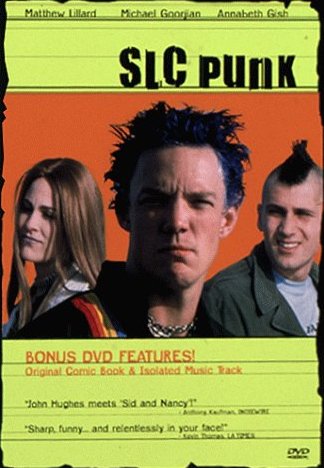
SLC Punk!


James Merendino's SLC Punk! (1999) evokes certain music-based subcultures of 1985 in the US and UK, but more specifically in Salt Lake City. It centers around Stevo, Heroin Bob (who doesn't actually do heroin) and various aquaintances. The soundtrack, including songs that are not included in the "official" soundtrack, is a good one, and includes three well-placed songs from The Stooges (1969), plus individual tracks by Roxy Music, Blondie, Velvet Underground, and other thematically connected bands.

The narrative technique is sort of an out-of-time remembrance in which the main character (in this case Stevo) tells the story in retrospect, but also by commenting on action seemingly as it occurs -- sort of like in Woody Allen's Annie Hall (1977) and Martin Scorsese's Goodfellas (1990). Considering it was shot on a very modest budget, SLC Punk! has some neatly executed scenes, and it breathes life back into the mid-1980s.    

I was working at Algonquin Books of Chapel Hill (North Carolina), in 1985, and was pretty aware of the various music genres and various "tribes." To me, Stevo and Heroin Bob are more like the local "hardcore" music scene of North Carolina, of which there were several bands carrying the torch. There was also a ska-tinged eclectic scene inspired by the English Beat, the Specials and bands like that. 1985 was, too, the year the Pogues released Rum, Sodomy & the Lash. Punk as in the Sex Pistols or even the Clash was long over, or so it felt. Even Dead Kennedys and the Cramps had almost burned out by then, as far as producing exciting new material. But SLC Punk! got me to thinking, and remembering. What else can one really ask of an indie flick?

Today's Rune: The Mystery Rune.             

Tuesday, February 21, 2012

Bob Sheldon's Legacy


My friend Bob Sheldon was killed during the first weeks of the Persian Gulf War on this date, February 21, 1991, in Chapel Hill, North Carolina, USA. 

He had been visible and vocal, providing rare dissent to the Gulf War on TV; he'd also protested against the U.S.-Vietnam War.  More people showed the same spirit before and during the Iraq, or Second Persian Gulf War, just as there are those now attuned to the possibility of a Third Gulf War, perhaps triggered by Israel-Iran folly or miscalculation.  


I first met Bob when he was working at the University of North Carolina as a sort of medic-nurse in 1981 -- he treated me, a callow undergraduate, for a nasty case of poison ivy, bandaging my arms like a burn victim. I was reading an article about the Sandinistas in Nicaragua and he struck up a conversation. He was impressive and no-nonsense.

Not long afterwards I checked out his new bookstore on Henderson Street, and when he set up shop at 408 West Rosemary Street not far from where I worked at Algonquin Books of Chapel Hill a couple of years later, I began working at Internationalist Books, too. We had a lot of pithy conversations over the years, and he was one of the few people I knew to provide moral support for a sit-in protesting American involvement with the Contras in the time of Reagan, in the mid-1980s.

Internationalist Books and Community Center lives on at a third location, right on Franklin Street (405 West Franklin): http://www.internationalistbooks.org/

Much more to write about Bob Sheldon and Internationalist Books and the sit-in, but today is his remembrance day, and in Chapel Hill, it's Bob Sheldon Day. This one goes out to Donna Sheldon, Bob's sister, and the rest of the family.


Today's Rune: Protection.

Tuesday, February 14, 2012

Vinyl Daze 1984 and 2012


No cellphones, no internet, no digital for the general populace. It's 1984 and these are artifacts for 2012.  In Chapel Hill in '84, you can get a fair deal on used records. 8 Track tapes ("Stereo 8") are dead, cassette mixes are raging. CDs are in the pipeline -- dressed in long boxes resembling thin caskets. People are afraid to shell out big bucks for such little products without the extra dressing. Shops include Schoolkids Records, Record Bar and Sam Goody. Pictured above is a 1984 snapshot of my records, with two Iggy Pop albums out front and center -- The Idiot (1977) and Lust for Life (1977).


The Relics, one of the bands that in 1984 plays the Cat's Cradle.

THE RELICS will debut at the Cradle on Thursday, March 29th [1984]. . . They cite their musical influences as Kenny Randall, John Lennon, Iggy Pop, and all their musical peers . . . The Relics are: Tom Scheft on drums, Russell Proops on vocals, Jeff Biddell on bass and vocals . . . Mike Evans on keyboards, Jim Choong on guitar, and Jim Carleton on guitar . . .

Today's Rune: The  Mystery Rune.

Saturday, March 12, 2011

On the Road: Jack Kerouac and the Beat Generation


[I originally posted this five years ago today, in 2006]:  

Today is Jack Kerouac's birthday (1922-1969). His reputation has survived quips like Truman Capote's clever if evil line, "that's not writing, that's typing." While he was alive, academia (for the most part) dismissed him as a joke. Now whole courses are taught on the Beats; their books can be found in major bookstores or easily obtained online. They have been absorbed into mainstream culture, and even the originally derisive Cold War term "beatnik" has a nostalgiac ring.

But Beat writing is more about unconventional freedom of movement and alternative lifestyles than it is about nostalgia. There is no uniform philosophy. Some of the Beats embraced Zen Buddhism, some launched cultural and political critiques and jeremiads (Allen Ginsberg's "Howl," Gregory Corso's "Bomb"); Kerouac mostly told stories and chronicled his own life and the comings and goings of key friends. William S. Burroughs started with a variation of crime noir (Junky) and moved through experimentation, drugs, voluntary exile, and the cut-up method (in collaboration with the artist Brion Gysin) to create such controversial works as Naked Lunch. The collective impact on interested parties in the 1960s was enormous, from Bob Dylan straight to the present. So happy birthday, Jack! Today your books live alongside Truman's and everybody be happy.

My sister Vickie told me Jack Kerouac's story when I was a teenager straight out of VMI. The first thing I read was an annotated copy of On the Road from the library, which was perfect because the "critical section" set the novel within an understandable context. The novel itself inspired me in many ways, but perhaps most imporantly it opened up possibilities for striking out on the road and living in unconventional ways. Between that and miraculously surviving a dramatic car wreck completely unscathed (the car flipped over and spun around a few times before landing in a watery ditch), I was ready to GO!


And away I went over the span of just four or five blindingly short years -- to New England with my friend Kenny Randall where we met Baba and Louise Toumajan; to Europe on a college trip where I got to know my friend Bill Caughlin; around the country by car with my sister Linda Stine, visiting relatives and Beat shrines along the way in Denver, San Francsico, New Orleans and elsewhere; to Mardi Gras with Bill; to Europe again, with Suzanne DePalma; to Manhattan and the Beat hangouts there; to Boulder, Colorado, with my friend Evan Farris to visit his sister Amy Farris (now Amy Kilbride) -- I'm talking thirty to forty hour car rides, hallucinatory experiences, for sure --then driving with my sister Vickie Charabati [now Stavish] to St. Paul, Minnesota, where she was moving. And in the middle of all these travels, I got a job at Algonquin Books of Chapel Hill and plugged into the literary world via publishing, as well. Certainly, it all makes more sense now than it did at the time! And certainly no regrets. I still get the travel bug, though I've come to appreciate (and can better afford) airplanes to get from place to place!


Kerouac married Edie Parker of Grosse Pointe; he stayed in the area from time to time, frequenting the still-functioning Rustic Cabins bar in Grosse Pointe Park, and the temporarily defunct Wooden Nickel (on Mack Avenue) in an earlier incarnation [now a sushi joint]. "There's no tragedy in Grosse Pointe," Jack proclaimed then, but if he had lived to see it, he'd come to know that on the contrary, there's plenty of tragedy in Grosse Pointe -- just like everywhere else.

A vast storehouse of Kerouac's papers are now owned by the New York Public Library; pleasingly, the same institution recently acquired William S. Burroughs' papers, too. Burroughs' importance will be better understood in due time.

On the road, adieu for now. . . . .

Today's Rune: Wholeness.  

Monday, February 28, 2011

You Have No New Messages


When I worked at Algonquin Books of Chapel Hill in the mid-1980s, one of my duties (i.e. chores) was to do an initial weeding of incoming mail. Sometimes I was also sent out to hand-deliver promo copies of new books. When something really interesting came in, it was usually passed around before being sent up to the bigger fish. One day we got a letter from Walker Percy, a big writer at the time, in praise of Kaye Gibbons' not-yet-then-published Ellen Foster. This letter helped launch her public sphere writing arc by calling attention to what turned out to be her debut novel.

Two things: one, more than one person may be checking in official mail (keep that in mind, all you writers out there, always be nice to the "little folks" at the bottom of  the hierarchy) and secondly, I'm rereading Walker Percy's Lost in the Cosmos: The Last Self-Help Book (1983), which is what triggered the memory. I made a photocopy of the letter and still have it, but can't reproduce it here because of copyright restrictions. But I can provide a fair use sample of Walker Percy's wicked little Lost in the Cosmos:

Why is it that the Self -- though it Professes to be Loving, Caring, to Prefer Peace to War, Concord to Discord, Life to Death; to Wish Other Selves Well, not Ill -- in fact Secretly Relishes War and Rumors of War, News of Plane Crashes, Assassinations, Mass Murders, Obituaries, to say nothing of Local news about Acquaintances Dropping Dead in the Street, Gossip about Neighbors Getting in Fights or being Detected in Sexual Scandals, Embezzlements, and Other Disgraces[?] (p. 57).

I don't know, but I think Hans Christian Blech may have had an existential inkling about life situations, judging from his look in the photo above (playing Major Werner Pluskat, 352nd Infantry Division in The Longest Day, 1962).  He's on the phone, but all it seems to say is: You have no new messages. Or maybe it's, Sorry, wrong number. Or perhaps more likely, Sorry, help is not on the way. You're on your own. Good luck to you!  

Today's Rune: Joy.

Thursday, June 24, 2010

Going Down to the Record Store


February 1970: Shocking Blue's "Venus," Sly and the Family Stone's "Thank You (Falettinme Be Mice Elf Agin)," the Jackson Five's "I Want You Back," Tom Jones' "Without Love (There Is Nothing)" and the B. J. Thomas cover of "Raindrops Keep Falling On My Head" (after Butch Cassidy and the Sundance Kid, 1969) . . . all hits. Forty years later: Michael Jackson, Mariska Veres and Paul Newman are dead, Sly Stone and Tom Jones are recording again, Robert Redford abides.

The Record Bar is gone, as are most of the chains (though a few remnants may remain here and there): Harmony House Records and Tapes; Sam Goody; Schoolkids Records; HMV; Music Zone; Tower Records; Planet Music, Camelot Music. Of these, I liked Schoolkids Records.   

But never fear, independent records stores persist, and are celebrated annually on Record Store Day every April. For more on that happy thought, please see: http://www.recordstoreday.com/Home


Good short story collection: Jill McCorkle's Final Vinyl Days and Other Stories (Algonquin Books, 1998).  I was working at Algonquin Books of Chapel Hill when her first two books came out in 1984: The Cheerleader and July 7th

Today's Rune: Warrior.

Wednesday, October 07, 2009

Public Relations That Worked


I never met Julian Scheer, but I met his brother George Fabian Scheer, Jr., and knew his nephew George Fabian Scheer III. The latter two were associated with Algonquin Books of Chapel Hill, where I worked in the mid-1980s.

Julian Weisel Scheer (1926-2001) was a key supporter and proponent of NASA. He'd been an energetic reporter covering the space program when, in 1963, he became NASA's Assistant Administrator for Public Affairs. He helped shape NASA's positive and exciting image in an inclusive way, actively drawing in news reporters and the average person alike. He seems to have believed that being transparent with developments was a better way of communicating the Apollo Moon program than any form of sugar coating. It was a dangerous mission to go to the Moon, but nonetheless, the Apollo 11 Moon landing should be covered live -- despite the risks. And he was right.

What NASA needs again is such a PR powerhouse as Julian Scheer. The Final Frontier should be inherently exciting, but without strong PR, NASA's efforts are drowned in the white noise of everything else. After all, isn't NASA more important than Jon & Kate Plus Eight? If not, we're not living on Earth, we're living in Hell.


Today's Rune: The Mystery Rune.

Thursday, May 28, 2009

Walking: Between Chapel Hill and Durham


This book, From Laurel Hill to Siler's Bog: The Walking Adventures of a Naturalist by John K. Terres (Algonquin Books of Chapel Hill, 1986; originally published in 1969), reminds me of a lot of things. Working at Algonquin. Walking the distance (about eleven miles) between Durham and Chapel Hill, and Dr. Dick Pearse. I worked at Algonquin from 1984 to 1987. I knew Dr. Pearse from the late 1970s until he died, an elderly man by that point. A friend of my parents, he lived in Durham County in a genteel way, with a lot of land, horses, and dogs out in northern Durham County. He was very big into history, and he regaled us with a lot of stories. The pertinent strand related to how he and friends would walk around North Carolina and just about anywhere they went, or rode by horseback. The idea of walking between towns and cities struck my imagination, and my friend Kenny's, too, so we tried it.

The walk between Durham and Chapel Hill was damned interesting. First, the impact of automobiles on the landscape was the most obvious fact, right down to seeing dozens of dead birds that had apparently been hit by cars without their drivers even knowing it. There was lots of living fauna and flora, too, of course, but the car exhaust and noise made itself known much of the time. In any case, you can easily walk between the two cities in a matter of hours, but we've become so accustomed to driving or being driven that this fact may not even dawn on most people. I thank Dr. Pearse for the inspiration, and for cultural memories of a time when it was not out of the ordinary to walk significant distances.

Today's Rune: Separation (Reversed).

Thursday, May 14, 2009

Bob Dylan's Big Bad Love: It's All Good!


Aside from featuring the same photo on their covers, I don't know if there's any deliberate connection between Together Through Life, Bob Dylan's new album, and Larry Brown's 1990 short story collection Big Bad Love (movie adaptation, 2001). I do know Algonquin Books of Chapel Hill published all but one of Brown's books, and I missed meeting him by less than a year. By that time, I'd moved on from Algonquin to Duke's Perkins Library in Durham. Sadly, Brown died in 2004 at the age of fifty-three. Dylan, on the other hand, at almost sixty-eight is still going strong and wild.


The two tracks that've grabbed me so far from Together Through Life are the opener, "Beyond Here Lies Nothin'," and the closer, "It's All Good." These are definite hits right off the bat. (Indeed, the album as a whole hit number one recently around these parts). I'll be happy with keeping these two on the old iPod, for sure. I've found that among other things, several of Dylan's tracks from recent albums are perfect for running on the treadmill to.

For a taste, one might check out YouTube or sample the downloads. "It's All Good" is a saucy number wherein Dylan lays out a litany of disasters followed by his brutally sardonic subversion of its cliché-title. As for the album's title, for all I know, it may be Dylan's wry acknowledgement that his music is, to use another cliché, part of the permanent soundtrack of his listeners' lives.

Today's Rune: The Mystery Rune.

Monday, December 22, 2008

Algonquin Books of Chapel Hill, 1980s


Many things to remember about Algonquin Books of Chapel Hill in the 1980s, where I worked as a simple runner and book shipper, but just a few observations for this post. Jill McCorkle was the coolest author I got to meet at the time, Clyde Edgerton was the nicest, and Kaye Gibbons seemed the strangest, accompanied into Algonquin's offices (across from Pyewacket Restaurant) by her mother. We published good books (ones by McCorkle and Edgerton, for instance, and later, ones by Larry Brown, Lewis Nordan, etc.) and what seemed like terrible books (Lylah! by Red Barber's wife Lylah was one of them), and we were always juggling multiple crises in a circus-like atmosphere.


Louis D. Rubin, Jr., was the main originator of Algonquin (along with Shannon Ravenel). I recall Rubin as irascible, a real pain in the ass grouch who often got into shouting matches with editors and authors -- I specifically remember terrible ones with Garrett Epps in particular. Rubin was not a people person and only treated those he already liked like human beings. On the other hand, he loved many of his authors, and cultivated several. He was good friends with Shelby Foote, the author, and Scholey Pitcher, Algonquin's figurehead publisher, a kindly gentleman who was always smoking a pipe and trying to figure out how to work the Xerox machine.

One of the things I discovered working at Algonquin was a trace of Jewish history from the Old South, something about Jewish enclaves in Charleston, South Carolina (where Rubin was from) and Richmond, Virginia. I loved talking with George F. (Fabian) Scheer and his son, George Scheer III -- who was also a jazz dj -- about such stuff.

Most of our books were stored next door in the warehouses of the Chapel Hill Newspaper, so I got to know just about everybody at the paper, including Orville Campbell, the publisher, an awful man who tyrannized his workers, literally driving some of them to tears. I learned a sobering lesson about the "real world" when I saw a fancy plaque mounted elsewhere in Chapel Hill honoring Campbell as a philanthropist.

Today's Rune: Joy.

Saturday, August 30, 2008

The Electric Circus


Amtrak seems worth checking out these days. When I worked at Algonquin Books of Chapel Hill, I knew this guy who worked on travel books (he was also a jazz DJ on UNC public radio) -- Algonquin got him to do "field research" and write one on Amtrak eventually called Booked on the Morning Train: A Journey Through America (George F. Scheer III, 1991). Seemed like a good idea at the time and still does. Personally, I can vouch for Canadian Via Rail, first class -- an absolutely civilized and fun form of travel that even features laptop plug-in, wireless connection, a morsel of decent food and a personally served drink. What I've seen of Amtrak so far is that it's cheap for coach class, more expensive for added "mod cons" and extra room.

Personal resolution: more train rides in the near future!


Here's the latest snapshot of the electoral struggle between Blues and Reds. Note that Alaska has a whopping three electoral votes! Obama still needs Michigan and Pennsylvania to win, me thinks.

Today's Rune: Signals.

Monday, July 21, 2008

Shipping Books

Jill McCorkle turned fifty on July 7. Her first books were published in 1984 by Algonquin Books of Chapel Hill when I worked in its shipping department. Because the "department" consisted of me and one other guy working behind a partition between the "business office space" and the "editorial office space," I got to see her woosh through fairly often. When both The Cheerleader and July 7 came out, we'd ship copies to company shareholders and book jobbers from boxes stored next door in The Chapel Hill News warehouse.

Besides the fact that Jill McCorkle was adorably cute in person, her books were good and got better as she kept writing. But how did she get her first breakthrough? Via Louis D. Rubin, Jr., the main driving force behind Algonquin. He'd taught her at UNC-Chapel Hill, as had Lee Smith and Max Steele. (After UNC, McCorkle had gone on to complete a master's degree at Hollins College/University in Roanoke, Virginia, where she'd also worked with Rosanne Coggeshall, George Garrett and Richard Dillard). Algonquin's primary big gun editor and co-driving force was Shannon Ravenel and McCorkle's agent was Liz Darhansoff. It was tantalizing stuff to be working around these busy bees!


Jill McCorkle's first novels are cool enough, but she became especially skillful as a short story writer later. For those who like the form, I strongly recommend Crash Diet: Stories (1992), Final Vinyl Days and Other Stories (1998) and Creatures of Habit: Stories (2001).

More about Algonquin days at some point, I'm guessing. To all those ex-Algonquin workers from the mid-80s -- including Jim, Alison, Liz, Rose, Casey, Diane, Robert, "Scholey" Pitcher (RIP), Mimi Fountain and the rest, cheers! And, of course, happy fiftieth to Jill McCorkle!

Today's Rune: Harvest.

Friday, April 25, 2008

Twenty Years of Schoolin'


Because the days of cheap petrol seem to be gone, I've become all the more obsessed with travels past and future. May just have to walk the Earth. Meantime, a used VHS copy of Andrei Codrescu's documentary Road Scholar is on its way, and more on that soon. For fans of New Orleans, there's his collection of short bits to check out, New Orleans, Mon Amour: Twenty Years of Writings from the City -- nod to the film Hiroshima, Mon Amour -- (Algonquin Books formerly of Chapel Hill, 2006, not to be confused with a new "experimental movie" of the same main title). Salute to Bubs and his Sprawling Ramshackle Compound, too, for a number of recent New Orleans-themed posts.


create your own visited states map

I've spent at least a day or a night in forty-seven states, the District of Columbia, Puerto Rico and the U.S. Virgin Islands sometime over the past twenty-eight years. Missed Utah, Alaska and Hawaii. Four members of my family have spent a lot of time in Alaska, so there's a vicarious thrill from that.

Most desired travel destinations outside the USA and its territories for moi, one way or another and sooner rather than later, God willing:

Vietnam; Cuba; Spain (return visit); France (ditto.); Buenos Aires, Argentina.


Meanwhile, Detroit is just fine for further exploration. We've got two Trader Joe's and various conservation projects in process, plenty to do and see right here. So the world is in fresh turmoil. Be resilient. If we can't walk the Earth, we can always walk around the block or read a book.

Today's Rune: Signals.

Monday, February 26, 2007

Wanna Have a Book Burnin'?


Librarians love it when people challenge materials for whatever reason. On those days it seems that books matter. Words have impact! Ideas collide! Yee-dog.

A little controversy tends to boost interest. I'm not referring to fabricated memoirs (that's a whole different matter), I mean fiction or, heaven forbid, poetry. Salman Rushdie's novels may have confused or bored most people to death before he was sentenced to death for "insulting Muslims." Presto, the Ayatollah Khomeini lays out a fatwa calling for assassination of the poor guy and suddenly he's the writerworld's equivalent of a rock star. If they'd let him slide to begin with, relatively few would have given a flying leap about his work. Now he's a household name, at least among the hyper-literate.

When I worked at Algonquin Books of Chapel Hill in the mid-1980s, Clyde Edgerton (a very nice guy) came out with Raney, a light satire involving Southern Baptists. Apparently having the same level of humor as their Shi'ite counterparts, Southern Baptist leaders attacked Edgerton and his novel! He was forced out of his teaching job at a Baptist-led college and within months, we were reprinting Raney because more and more people wanted to read what all the fuss was about. It was the best thing that could have happened to him and Algonquin and, of course, we all loved it. I think we ran through five or six printings of Raney, and what writer wouldn't love that?

Clyde Edgerton has written another eight books since Raney, and last I heard, teaches at UNC-Wilmington. The Southern Baptist leadership has meanwhile stumbled from one scandal to another, hypocritical as ever -- only reinforcing the validity of Clyde's satire.

Today's Rune: Protection.

Birthdays: Victor Hugo, Fats Domino.