Showing posts with label Apollinaire. Show all posts

Friday, October 26, 2018

Allen Ginsberg: 'The Best Minds of My Generation' (2017). Finale

Allen Ginsberg, The Best Minds of My Generation: A Literary History of the Beats, edited by Bill Morgan. New York: Grove Press, 2017. Foreword by Anne Waldman.

On Gregory Corso. "He's dealt with truth,  god, love, hate, hope, beauty, so it's actually very interesting. He's taken what he would call the biggies, the big themes, and dealt with them in one or two lines each. Appreciation, but nonattachment, not getting addicted." (p. 341)

William Blake. "The Eye Altering Alters All" [circa 1803.] (p. 347)

William Carlos Williams, 1953: "For man and poet must keep pace with his world." (p. [359])

Ginsberg: "I was high on grass and so it was triply awesome or doubly awesome, the realization that the mind could be spaced out and then come back and focus. . . an aspect of the notion of a gap or jump from one phase of consciousness to another, one unconscious daydreaming to a real place, a focus on the external phenomenal world." (pp. 364-365)

". . . I started looking . . . to ordinary-mind observations for visionary perceptions." (p. 366)

William Carlos Williams: "'. . . make a coordinate point where others can see, compare their perceptions with your perceptions.'" (p. 367)

Ginsberg: "We'd burn all night on the jackpine peak, seen from Denver in the summer dark . . ." (p. 372)

"Old love and remembrance -- I resign
All cities, all jazz, all echoes of Time . . ." p. 381)

"As in movies, the poignancy or charge or visionary aspect or satori or sunyata or mental electric comes from setting up one pole of thought form or word or picture and then setting up another pole. Then the mind has to fill in the space between by connecting them. . . like an electric charge between the two poles . . . One minute it's somebody talking, the next minute it's a tombstone." (pp. 388-389) 

"Naturally there's going to be a little brain pop." (pp. [390]-391)

". . . the constant awareness of setting something down which other people will read." (p. 393)

"Howl." "The precursors to this were things like Apollinaire's poem "Zone." The parallel texts . . . in addition to . . . "Zone . . . were Christopher Smart's "Rejoice in the Lamb," which has the same construction."  (p. 395)

Surrealistic method. "Hop up your image with some totally opposite zonk. You zonk the image with something so weird that people will ask, 'How'd you get to that?'" (p. 396)

Can you dig? 

Today's Rune: Possessions.

Wednesday, October 24, 2018

Allen Ginsberg: 'The Best Minds of My Generation' (2017). Part II

Allen Ginsberg, The Best Minds of My Generation: A Literary History of the Beats, edited by Bill Morgan. New York: Grove Press, 2017. Foreword by Anne Waldman.

Fyodor Dostoyevsky. "The Idiot and The Brothers Karamazov were our favorite books then . . . (p. 101).

Visions of Cody. "I had the idea that Kerouac was influenced by Neal [Cassady] reading [Marcel] Proust aloud. In 1947 when Cassady was in town we had a copy of Scott Moncrieff's translation of Proust and Neal would read that aloud when we were high on grass. He read Proust very beautifully and . . . enjoyed the long organic sentences that were inclusive of many varieties of thought forms and associations that rose during the composition of the sentence. . . . as in [John] Milton, Proust used long sentences to include everything in his mind."  (pp. 105-106)

"When you hear yourself echoed in somebody else's indulgent, tender, sympathetic consciousness, you begin to appreciate yourself." (p. 115)

William S. Burroughs. "Burroughs ascribes Kerouac's enthusiasm and encouragement as the greatest single force in making him write, finally . . . Kerouac and I saw Burroughs as very shy, tender, and sweet, with good manners. Quiet with a sense of humor cutting through."  (p. 116)

Kerouac imagined writing an American Civil War book, with Burroughs as a "morphine-addicted . . . general." (pp. 120-121) 

Herman Melville and "American loneliness. The central image of that for Kerouac was everybody looking for 'the center of Saturday night in America' . . . in the back alley, under a redbrick building, under a neon sign, with nobody looking at him . . . which is where everybody wound up, unsatisfied." (pp. 121-122

"Visions of Cody is the most serious text we'll run into . . . Kerouac . . . undergoes a transfiguration and becomes his art, he ceases to be a guy writing at his art and becomes interchangeable with the art . . . His writing and his personality become identical and becomes a superprofessional in the sense that he's a saint of writing. (pp. 128-129)

And the Hippos Were Boiled in Their Tanks. For Burroughs, writing "was not so much . . . redemption, but . . . a communicative activity which linked him with me and other people, with the rest of humanity, with friends." He found writing to be more practical than "a romantic thing." (p. 153)

Burroughs "sees right through everything immediately with no illusions." (p. 164)

"Trace back along the word vine to find the source of control. Who started the whole maya, the illusion, and to what extent does language dictate to our sense of what we see, hear, smell." (p. 169)

Burroughs on New Orleans: "'The drivers orient themselves largely by the use of their horns, like bats. The residents are surly. The transient population is conglomerate and unrelated, so that you never know what sort of behavior to expect from anybody.'" (p. 171) 

Burroughs as visual writer. (pp. 179-180)

"The Waste Land is not much different from Burroughs . . . collage method . . . Apollinaire . . . I think that the thing Burroughs and Eliot have most in common is 'music down a windy street,' . . . spare, nostalgic, pungent images that will haunt you with an echo of time past." See also Saint-John Perse, Anabasis. (p. 188)

"His unconscious life and his every day life are merged. With Burroughs writing becomes a probe into consciousness, or a probe into depth." (p. 191)

". . . the entire fabric of appearance and phenomenon." (p. 199) 

Today's Rune: The Mystery Rune. 

Friday, August 24, 2018

'Genius: Picasso' (2018)

Genius: Picasso (National Geographic), 2018.  An impressively epic ten-part mini-series, Picasso provides a good introduction and overview, with crafty historical context. Its ensemble approach works, though it took me a while to acclimate to the chronological jumping back and forth. Very worthwhile. 
Picasso actors include: Alex Rich and Antonio Banderas as Picasso (younger and older, respectively); Samantha Colley (Dora Maar); Clémence Poésy (Françoise Gilot);  Sofia Doniantes (Olga Stepanovna Khokhlova); Aisling Franciosi (Fernande Olivier); Poppy Delevingne (Marie-Thérèse Walter); Valentina Bellè (Jacqueline Roque); Tracee Chimo (Getrude Stein), Simon Buret (Jean Coctaue); Andrew Buchan (Henri Matisse); Kerr Logan (Georges Braque); T.R. Knight (Max Jacob); Seth Gabel (Guillaume Apollinaire). 
Picasso is clearly based at least in part on various memoirs. Françoise Gilot's observations jump out in particular. At the time of this post she's still alive -- and ninety-six years old.   
Dora Maar (1907-1997), the coolest of them all. 

Today's Rune: Warrior. 

Friday, July 01, 2016

The Sum of All Parts: First Battle of the Somme, 1916-2016

I.
     The Sum of All Parts
You are interested in the arc of your life, your history
In how you are now, why you are here
Where you are going, how you came to this place
What to put on, what to take off
What to cover and what to bare
What to forget and how to bear witness
You are interested in history.

You are interested in family, in friends,
In those who came before you
And in those who will come after.

You are interested in what was, in what is, 
And in what is to come
You are interested in history
You are interested in history because
You are interested in life.

II. 
A hundred years ago today, July 1, 1916, there began in Northern France the First Battle of the Somme amidst what we often now call the First World War. Among the participating troops of the British Empire, and those of France and Germany, casualties came to some 94,000 -- in one day.  

From around the British Empire, some 19,240 men were killed on that day. For Americans, one might want to consider the bloodiest of American wars of the past fifty years, the US-Vietnam War. Fifty years ago, for the entire year of 1966, the US lost 6,350* killed in Vietnam, or about 18 men per day. In Iraq (2003-2010), the US lost 4,489 killed and in Afghanistan since 2001, the US has lost some 2,346 troops. Total casualties at the First Battle of the Somme amounted by its end to perhaps 1.3 million, or closer to the total of Vietnamese deaths (on both sides, North and South) suffered between 1964 and 1975. 

Think of the impact of each and all of these casualties, individually and collectively, still reverberating, everywhere on this earth. 

III. 
A touch of poetry: "Guerre" / "War" (1918) by Guillaume Apollinaire (1880-1918), who before he died could see well into the future.

Rameau central de combat
    Contact par l’écoute
On tire dans la direction «des bruis entendus»
Les jeunes de la classe 1915
Et ces fils de fer électrisés
Ne pleurez donc pas sur les horreurs de la guerre
Avant elle nous n’avions que la surface
De la terre et des mers
Après elle nous aurons les abîmes
Le sous-sol et l’espace aviatique
Maîtres du timon
Après après
Nous prendrons toutes les joies
Des vainqueurs qui se délassent
Femmes Jeux Usines Commerce
Industrie Agriculture Métal
Feu Cristal Vitesse
Voix Regard Tact à part
Et ensemble dans le tact venu de loin
De plus loin encore
De l’Au-delà de cette terre


With great ambivalence and irony, perhaps. A snippet from Roger Shattuck's translation in Selected Writings of Guillaume Apollinaire. New York: New Directions, 1971, page 175:

Yet don't cry about these horrors of war
Before it we only had the surface
Of the earth and of the sea
After it we shall have the depths [i.e. with submarines]
The underground [deep bunkers] and free space overhead [aeroplanes, zeppelins, etc.]
Men at the tiller . . .

Voice Light Touch . . .
And together in the touch of distant things
Of the great distances
Beyond this earth even.

Today's Rune: Harvest. *A host of information about US casualties during the US-Vietnam War is here. 

Saturday, August 23, 2014

Modigliani and Braque

Amedeo Modigliani (1884-1920) and Georges Braque (1882-1963): a study in contrasts, and yet . . . this world may be big enough for both. 

Alex Danchev, in Georges Braque: A  Life (New York: Arcade, 2005), gives us a fresh perspective from Braque's point of view, filling in gaps as he goes.

On the mischievous side, Danchev delights in poking fun at Braque's fellow artist, Pablo Picasso (1881-1973), but this effort sometimes inspires the opposite of the intended effect: making Picasso seem at times more vibrant by default.
One of Braque's existential turning points came with the Great War of 1914-1918. He went off to the French Army, was promoted to sub-lieutenant in November 1914. He was badly wounded in the head and "left for dead" in no man's land during a horrendous assault on German trenches near Vimy Ridge in May 1915. He barely survived, and it took a substantial period of recovery before he could resume painting. (See Danchev, Georges Braque, especially pages 122-126). 
"Modi" Modigliani, an Italian national with Sephardic ancestry, had no interest in getting into the war, and while living in France, he didn't have to. He also had serious health issues (tuberculosis being the most salient), not made any better by his wild Bohemian lifestyle. Though he succumbed in 1920 at age 35, he survived the Great War. However: 

'Many of Modi's friends -- the writers Salmon, Apollinaire and Cendrars; the artists Gaudier, Derain, Vlaminck, Zadkine, Kisling and Soutine -- joined the army, and most of them went straight into combat . . . The Delta artists Maurice Drouard and Henri Doucet, Gaudier and Apollinaire, the Italian Umberto Boccioni, the Germans Franz Marc and August Macke were all killed in the war.'  ~ Jeffrey Meyers, Modigliani: A Life. Duckworth Overlook, 2008; first published in 2006, page 131.

Picasso, a Spanish national, also refrained from diving into the Great War (Spain remained neutral during the conflict). But still, from his point of view, too, everything changed in the 1914-1918 years, including his friendship with Braque. As he rather wickedly put it: "On 2 August 1914 I took Braque and [André] Derain to the station at Avignon. I never saw them again" (quoted in Danchev, Georges Braque, page 121).   

Today's Rune: Growth. (Source for sketch at top of post: "A Modigliani 005 Wiki Commons Baster78 uploaded 2006").  

Monday, November 11, 2013

Remembrance Day 2013


Barely a year ago, the last of the Great War veterans died, moving our understanding of that cataclysm from direct (and personal) to historical memory. That is, so far as we know, out of an estimated 65 million veterans of the 1914-1918 "War to End All Wars," we are now down to *not a one* left among the living. Think about that for a grave moment or two. 

In addition, 99 years after the start of the the First World War, there are scores of newer wars to muse over.   

Little children -- tiny tots -- who survived and can still remember the WWI catastrophe are a hundred years old or more. 

This post is for all of them, and for all of us now and all of us in between.

The poet Guillaume Apollinaire fought in the 1914-1918 war, was wounded and survived his wounds -- only to die in the Great Influenza Pandemic, two days before Armistice Day, November 11, 1918, a date now memorialized as Remembrance Day, and since the 1950s in the USA, as a subset of Veterans Day.    


"Ombre" by Guillaume Apollinaire (1916)

Vous voilà de nouveau près de moi
Souvenirs de mes compagnons morts à la guerre
L'olive du temps
Souvenirs qui n'en faites plus qu'un
Comme cent fourrures ne font qu'un manteau
Comme ces milliers de blessures ne font qu'un article de journal
Apparence impalpable et sombre qui avez pris
La forme changeante de mon ombre
Un Indien à l'affût pendant l'éternité
Ombre vous rampez près de moi
Mais vous ne m'entendez plus
Vous ne connaîtrez plus les poèmes divins que je chante
Tandis que moi je vous entends je vous vois encore
Destinées
Ombre multiple que le soleil vous garde
Vous qui m'aimez assez pour ne jamais me quitter
Et qui dansez au soleil sans faire de poussière
Ombre encre du soleil
Ecriture de ma lumière
Caisson de regrets
Un dieu qui s'humilie

Here's a rough and dirty transliteration:

You're here again about my memories
Of my companions, war dead 
Olive of time
Memories that make one more
As one hundred furs make a great coat
As thousands of injuries make one story in a newspaper
Intangible and dark apparitions who have
Taken the changing form of my shadow
An Indian lookout from eternity's shadow
You feel me but you do you hear me anymore?
You know more divine poems that I sing
While I hear you, I still see you
For multiple shadows that the Sun keeps
You that may love enough to never leave me
And dance in the Sun
Without dust, shadow
Shaded ink of the Sun 
Writing of my light
Caisson of regrets
A god that is humbling

Today's Rune: Fertility.

Thursday, January 26, 2012

Heddy Honigmann: Forever


Père Lachaise Cemetery/Le cimetière du Père-Lachaise in Paris becomes the nexus for Heddy Honigmann's superb documentary Forever (2006), drawing together for communion the living and the dead.

Deep emotional connections abound in this film. There are people tending to specific graves and sections, watering plants and cleaning burial sites. There are international visitations, people paying respects to a beloved someone, usually a poet, artist, writer or musician of some kind. We see the graves of Yves Montand and Simone Signoret and we also see three blind people (at home) listening raptly to Simone Signoret in Les Diaboliques (1955).

People from France, Spain, Korea, Japan, Iran and elsewhere speak about lost loved ones, or about Marcel Proust, Apollinaire, Ingres, Chopin, Jim Morrison (tangentially), Oscar Wilde, Modigliani, Sadegh Hedayat and others.

It would be hard to watch this film and not come away at least a little more thoughtful about life, death, art and spirit, about where we've been and where we're going, and perhaps more thankful for artists and dreamers.

For more, please see: http://www.heddy-honigmann.nl/hhonigmann/films/forever/index.php

Today's Rune: Wholeness.

Friday, November 11, 2011

Remembrance Day 2011


The last of the Great War veterans are passing from direct to historical memory. Little children who survived and can still remember the catastrophe are a hundred years old or more. This post is for all of them, and for us now.

The poet Guillaume Apollinaire fought in the 1914-1918 war, was wounded and survived his wounds -- only to die in the Great Influenza Pandemic, two days before Armistice Day, November 11, 1918, a date now memorialized as Remembrance Day, and as Veteran's Day.    


"Ombre" by Guillaume Apollinaire (1916)

Vous voilà de nouveau près de moi
Souvenirs de mes compagnons morts à la guerre
L'olive du temps
Souvenirs qui n'en faites plus qu'un
Comme cent fourrures ne font qu'un manteau
Comme ces milliers de blessures ne font qu'un article de journal
Apparence impalpable et sombre qui avez pris
La forme changeante de mon ombre
Un Indien à l'affût pendant l'éternité
Ombre vous rampez près de moi
Mais vous ne m'entendez plus
Vous ne connaîtrez plus les poèmes divins que je chante
Tandis que moi je vous entends je vous vois encore
Destinées
Ombre multiple que le soleil vous garde
Vous qui m'aimez assez pour ne jamais me quitter
Et qui dansez au soleil sans faire de poussière
Ombre encre du soleil
Ecriture de ma lumière
Caisson de regrets
Un dieu qui s'humilie


Here's a rough and dirty transliteration:

You're here again about my memories
Of my companions, war dead 
Olive of time
Memories that make one more
As one hundred furs make a great coat
As thousands of injuries make one story in a newspaper
Intangible and dark apparitions who have
Taken the changing form of my shadow
An Indian lookout from eternity's shadow
You feel me but you do you hear me anymore?
You know more divine poems that I sing
While I hear you, I still see you
For multiple shadows that the Sun keeps
You that may love enough to never leave me
And dance in the Sun
Without dust, shadow
Shaded ink of the Sun 
Writing of my light
Caisson of regrets
A god that humiliates

Today's Rune: Strength.

Friday, November 04, 2011

That Was the Year That Wasn't: Year Zero


I. So, I'm born into this calendar system and have been using it for as long as I can remember, the one that says this year is 2011. That is, Anno Domini 2011, A.D. 2011, 2011 A.D., In the Year of the Lord 2011. It often strikes me as weird and a little off-putting. I faithfully date checks, documents, diary entries, blog posts and so on using this scheme, because most of the people I interact with use it, too. But what's it all about?

II. Where's a calendar to start? With the emperor's ascension to the throne, the queen's coronation day, the start of the Revolution, the birth of a religious figure, or from the date of some Earth-changing event?

III. One thing to note about the A.D./B.C. (Before Christ) dating system is that it's off kilter. Almost nobody (among scholars and religious experts) believes that Jesus Christ was born on this coming Christmas Day 2011 years ago. In fact, there is no exact consensus of birth date. Estimates now range from 2 "B.C." to as far back as 18 "B.C.," with death (in human form) dating to between 29 and 36 A.D.  In other words, "all that seems solid melts into air" once carefully considered. No wonder, as the cliché goes, ignorance is bliss! 

IV. In the B.C./A.D. system, there is no Year Zero. As constructed, the years flip from 1 B.C. to 1 A.D.  This is truly a strange system for thinking about -- or even trying to grasp -- chronological time.

V. How often do we deliberately "do" a countdown in modern life? 

a. New Year's Eve, countdown to the next year. 
b. Sporting events.
c. Medical/scientific events.
d. Ultimata (ultimatums).
d. Blasting off: rockets and spaceships.

The last image has me imagining the countdown from B.C. to A.D., to the moment when Jesus blasts off into the Heavens!   (The Ascension pictured above: circa A.D. 1410, Les Très Riches Heures du duc de Berry)

3 B.C., 2 B.C., 1 B.C.
We have lift-off . . .

Except the Ascension is estimated to have occurrred somewhere between A.D. 30 and 36.

VI. I was earlier imagining Jesus blasting off by jetpack, but it turns out there's already a Jetpack Jesus action figure!  Besides which, neither God nor the Son of God need technology to perform miracles, right? 

"It's Christ who climbs to the sky better than any pilot / He holds the world record for altitude" -- Guillaume Apollinaire, "Zone" (trans. Charlotte Mandell) from Alcools, 1913.

VII. Today's Rune: Harvest. 

Monday, June 14, 2010

Gestalt vs. Gefüllter Fisch or: "Winged Victory"


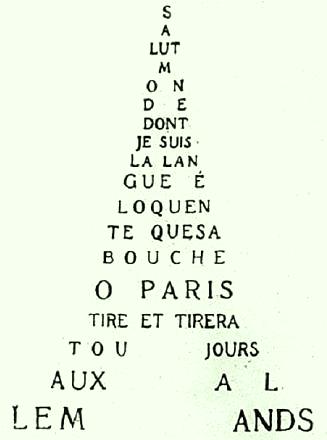
La tour Eiffel?  From Guillaume Apollinaire's Calligrammes: Poèmes de la paix et de la guerre (1918).  How can anyone really tell what's what via pictograms, cartoons, curves, shapes, forms and fields?   Gestalt, or compare with Malcolm Gladwell's Blink: The Power of Thinking Without Thinking (2005).  What the hell, what the heck!  We can complete forms in our heads!


Sometimes, form throws the mind into a pickle jar of confusion.  Here, the NUMBER ONE issue of VVV (that's three Vs, as in the 1963 Thomas Pynchon novel V. , but dating to 1942 and in trio rather than solo form, not quite a triptych).  Surrealism in action! Is it a flying M or two mushed overlapping Ws or one inner V crowded by two outers?  Is it Gestalt or Gefilte Fisch?

Today's Rune: Movement.

Monday, August 17, 2009

Permanent Parisians


If you go to Paris in your imagination or in person, Permanent Parisians: An Illustrated Guide to the Cemeteries of Paris by Judi Culbertson & Tom Randall (1986+) is a handy book to bring along. I've used it three times while walking around the great Cimetière du Père-Lachaise, which was created by Napoleon I in 1804 and "houses" all sorts of people (or in some cases the heart only) as diverse as Jim Morrison and (Sidonie-Gabrielle) Colette, Guillaume Apollinaire (Wilhelm Albert Włodzimierz Apolinary Kostrowicki), Honoré de Balzac, Frédéric Chopin, Jacques-Louis David's heart, Eugène Delacroix, Paul Éluard, Paul Éluard, Max Ernst, Molière (Jean-Baptiste Poquelin), Marshal Michel Ney, Yves Montand (Ivo Livi), Édith Piaf (Édith Giovanna Gassion), (Valentin Louis Georges Eugène) Marcel Proust, Countess Marie Walewska's heart, Gertrude Stein, Alice B. Toklas, Oscar Wilde (Oscar Fingal O'Flahertie Wills Wilde) and Richard Wright. And that's just for starters.


In Paris, even the cemeteries are beautiful social spaces.

Today's Rune: Partnership.

Sunday, August 26, 2007

Calligrammes, Alcools


Moe Tucker's birthday. The Velvet Underground, ya know. Forty years later, they look completely contemporary -- a sure sign of cool.


Tatar Russian rock star Zemfira. Here's a machine translation sampled from the Russian lyrics of "Jim Beam." A little like piecing together a cut-up by William S. Burroughs and Brion Gysin:
Forward I search for before the sky of cloudlet not one I thus far see as usual, this rhythm from the neighbors Melancholiac- dipsomaniac they are pulled in the sleep to me sucking knobs Ay, thanks, that I do not see, brought me to the colics Ay, the thanks druggie and melancholiac- dipsomaniac yes, brought me druggie and melancholiac- dipsomaniac, dipsomaniac of knob, knob, whispers past the knob, the knob, whispers by druggie and melancholiac- dipsomaniac To kiss unpleasantly - herpes reached on the high on containers Jim Beam into the lips. But under the stars on the roof of heat- completely. Can convergent- will take a walk, let us take a step? Forward . . .


Mexican pop star Thalía posing with large image of herself. It's plain bizarre.

Today's Rune: Breakthrough.

Birthdays: Zona Gale, Guillaume Apollinaire (b. Wilhelm Albert Vladimir Apollinaris Kostrowitzky), Peggy Guggenheim, Chen Yi, Christopher Isherwood, Albert Sabin, Mother Teresa (b. Agnes Gonxha Bojaxhiu), Julio Cortázar, Benjamin C. Bradlee, Geraldine Ferraro, Maureen Moe Tucker, Shirley Manson, Thalía (b. Ariadna Thalía Sodi Miranda), Zemfira (Zemfira Talgatovna Ramazanova).

Ciao Detroit! (Or, as a Tatar rock star might say): Sau buligiz!