Showing posts with label Freud. Show all posts

Wednesday, November 12, 2014

Gabriele Oettingen: Rethinking Positive Thinking (2014)

Gabriele Oettingen's Rethinking Positive Thinking: Inside the New Science of Motivation (New York: Current, 2014) alchemizes New Thought into New Science. Using the scientific method, Oettingen examines and refines ideas that have been around for quite a while, albeit in more mystical terms. Consider Florence Scovel Shinn (1871-1940), for example: "As one door shuts another door opens" -  in both "Intuition or Guidance," The Game of Life and How to Play It (1925) and "Success," Your Word is Your Wand (1928). 

Oettingen (with various assistants and collaborators) has conducted numerous studies that consider how effectively -- or ineffectively -- positive thinking works.

One of her conclusions seems to suggest a continuum spectrum, with positive thinking not-followed-up-by-action (dreaming only/"indulging") at one end, and negative thinking (nightmaring only/"dwelling") at the other. Indulging results in inaction, while dwelling results in paralysis. With indulging, one imagines great accomplishments to the point of not wanting to actually work toward the reality of such accomplishments; with dwelling, one is paralyzed with inaction because of perceived obstacles or excessive worries that may block one from achieving anything.

Oettingen brings up psychological contexts and possible origins (name checking William James and Sigmund Freud, for example) for our personal outlook and action styles, but that's not necessary to understand (or agree with) in order to deploy her suggested plan of action. Her suggestion? Utilize positive thinking but energize it with a technique she calls WOOP: 

Wish (what is your wish?) + Outcome (a good outcome if your wish were to become reality) - Obstacle (what's blocking your wish fulfillment?) = Plan (Outflank obstacle: If/then . . .). 

Using WOOP helps you focus on just about anything, for it is, as Oettingen states, "content neutral." 

Simple example. Suzy wishes to meet Sarah for brunch downtown. Ideal Outcome: they rendezvous, enjoy brunch and conversation and it's not too expensive. Obstacle: possible traffic issues, parking, eatery could be crowded, it's too pricey. Plan: do some research ahead of time about all of the above. If Highway 5 is closed, go via Route 23; if parking is full or the eatery is too crowded, go to a pre-considered backup place. In other words, have some kind of pragmatic plan, with alternative backup plans in reserve. 

WOOP can help one refine more grandiose wishes, too. Buddy may wish to make a billion dollars in one year, but there's a major obstacle to this wish's fulfillment: reality. Once he sees reality as a serious obstacle, he may determine on a more realistic wish: maybe save $1,000 in "x" amount of time. A personal obstacle Bobby has toward saving any $ is, perhaps, "impulse control." So, Bobby works with a partner on an if/then plan that will result in his actually saving $ toward his goal.

I've tried the WOOP technique now for a couple of weeks. So far, it's simple, direct, and works for just about anything.  I've already tweaked several either/or if/then decisions -- big and small -- simply by mind-mapping with WOOP. It's fun, it works, and it even lets you play "the game of life" with a little more cohesion.

Today's Rune: Possessions.  

Friday, October 31, 2014

Häxan (1922) / Witchcraft Through the Ages (1968)

Benjamin Christensen's silent movie Häxan (1922) clocks in at 87 minutes (or is it 104?); via Antony Balch, it morphs into a 77-minute version: Witchcraft Through the Ages (1968), wickedly narrated by William S. Burroughs and accompanied by a jazz soundtrack courtesy of Jean-Luc Ponty and Daniel Humair. Both versions are weird and fascinating and come together on one DVD thanks to the Criterion Collection.
"Häxan integrates fact, fiction, objective reality, hallucination, and different levels of representation -- all within a first-person discourse. . . The mixture of narrative modes . . . is astonishing for its freedom and audacity." - Gillian Anderson, liner notes, Criterion Collection DVD, 2001. 
"At times, Häxan appears to be a literal depiction of the imaginings of people of medieval Europe . . "  Sometimes funny, sometimes scary, sometimes both (the Devil's obscenely flickering tongue, for example). Crazy cool stuff, indeed, ending with little psychiatric episodes from the 20th century.

Happy Hallowe'en!

Today's Rune: Initiation.

Saturday, February 23, 2013

W.E.B. Du Bois: The Birthday Party


Thinking of W.E.B. Du Bois (1868-1963) reminds me of a lot of things beyond his books and ideas, public campaigns and transcendent inspiration. It reminds me of the 30th Street Post Office in West Philadelphia, a grand building with engaging postal workers, one of whom once held forth on Dr. Du Bois while selling me Du Bois stamps (must have been 1992-1993). "Some people will try to say his name in the French way, but they'd be wrong and need to look it up or ask me," he said, chuckling.

Philadelphia is a great city for talking with people, as all cities have been, in my experience. Strength through diversity. Yearnin' and learning.

Today is Du Bois' birthday. 110 years ago, he published The Souls of Black Folk (1903), a book on social psychology (sociology if you prefer), about the structures and systems of society, how they shape perception, worldview. Du Bois was cool -- with things like the "veil of double conciousness" to ponder, like an evolving blend of Marxian social thought and psychoanalysis with an African American focus. This was cutting edge, keeping in mind that Freud's Die Traumdeutung / The Interpretation of Dreams was first published in 1899. The Souls of Black Folk came into being almost exactly as Carl Jung finished his dissertation across the sea, what would later be translated as Psychology and the Occult. New and reshaped ideas abounded. They still do. Du Bois was part of it. Happy birthday to him.

Today's Rune: Wholeness.      


Wednesday, October 10, 2012

La Mort d'Orphée


Mort d'Orphée by Émile Lévy (1866, Musée d'Orsay, Paris). Here, Maenads are in the process of slaying Orpheus. Why? Paging Dr. Freud . . . Who knows?  Has Orpheus pissed off a god or goddess, or just the Maenads (in Roman terms, the Bacchae) themselves? Is it a case of "Heaven has no rage like love to hatred turned, Nor hell a fury like a woman scorned," as William Congreve put it in The Mourning Bride (1697)? Does this mythical scene represent the transient arc of the artist in life, the fickle nature of how art is perceived?

"Whatever prompted the Maenads to do it, each one wanted Orpheus for himself, and their tugging at him ended in a bloody death," according to Stephen P. Kershaw, in A Brief Guide to the Greek Myths (London: Robinson, 2007), page 56.

As for the painting, that's quite a fantasia there imagined by Lévy. I wonder if he had actual models act out the scene?      


Nymphs Finding Head of Orpheus by John Williams Waterhouse (1900, Collection of Sir Tim Rice). In any case, the myth continues. The head of Orpheus -- along with his lyre -- makes its was to the Island of Lesbos, where it's found either by "nymphs" (as pictured above) or Muses or their representatives. Orpheus was, by most accounts, a son of the Muse Calliope, who also happened to be the "Sing to me, O Muse" of Homer, apparently. So, we've got a case of energy transfer here, a touch of good feng shui and good luck or the will of the gods, because the talents of Orpheus begin to permeate around Lesbos, inspiring later artists such as the poet Sappho. And so, as is often the case, something "good" comes out of something "bad," eh?    

Today's Rune: Initiation.  

Monday, July 02, 2012

Lucian Freud Exhibition at The Modern

Yesterday, checked out the Lucian Freud Exhibition at The Modern Art Museum in Fort Worth, Texas. Lucian Freud: Portraits
(July 1 - October 28, 2012). The official rendering goes like this: "Lucian Freud is widely considered the greatest portrait painter of the twentieth century. His visceral renderings of people from all walks of life have a painterly and psychological drama that is unparalleled in contemporary art. . . Fort Worth will be the only U.S. venue" (Source: The Modern).


Lucian Freud (12/8/1922-7/20/2011) didn't sugarcoat his portraits. They are brutal. Many of them are hideous. They present a corrective to false advertising, I suppose. For more information, here's a link: http://www.themodern.org/visit/hours-and-admission 

Today's Rune: Harvest. 

Friday, March 02, 2012

The Girl on a Motorcycle: Take Two


Jack Cardiff's The Girl on a Motorcycle (1968) / La motocyclette (aka Naked Under Leather), based on André Pieyre de Mandiargues' short 1963 novel La Motocyclette, delves into psychology and philosophy partly through the professor (play by Alain Delon) and partly through Rebecca (played by Marianne Faithfull). The two characters meet at Rebecca's father's bookshop, where the professor seeks, among other things, the writings of Emanuel Swedenborg (1688-1782). In addition to Swedenborg, he finds Rebecca.

While Rebecca subsequently rides her motorcycle from husband (a high school teacher) to paramour (the professor), she passes by a large World War One cemetery, and later a convoy of troops. At those points, she muses on blind acceptance of received authority, and the violent deaths of a million men now buried in the cemetery.   


At other points, both Rebecca and the professor wonder about the nature of love and the nature of marriage. Some of their musings consider marriage as mostly a form of "protection" or stability in the unstable greater world. Enter Swedenborg's Wisdom's Delight in Marriage ("Conjugial") Love: Followed by Insanity’s Pleasure in Promiscuous Love (1768, 1949). Sample: "That with man marriage love is within the love of the sex, as a gem in its matrix." Or so sayeth the dude. 


Note: This promotional should read MARIANNE FAITHFULL, not MARIANNE FAITHFUL.  Possibly a Freudian slip, more likely a typo.


In any case, Rebecca is torn between the protection of marriage, which she also projects as stultifying and routine, and the freedom to engage in "free love," but also wonders about the effects of both stability and instability on her identity as a person. Her free love is not free, but rather comes at a cost; while marriage also comes at a cost of freedom curtailed. It's no wonder that, while considering her internal imbroglio, Rebecca's most coherent thought may be: "God, I must have a drink." And she does, in a bar in Alsace, a region fought over for centuries between speakers of different tongues.

Today's Rune: Protection.   

Tuesday, September 13, 2011

The Most Beautiful Thing in America


I. The most beautiful thing in Tokyo is McDonald's. -– Andy Warhol, “Beauty,” The Philosophy of Andy Warhol: (From A to B and Back Again), 1975.

II. Venus Flytraps ring the city.

Venus Flytraps ring the city
Set to catch commuters:
38 Subways
31 Jack in the Box drive-throughs 
30 Sonic Drive-Ins
28 7-Elevens
26 McDonald’s
25 Whataburgers
23 Starbucks
22 Domino’s
17 Taco Bells and
17 Pizza Huts
16 Braum’s
14 Wendy’s
12 KFCs
11 Waffle Houses
10 Burger Kings
8 Denny’s and
8 IHOPs and
8 Long John Silver’s
7 Taco Cabanas and
7 Mexican Inns and
7 Taco Casas
3 Cheddar’s Casual Cafes and
2 Captain D’s.

Yes, Venus Flytraps ring the city
Set to catch commuters.

III. "The M stands for McDonald's, but the rounded m represents mummy's mammaries, according [to] the design consultant and psychologist Louis Cheskin. In the [1960s] McDonald's was prepared to abandon this logo, but Cheskin successfully urged the company to maintain this branding with its Freudian symbolism of a pair of nourishing breasts."  -- "Fast Food Factory: Attracting the Customers," BBC World Service Specials.

IV. In every city and in every town, an outpost. How about in your neck of the woods?

Today's Rune: The Self.  

Thursday, March 10, 2011

Michael Angelo Tata Interview, Part II


Part II of the Erik's Choice interview with Michael Angelo Tata. Photo: MAT with his Mom and Sunni, a stuffed chicken, on Christmas Day 2010 (Courtesy MAT).

EC: What have you been into lately, textually?

MAT: I’ve been on a Wittgenstein binge lately—I think what got me into it was that I was writing a piece about poet Charles Bernstein for the forthcoming Salt Companion to his work, and coming back into contact with his love of Wittgenstein inspired me to give Ludwig another go, now that all the poets have forgotten about him.  To be specific, I’m reading The Blue and Brown Notebooks.  Their style is so anti-philosophical, even diaristic: rambly, anecdotal and immediate.  I’m hooked.  They also provide many crucial insights into his published writings and into the divergence of his thought from Logic and Analytic Philosophy and its embracing of the problems of ordinary language in all its gorgeous cacophonousness.

EC: What types of texts do you like to read and who are some of your fave, most inspiration-inducing writers?

MAT: I love reading poetry, philosophy and psychoanalysis--Ted Berrigan, James Schuyler, Jean-Paul Sartre, Søren Kierkegaard, Sigmund Freud, Jacques Lacan, all the stuff that gives you a migraine.  Then of course there’s physics and evolutionary bio—Brian Greene, Albert Einstein, Michio Kaku, Lynn Margulis, Humberto Maturana.  Within fiction, which has influenced my structural choices immeasurably, even outside the realm of the prosodic, there’s Jane Austen and Marcel Proust, bitches on wheels if ever there were bitches on wheels.  They both taught me so much about syntax, especially about how to encode attitude into it, how to put it to the service of triple entendre and keep it coiled tightly, every word spring-loaded and overdetermined.  Proust especially fired me up: who would have thought a sentence could go on for so long, and still be respectable?  After Marcel, I was ruined for sure.   

EC: Are you working on new texts or other works?

MAT: As usual, I have a few projects going.  Poetically, I have been working on a series of numbered zeroes: the series is tentatively called Sweet Nothings, and it focuses on the little pools of nothingness that perforate the everyday.  The poems are elaborately lyrical, even to the point of absurdity, and in many ways use what Keats called the Egotistical Sublime as counterpoint to the impersonality and cold procedurality of so much Language School poetry.  I’ve also completed my first novel, Scattering Brightly.  It’s pretty much a pomo picaresque about the tangled life of a dumpster baby left outside Studio 54.  Lastly, I’m nearly done with the sequel to my Warhol book.  It’s called Andy Warhol II: Inescapable Da_sein, with Da-sein’s hyphen becoming the cursor’s underscore.  It’s a little grammatical trick I’m using to reinforce the notion that Warhol’s work redefines the ‘thereness’ of Heidegger’s ‘being-there’ in terms of mechanism and virtuality.  Oh—and I promised Black Camera a piece about Sapphire’s use of the word ‘cuntbucket’ in her Push.  That is gonna be loads of fun to develop. 

EC:  The hardest part of writing is . . .

MAT: The hardest part of writing is not-writing. Stopping.  Putting the words away.  Being-silent.

EC: Can you give us some kind words of advice about writing and publishing?

MAT: Just keep on going, no matter what.  Keep track of who inspires you, and follow their work relentlessly.  Reading is as important as writing: you have to consume to produce, as biological gaucherie would have it.  Try your stuff out on friends and family.  And don’t take rejection personally—use it as an occasion to learn what about your work people actually do like, and then capitalize upon it. 

EC:  What’s your approach to promoting Andy Warhol: Sublime Superficiality?

MAT: Because smaller presses do not have the widest net of distribution, you have to be inventive.  Make lists of all the people you’d like to read what you wrote, and if they’re alive, have your publisher get them a copy.  That’s what I did with Danto, and I was shocked to learn that he not only read the book, but loved it, and wanted to help promote it.  He was kind enough to put out a call on Facebook, which was quite surreal, and he got it reviewed by the Journal of Aesthetics at Temple by his colleague David Carrier.  I was also fortunate enough to have a literary PR guru from Sizzle, San Diego give me loads of advice about how to build up my Amazon author profile, develop some guerrilla marketing concepts,  and other helpful tidbits.  My friend who dances at the Penthouse Club in NYC is actually supposed to YouTube herself reading my book while up on the pole—I am so praying this happens!  I’m hoping to involve Krystal Something Something and Ultra Violet in the campaign, if I can lure them in.

EC: How can interested folks acquire a copy of Andy Warhol?

MAT: The best place to go is www.intertheory.org: just look for the image of the Empire State Building, and click away.  You can also check out my profile at Amazon.com by typing my name into the search engine.  Or, you can go to my company page, www.ipublishingllc.com, where there’s links to my work, as well as to all the advertising stuff I do to bring home the bacon, as Andy liked to say.  Only now it’s turkey bacon—European denim is not exactly roomy! 


Today's Rune: Defense.

http://intertheory.org/warhol.htm

Monday, January 18, 2010

London: Sir John Soane's Museum


While doing my ICOMOS library internship in London in the early 1990s, I stayed part of the time with architects John Adams and Marina Dunbar Adams in Clapham. They were always giving good advice about places to check out; one of them was Sir John Soane's Museum at 13 Lincoln's Inn Fields.

Primarily an architect, Soane (1753-1837), like Thomas Jefferson (1743-1826), loved to tinker endlessly.  The museum shows this. Walk around and see his crazy love of Neo-Classical designs and artifacts. (Neo-Classical?  Inspired by ancient Greek and "finer" Roman architecture, and by Renaissance Italy).  In more than one way, it's a trip. 

http://www.britishtours.com/360/soane-museum.html


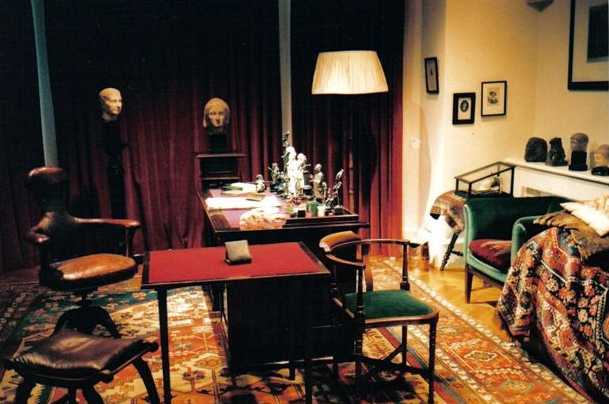
Soane's whole place is filled with nutty treasures, but even people like Sigmund Freud and Carl Jung populated their offices with all sorts of totems and artifacts from other times and other places.  More on them at some point, I suspect.  How about you?  Do you have favorite things around you while in repose?

Here's to a more civil society as strived for by MLK and his spiritual cousins . . . 

Today's Rune: Journey.

Saturday, November 14, 2009

Mouse Trap!

Memory flash -- maybe 1964 or '65 -- East Stroudsburg, Pennsylvania. Mouse Trap. Does anyone else remember this? "It's Mouse Trap!" I was working today on an odd job that required getting up before dawn, and this came to mind. Proust meets Freud and another memory surfaces. Do you remember any favorite childhood games or whatnot? I just remembered a model of the Jupiter 2 from Lost in Space; and maybe a few years later, a model flying saucer spacecraft from The Invaders. And now, there's water on the Moon . . . The discovery of cheese there is still pending.


Today's Rune: Defense.

Monday, October 12, 2009

Tyson: After the Fall


Highly recommended: James Toback's documentary Tyson (2009). Not only is the film well constructed, but the director allows Mike Tyson to speak his mind in a non-intrusive way. Unlike the usual interview technique, there is no talking head across from Tyson. During filming, Toback asked questions from behind, like a cagey modern Freud. The results are outstanding. Tyson's unique observations are fascinating, and well-worth hearing. Tyson also appeared with Oprah Winfrey earlier today in a way that supplemented the film.


Tyson is one of the most interesting documentaries I've ever seen. There are other films on boxers that are good, too, covering Muhammad Ali, Sonny Liston, Smokin' Joe Frazier, George Foreman, Joe Louis, Rocky Marciano, and so on. What's amazing to me is how familiar these icons are, largely through cultural osmosis, as primal archetypal figures. Tyson shows a mortal person in a memorable way.

Today's Rune: Movement.

Wednesday, April 15, 2009

Voltaire Almighty II


On a day of Fox & Hound Tax Day Tea Party demonstrations, seems as good time as any for a return to Voltaire, European wild man and champion of free speech.

Though Voltaire wrote all sorts of things, he's probably best known outside of France for Candide, ou l'Optimisme / Candide, or Optimism (1959), written in his early-to-mid sixties and published when he turned 65. I love Candide for its ribald wit and continued relevance, its Enlightenment values and keen understanding of human nature.

Still not quite through with Roger Pearson's packed biography, Voltaire Almighty: A Life in Pursuit of Freedom (2005), with Voltaire in his seventies. For now, I'll make my leave with the following statements by Voltaire about everything happening in the world: "Reader, you must reflect. Develop this truth: draw your own conclusions." And, "What should we conclude? You who are reading and thinking, you conclude." (Pearson, p. 299). Amen, brother. Much of the rest is Death and Taxes.


Today's Rune: Partnership.

Sunday, May 06, 2007

Ségolène & Sarko


National elections in France today. High turnout so far. Change is in the air, revolution in the streets. Regardless of who wins, the older generational status quo will hand off to the post-WWII kids, now in their fifties. It's exciting to think that soon, too, Tony Blair (UK), Vladimir Putin (Russia), G.W. Bush and Dick Cheney (USA, Haliburton) will all be out of office -- though the demonic Bush-Cheney duo will, barring a strange turn of events, be the last to go.

Today's second and final cycle in France pits center-left Ségolène Royal (Parti Socialiste or PS) vs. center-right Nicoloas Sarkozy (Nicolas Paul Stéphane Sarközy de Nagy-Bocsa of the Union pour un Mouvement Populaire or UMP).

Opinion polls favor "Sarko" Sarkozy. More will be revealed. As Jim Morrison, (now resting in Père-Lachaise Cemetery in Paris) sang it with the Doors, "The future's uncertain and the end is always near." There's already a strong rumor that, regardless of today's outcome, Sarkozy's wife will be leaving him permanently. Either way, a Pyrrhic victory of sorts. Royal is not formally married, so the worst she'll lose is the election.

Today's Rune: Possessions.

Today's Birthdays: André Masséna, Maximilien Robespierre (b. François Marie Isidore de Robespierre), Sigmund Freud, Nicholas II (b. Nikolay Aleksandrovich Romanov), Rudolph Valentino (b. Rodolfo Alfonso Raffaello Piero Filiberto Guglielmi), Orson Welles, Theodore White, Bob Seger, Tony Blair (Anthony Charles Lynton Blair), George Clooney.

Liberté, égalité, fraternité! Vive la France!

Thursday, November 02, 2006

William Styron: Lie Down in Darkness


The death of William Styron (b. Newport News, Virginia, 6/11/1925-d. 11/1/2006, Martha's Vineyard, Massachusetts) throws my mind back to my high school years in Durham, North Carolina.

Given that every English teacher I've ever taken classes with has ranged from eccentric to outlandish and sometimes outrageous, Mrs. V. stands out as a moody mix of them all, only with a very Southern twist. Hailing from Mississippi, she taught an outstanding class called "Southern Writers." Mrs. V. loved her people and championed their work, had met Faulkner, the master, and had us read his novels, plus Tennessee Williams' plays, Flannery O'Connor's writings, Carson McCullers, Walker Percy, and also her friends Eudora Welty and Reynolds Price (who came to class once). Anne Tyler was in the mix somehow, too. For a special research paper, I was given William Styron's The Confessions of Nat Turner (1967), which I found alternately absorbing and nauseating, and certainly memorable.

Styron was an intense guy, masking depression with various addictions I suppose, but also, perhaps, because of his sensitivity, perceptiveness and depth. After attending Davidson College, he graduated from Duke, with stints in the Marine Corps before and after. Before he died yesterday, he completed five novels (including Sophie's Choice, 1979) and three other books, including Darkness Visible: A Memoir of Madness (1990).

I thank Mrs. V for making me read Styron early. I don't remember a Mr. V, but she had a son who suffered from a wasting disease. In class, she alternated between fussy propriety to whispered enthusiasm at "Freudian symbolism" like cigars, hot lava, Cat on a Hot Tin Roof.

Mrs V. refused to ever mention General William Tecumseh Sherman's name ("that awful man") because of Vicksburg and Atlanta, and always referred to the American Civil War as "The War of Northern Aggression" or "The War for Southern Independence." Since I was born in Yankee Pennsylvania, I found her observations highly entertaining and a bit Mississippi crazy. In her mind, very little of importance happened in the world since "The Night They Drove Old Dixie Down." Except, of course, for Southern writers -- America's saving grace in the twentieth century.

Today's Rune: Journey.

Adieu, William Styron.

Wednesday, August 30, 2006

Gina Frangello: My Sister's Continent


In the past two years, only a handful of newly published literary novels have grabbed my attention. The latest, My Sister's Continent: A Novel by Gina Frangello (Portland: Chiasmus Press, 2005), thoroughly enchanted me. Why?

First, here are some of the others I've enjoyed reading and pondering: Zoe Heller, What Was She Thinking? Notes on a Scandal: A Novel (2003); T. Coraghessan Boyle, The Inner Circle: A Novel (2004); Mary Gaitskill, Veronica (2005); and, as supplemental reading, Hitomi Kanehara, Snakes and Earrings / Hebi ni piasu, translated by David Karashima (2005) and Marcy Dermansky, Twins: A Novel (2005).

What do they all have in common? All are entertaining and well written; more interestingly, they all explore identity, social boundaries and existential choices with vigor and excitement. They uniformly tread where many fear to go -- into unconventional (and often taboo) social interactions and notions of self. Indeed, they all delve into edgy psycho-sexual relationships (i.e. mature readers preferred) that develop into something deeper.

To compare Frangello's narrative approach in My Sister's Continent with filmmakers, imagine a blend of Woody Allen drama, David Lynch imagery, and character development a la Audrey Wells' Guinevere (1999) and Ingmar Bergman's Persona (1966).

When exploring identity, what could be more intriguing than identical twins? Especially two "women in trouble" who are beautiful and identical in some ways, vastly different in others? Set them (Kirby and Kendra) in the interwined, completely enmeshed milieu of the Braun and Kelsey families, frame them with Freud's "Dora" (Fragment of an Analysis of a Case of Hysteria, 1905), and set them (mostly) in Chicago, with flashbacks and other time shifts, give the father AIDS, follow several transgressions of the status quo, and there you have it, one gripping psychological journey. My Sister's Continent also reminds me of Sue Kaufman's Diary of a Mad Housewife (1967) -- but from the perspective of Bettina Balser's daughters Sylvie and Liz, in their twenties, and with more elaborated detail.

For more on Chiasmus Press, here's a link to their website.

Today's Rune: The Blank Rune.

Bon voyage!

Sunday, August 13, 2006

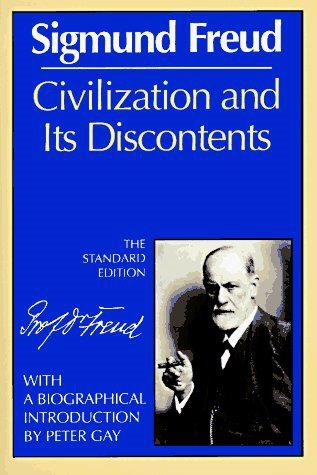
Sigmund Freud: Civilization and Its Discontents, Parts III-VIII


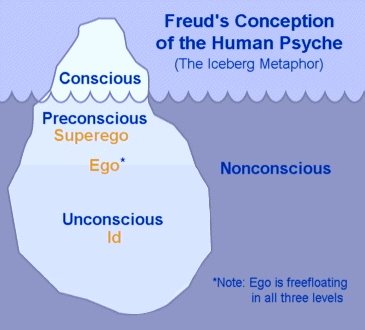
In the final sections of Civilization and Its Discontents, Freud runs quickly through his general ideas of how the id/libido, ego, and superego operate. Including the rise of technology in his assessments, he sees civilization as a struggle between individual wants and group needs. He speaks also of love and beauty, with a nod to St. Francis of Assisi. "On the one hand love comes into opposition to the interests of civilization; on the other hand, civilization threatens love with substantial restrictions."

One of his biggest ideas is to posit that human beings and their civilizations are at constant warfare with themselves and each other in a struggle between life-affirming Eros and an aggressive death drive:

[M]en are not gentle creatures who want to be loved, and who at most can defend themselves if they are attacked; they are, on the contrary, creatures among whose instinctual endowments is to be reckoned a powerful share of aggressiveness. As a result, their neighbor is for them not only a potential helper or sexual object, but also someone who tempts them to satsify their aggressiveness on him, to exploit his capacity for work without compensation, to use him sexually without his consent, to seize his possessions, to humiliate him, to cause him pain, to torture and kill him." He goes on to list various acts of barbarism, many committed under the banner of organized religion (and some of which Robin listed in a recent comment), examples of which "reveals man as a savage beast to whom consideration towards his own kind is something alien."

Though Freud makes other striking points, I'll end with these, with our world now engulfed in a seemingly permanent state of global mayhem:

In consequence of this primary mutual hostility of human beings, civilized society is perpetually threatened with disintegration. The interest of work in common would not hold it together; instinctual passions are stronger than reasonable interests.

Lucky us.

Sigmund Freud: Civilization and Its Discontents, Part II


In Civilization and Its Discontents, Freud continues to muse about civilization and the individual's place in society. He discusses personal development and even, at one point in the previous section, brings up the power of yoga and meditation.

As for organized religion, he sees it as a "system of doctrines and promises which on the one hand explains . . . the riddles of this world with enviable completeness, and, on the other, assures [the believer] that a careful Providence will watch over his life and will compensate him in a future existence for any frustrations he suffers here." He says that for most, the idea of God is based on "an enormously exalted father" figure.

Freud's response: "The whole thing is so patently infantile, so foreign to reality, that to anyone with a friendly attitude to humanity it is painful to think that the great majority of mortals will never be able to rise above this view of life. It is still more humiliating to discover how large a number of people living to-day, who cannot but see that this religion is not tenable, nevertheless try to defend it piece by piece. . ."

In the next sections, Freud gets at primal sex and aggression drives and the way civilization seeks, without much success, to contain and channel these drives through rules, laws, and customs; even when they do succeed, such restrictions tend to create in people a byproduct of neurotic behavior. He also gets at the idea of sublimation, channeling energies into acts of cultural creation.

While I agree with Sheila that some of the specifics of Freud's notions about individual psychology were a bit wacky, overall, he was onto some major truths. Robin, wouldn't it have been fascinating to talk about all this with him?

Today's Rune: Wholeness.

Saturday, August 12, 2006

Sigmund Freud: Civilization and Its Discontents, Parts I-II


Many Jewish European visionaries have profoundly changed the way we think and see the world and ourselves. A handful of examples: Karl Marx, Sigmund Freud, Franz Kafka, Albert Einstein, and Martin Buber.

As I started to get my 1928 apartment in fighting trim for the fall, I came across the often hilariously pensive little volume of Freud's, Civilization and Its Discontents / Das Unbehagen in der Kultur (1929). It's a wonderful jumping off point for all sorts of creative endeavors. Reading through it again, it reminds me that Woody Allen's filmic worldview dovetails nicely with much of this work. As does much of Fellini's. Just as Fellini remarked about recreating the Remini of his memory via Ostia, Italy, so Freud speaks of the layered remnants of ancient Rome: "Their place is now taken by ruins, but not by ruins of themselves but of later restorations made after fires or destruction."

In the first two sections of the 92-page book, Freud examines all sorts of things dear to artists: the pleasure principle/pain avoidance, the reality principle, the libido/id, the ego, plus the nature of love, art, religion, and life. His comic Woody Allenesque gloominess asserts things like: "Life, as we find it, is too hard for us; it brings us too many pains, disappointments and impossible tasks. In order to bear it we cannot dispense with palliative measures." He then goes on: "There are perhaps three such measures: powerful deflections, which cause us to make light of our misery; substitutive satisfactions, which diminish it; and intoxicating substances, which make us insensitive to it. Something of the kind is indispensible." Ah, yes.

And what is it about these three measures he has in mind? "Voltaire has deflections in mind when he ends Candide with the advice to cultivate one's garden; and scientific activity is a deflection of this kind, too. The substitutive satisfactions, as offered by art, are illusions in contrast with reality, but they are none the less psychically effective, thanks to the role which phantasy has assumed in mental life. The intoxicating substances influence our body and alter its chemistry. It is no simple matter to see where religion has its place in this series. We must look further afield." He goes on to say that organized religion is a "mass-delusion." Freud was a funny man, indeed. I was lucky enough to check out his main dwellings and office spaces in Vienna and London back in the 1980s. He died in London in 1939, having escaped from the Nazis.

(British) English translation by James Strachey (1961).

Auf Wiedersehen!

Tuesday, June 06, 2006


Bernays: Hypnotizing the Consumer

Ever heard of Edward L. Bernays? This dude, a nephew of Sigmund Freud living in the USA, began his role as a "Father of PR" during the First World War. Like Goebbels of Germany in the sequel, he worked to manipulate public opinion through the clever and shameless use of government-sponsored propaganda. A lot can be picked up by reading his theories and following some of his projects, and also by checking into his 1928 book pictured above and to the left.

Bernays, using techniques of social psychology and market research, seamlessly moved back and forth from government to corporate sponsorship. This makes perfect sense: after all, is there any essential difference between government propaganda and corporate public relations or advertising? Either way, a large body with huge economies of scale commits monetary resources to shape how people think and act. Governments and corporations seek to sell something -- a war, a product, a brand, an idea.

If, however, the divergence between rhetoric, flash, and spin control becomes great enough, cognitive dissonance may shake the target audience's beliefs, threatening the manipulation campaign. People like Bernays could care less -- they move on to the next project. People like Goebbels go down with the ship.

After World War One, women earned the right to vote in the USA; but culturally, it was widely seen as cheap and vulgar for women to smoke, drink, act, dance, apply make-up, or otherwise exercise any personal freedoms usually reserved for men. Bernays wanted to change one thing immediately: women and smoking. Why? He wanted to help a client sell more cigarettes. Hence, he launched a highly successful Virginia Slims campaign, transforming the popular image of women smoking into something chic and wonderful, perhaps even healthy. Others worked to make women's ideal body image as sleeker to emulate the small but highly visible contingent of Flappers. Bernays et al. succeeded brilliantly! As late as the 1970s, Virginia Slims sponsored internationally televised sporting events, particularly women's tennis (think Billy Jean King). Ain't that nifty-fifty?

To Bernays, the "truth" was relative, and didn't really matter anyway. What mattered was how to redirect people to believe something you wanted them to believe, even create something out of nothing. In recent times, when exactly did the concept of WMD come into everyone's conciousness? How about the Axis of Evil? The techniques of propaganda/public relations are now as widely used by wildly differing types of insurgencies, Islamic plotters, and leftists as by the traditional right and center. Not to put too fine a point on it. . . . . but if you really want to know what's going on underneath the surface, maybe Bob Dylan has it right: Don't follow leaders: watch the parking meters. Follow the money trail. But follow the ideological trail, too.

It's after closing time. When I snap my fingers, wake up.

Monday, April 17, 2006


A Basket Full of Kisses for a Basket Full of Hugs

All of us but the most saintly probably have at least a touch of evil in us. But there is a threshold that most of us mercifully never reach. Such is not the case with the criminally insane psychopath. On Good Friday, authorities in a Purcell, Oklahoma apartment complex found the body of Jamie Rose Bolin, a ten-year old girl, in a bedroom closet rented by 26-year old Kevin Underwood. The man apparently intended to butcher and eat her as human shish kebab.

What makes a man in our society want to do this? What impelled Underwood to 1) want to do it; 2) think it was a good idea; 3) plan to do it; and 4) attempt to carry out the crime? Could anything be more heinous? Probably, but this is about as evil as it gets on an individual human scale. Obviously, Underwood must be removed from society and dealt with appropriately. Most adults would probably advocate for or acquiesce to the death penalty in this and similar cases.

Recently, I watched The Bad Seed (1956), which I’ve seen twice before over the years. Based on the William March (1893-1954) novel of the same name (first published in 1954) and the subsequent Maxwell Anderson (1888-1959) play, the film explores the issues of what makes a person – of any age or either gender – evil. The answer is left to the audience, but a strong case is made for genetic moral deformity. Directed by Mervyn LeRoy (1900-1987), the action and character development closely follow the book and play (except for the ending, which was dictated by then-current film codes); many of the same actors worked in both show versions.

Rhoda Penmark (played brilliantly by Patty McCormack, who now incidentally acts as Liz Le Cerva, Adriana’s mother on The Sopranos – see “Long Term Parking,” 2004), is the Bad Seed. Through much of the movie, she frenetically plays Claude Debussy’s “Clair de lune” on her piano. Only eight years old, she has already developed a full case of greedy and maniacal narcissism. Quite adept at charming adults, she is a budding psycopath who is willing to kill anyone in her way to get what she wants. She plays “princess” games with her father and family friends; particularly creepy is her little game of a basket full of kisses for a basket full of hugs. What makes this black and white film so effective despite its theatrical contrivances and stark shadows is the weird mix of subtle humor, pure evil, and the moral dilemmas of perplexed "normal" adults.

Without going into the whole plot, let’s just say that what Rhoda wants, Rhoda must have. When her father Kenneth, about to leave for a military assignment, promises to his wife Christine that he’ll call and write often, Rhoda, in a princess dress and pigtails, responds: “A special page for me?” Kenneth melts and assures her special pages and all his love. Husky voiced Christine seems haunted and troubled even before he leaves. “Oh, four weeks is a long, long time,” she says. Indeed, she is right.

Enter a large and darkly humorous dose of Freudian psychology in the guise of Monica Breedlove, the matronly upstairs neighbor and apartment owner who lives with her brother Emory. She is delighted and intrigued by Rhoda, noting above Christine’s objections that Rhoda plays by her own rules. Monica, amid and despite all her giddy and modern ideas about psychology, vitamins, and sleeping pills, dotes on the evil little princess. “I have a surprise for you,” she says. Rhoda immediately responds: “Presents?” Monica’s interaction with Christine and Rhoda is fascinating: she treats the mother like a child and the child like a young protege.

Enter Reginald Tasker, who studies the criminally insane. Eventually, he explains one theory of the genetic transmission of evil, in this case skipping one generation. “It’s as if these children were born blind,” he says. From early childhood, they are “bad seeds, and nothing can change them.”

There is much in the story about “breeding” (developed with irony and wit), which brings us to the apartment’s groundskeeper and handyman, Leroy Jessup. Monica Breedlove early on posits that Leroy “has the mind of an eight year old” – which makes him the perfect foil for Rhoda (he is one of the first to figure her out, as he is a bit touched himself). Leroy’s interactions with Rhoda are hilariously creepy.

The question remains open: how much are a person’s actions dictated by nature, and how much by nurture? And why, according to most empirical facts, are males more likely to commit atrocious acts than females? Even the method of killing usually differs according to gender, with males using extreme physical violence, females employing more subtle methods like poison. Interestingly, the same goes for methods of suicide. As Christine posits at one point: “Something to do with hormones, I suppose.”

The Bad Seed
is a classic. Not quite as good in execution as Arsenic and Old Lace, the Frank Capra film (released in 1944) adapted from Joseph Kesslering’s play, or as clever as Alfred Hitchcock’s Rear Window (1954), it nonetheless carries similar cultural freight and explores some of the same kinds of social mores juxtaposed against the criminally insane. I love how in The Bad Seed the audience can glimpse the social etiquette of the 1950s, when men knew to take their hats off indoors and hosts immediately offered drinks to their guests. It would be nice to see such etiquette and hospitality restored.

Meanwhile, be careful out there. There are a lot of crazies in the world, and evil is everywhere. In the words of Arthur Miller, attention must be paid.

Peace be with y'all. Knuckle up and guard your grills.