Showing posts with label Economic Development. Show all posts

Wednesday, November 28, 2018

Olivier Azam and Daniel Mermet: 'Howard Zinn, une histoire populaire américaine’ (2015)

Olivier Azam and Daniel Mermet: Howard Zinn, une histoire populaire américaine (2015). First part: Bread and Roses. I first caught this on Free Speech TV. It provides a good sampling, focusing in good part on the Robber Baron period and the impact of the First World War.

Howard Zinn (1922-2010) devoted much of his energy on consciousness raising, building up an appreciation of the history of people and clashes and changes often forgotten or -- like the eight hour work day -- taken for granted. His work is influential; and he was a sweet person.   


"Between 1900 and 1920, like Howard Zinn’s parents, more than 14 million immigrants arrived in the United States. They came fleeing poverty or war, racism or religious persecution. They dreamed of a promised land, of wealth, or simply of a better life. The New World opened its arms wide to the poor and huddled masses of the Old: its unwanted, its fugitives, and even a few utopians . . . After all, the rapidly expanding industries of the time required cheap labor, and immigrant workers - men, women and children - were easy to exploit. But the same period also saw the birth of organized labor, with its strikes and conflicts, and the appearance of great figures like Emma Goldman, Mother Jones, Eugene Debs and the Wobblies."  (Source here). 
Olivier Azam and Daniel Mermet: Howard Zinn, une histoire populaire américaine (2015). Zinn's A People's History of the United States was originally published in 1980.

Zinn Education Project: link here.

Les mutins de Pangée est une coopérative audiovisuelle et cinématographique de production, d’édition et de distribution (en salles, DVD, VOD). Here is a a link.

Today's Rune: Initiation.  

Tuesday, October 09, 2018

Donald J. Raleigh: 'Soviet Baby Boomers' (2012), Part IV

Donald J. Raleigh, Soviet Baby Boomers: An Oral History of Russia's Cold War Generation (New York: Oxford University Press, 2012).

"The Soviet practice of sending work cohorts on vacations together made it complicated for families to travel together, giving rise to vacation romances." (page 206

Families became smaller. "At the end of the 1970s, 52 percent of Soviet families with children had only one child . . ." (page 206)

On Lithuanians: "The people . . . are very peculiar  . . ."  (page 208)

Marina Bakutina, guide-interpreter: "'I could think whatever I liked, but not say it.'" (page 209)

"The Baby Boomers also continued to have vicarious encounters with foreign cultures through movies and books . . ." Olga Kamayurova: "'I like the films they used to show at film clubs, that is, complicated, sophisticated films not for ordinary viewers . . . They showed us lots of such films, including, my heavens, Fellini and Antonioni. It was like food for us movie lovers . . . Sometimes, when they picked some sensational film, I would think . . . this is so extraordinary.'" (page 210)

When some of the Soviet Baby Boomers moved to the USA, they were appalled by the high cost of health care and education (page 217).  

Travel: "'It's better to see something once than to hear about it seven times,'" goes the Russian proverb."

Viktor D. on the late Soviet era: "'health care was free and unequivocally on a higher level than now. Education was free, including higher education and graduate school . . . People received apartments, they had confidence in tomorrow. Maybe everything was on a lower level than in America, but there was stability.'" (page 237)

The Brezhnev to Chernenko era became an embarrassing gerontocracy, "'an awful spectacle.'" (page 240) "Yelena Kolosova recalled asking, 'Who's Chernenko? He was even worse than Brezhnev, absolutely nothing more than a joke.'" (page 243)

Oddly, at the New World resort in Crimea, some Russian Baby Boomers became New Age types, or joined Osho (the Bhagwan Shree Rajneesh movement that spread worldwide, with a "Zorba the Buddha" style colony in Oregon) . (See page 246)

Ideas of existential freedom. L. G. Ionin: "'The Soviet people chose from among the available choices and understood freedom as having choices from among what was.' In this regard, for a free person, the Soviet Union was a free society. Freedom existed as a real choice, as an individual emotional experience." (page 249)

[to be continued.]

Today's Rune: Possessions

Friday, October 05, 2018

Donald J. Raleigh: 'Soviet Baby Boomers' (2012), Part II

Donald J. Raleigh, Soviet Baby Boomers: An Oral History of Russia's Cold War Generation (New York: Oxford University Press, 2012).

"Soviet teachers were among the strongest believers in socialist values." (page 94)

From the Young Pioneer manual: "'It will be the best, the most just and the happiest society on earth.'" (page 110)

"influence, connections, and pull -- blat in Russian." (page 118)

Soviet schools: "They instilled in their charges basic human values that would be appreciated in most societies." (page 118)

A Soviet Baby Boomer about living in the 1960s: "'We always had decent food; we went to the theatre, to the movies, to the circus, and to whatever else was of interest. We didn't differ from other average people of our time.'" (p. [120]).

Many Soviet Baby Boomers developed an "identification with a larger global youth culture;" guys in particular tinkered with space-related themes (page 121).

"Many female Baby Boomers loved theatre, ballet, dancing, reading, hanging out with friends . . . Olga Gorelik liked to read, draw, go to the movies, and spend time with her girlfriends." (page 122) 

Many enjoyed sporting events. Pioneer palaces gave people places to hang out. (pages 122-124) Kids loved to play in apartment courtyards (dvor), too. (page 125)

On social relationships, Raleigh notes: "Friendship lacks a definition that works for all times, places, and peoples, because the phenomenon is a cultural and historical one that changes over time: the type of society determines the nature of friendships." (page 126) Soviet friends provided emotional and practical support for each other, and they could counter or at least alter government and family controls (pages 126-127). A fair number of high school friends remain friends for life. (page 127)

"The Soviet Union prided itself in being the 'most reading' nation," and many continue to read heartily long after the collapse of the USSR. Friends traded books and they also utilized libraries, like many sensible people still do wherever they are available. "Reading conferred status" (page 129). During an interlude in the 1960s, Mikhail Bulgakov (Master and Margarita), Solzhenitsyn (One Day in the Life of Ivan Denisovich) Kafka and Kierkegaard were published (pages 130-131). Samizdat (underground writings produced in the USSR) and tamizdat (things smuggled into the country from the outside) also made the rounds (page 131) -- and made reading all the more exciting, no doubt. Eventually, photocopy machines sped up the process of underground writing production. (page 132)

Movies opened up portals to other worlds (as T. Bone Burnett, an American Baby Boomer, has put it, after growing up in conservative Fort Worth, Texas). These were real social events: "it was always something you simply had to see. . . not only so that you could take part in conversations but also because they really were worth seeing" (such as Andrei Arsenyevich Tarkovsky films) . Through cultural diffusion, in came American jazz, Western fashion and music, and exotic tastes. (page 135)

"'[B]ut it was difficult to get hold of such things. . . and we need to "get hold of" them. The meaning of the very "get hold of" is probably uniquely Russian' . . . it means acquiring something with great difficulty." (page 136)

Tape recorders became popular when they were made available -- music could be recorded and shared, especially underground material: "'forbidden fruit is always sweet.'" (page 140)

[To be continued.]

Today's Rune: Possessions.

Monday, September 17, 2018

Raoul Peck: 'The Young Karl Marx' (2017)

Raoul Peck's The Young Karl Marx (2017) spotlights the intellectual rise of Karl Marx and "Fred" Engels in the 1840s. It's a fun, interesting film, perfect for lively and intelligent audiences.

For a brief review of I Am Not Your Negro, Peck's powerful 2016 documentary about James Baldwin, here's a link.
Main characters in The Young Karl Marx include Karl Marx, Friedrich Engels, Jenny von Westphalen, Mary Burns, Lizzy Burns, Helen "Lenchen" Demeth, Pierre Proudhon and Mikhail Aleksandrovich Bakunin (the anarchists), Wilhelm Weitling, et alia. The actors are uniformly excellent. The international aspects of the film make clear the cosmopolitan nature and universalist appeal of Marx and Engels' ideas. 
"Mary from Tipperary:" her parents emigrated from Tipperary, Ireland, to Manchester (where Mary was born), for work. She becomes Engels' main paramour.

"Happiness requires rebellion." - Jenny Marx.

"Everything is subject to change. Nothing lasts." - Karl Marx.

"All social relations -- slavery, serfdom, salaried work -- are historical and transient. The truth is, current conditions must change." 

"Do we not have all history before us?" -- Pierre Proudhon. 

Today's Rune: The Mystery Rune. 

Thursday, July 19, 2018

Boots Riley: 'Sorry to Bother You' (2018)

Boots Riley's first film, Sorry to Bother You (2018), takes the side of workers against one-percenters, the proletariat vs. late capitalism. The movie is satirical and surreal with a variety of sometimes bizarre comic elements. It's not all fun and games, certainly. During a first watch, one may feel anxious and uprooted by dread. After experiencing Sorry to Bother You, who will engage in direct action? Who will think about culture and economics a little more deeply?    
The tone of Sorry to Bother You very much reminds me of Lindsay Anderson's O Lucky Man! (1973) and, to a lesser extent, Anderson's Britannia Hospital (1982). The music is at times as eerie as the soundtrack of Liquid Sky (1982). It could have also been accompanied by a few choice Gang of Four cuts.  
In addition to its lively critique of capitalism, Sorry to Bother You takes into consideration interrelated variables of race/culture, gender, possibility, technology/communications, art/production/consumption and location (in this case, Oakland) -- among other things.   
Boots Riley is a music dude, too -- check out The Coup and Street Sweeper Social Club if you want to sample some. 

This kaleidoscope of modern American life is creating a stir, for sure. Actors in Sorry to Bother You include Lakeith Stanfield (Cassius "Cash" Green), Tessa Thompson (Detroit), Danny Glover, Armie Hammer, Omari Hardwick and Stven Yeun. 

Today's Rune: Separation (Reversed). 

Wednesday, June 27, 2018

Susanna Forrest: 'The Age of the Horse: An Equine Journey Through Human History' (2016, 2017)

Susanna Forrest: The Age of the Horse: An Equine Journey Through Human History (New York: Atlantic Monthly Press, 2016, 2017).

Brilliantly written, fantastico!  Forrest clearly loves horses, but does not shy away from any aspect of their history or roles in conjunction with human beings.

Chapter headings (not including their subheadings; originals in caps): "Evolution, Domestication, Wildness, Culture, Power, Meat, Wealth, War."

The height of exploiting the horse must include the height of the British Empire. Certainly it was up there. "And so we reach the scrum of our London gentleman's horse-powered Britain, with its vanners, bussers, cabbers, pitmen's horses, farm horses, cab horses, costers' donkeys, trammers, drays, ferry and railway horses, all leaning their weight into their collars and drawing the nation along." (Pages 178-179). "By 1871, there were as many horses in the city as in the countryside, and by 1901, urban horses outnumbered rural by two thirds to one third." (Page 179). Contrary to popular imagination.

The change from horse-driven reality to truck and car-driven reality was even more shocking than the onset of self-driving vehicles will be in the near future. A similar "future shock" moment arrived with the replacement of the analog world with digital technology at the beginning of the 21st century. 

Think in terms of dramatic "tipping points" of the past, present and future. This is just one of may reasons that Forrest's The Age of the Horse is so riveting.
Horse Progress Days -- among the Amish in the 21st century, Forrest observes a twelve-horse team on display. "When this juggernaut marched on  . . . it was like standing by as a siege engine passed: the air was filled with the high jingle and clink of the connectors and heel chains, bits champed and mouthed, the work of muscle and mass, the soft rush of the Ohio soil as it was sliced deep, caught and turned over by the plough, leaving a black, shining and broken wake behind like a harbour ferry's." (Page 189).

Forrest crafts scores of such evocative, even exciting sentences, right up there with Marcel Proust and Vladimir Nabokov, among others.  I am deeply impressed.

I also like the fact that she wields the word "poleaxed" on more than one occasion. It sticks to mind.

Vivid descriptions do the job repeatedly. When Forrest is visiting China after "Golden Week," industry has paused long enough for air pollution to abate. "Over Chaoyang Park on the fourth of seven Beijing ring roads, the skies were deep blue and there was a fresh, brisk breeze that bent the tops of the silver birches lining the entry roads."  (Page 280).

To the Great Wall: "A rampart of rocky slopes rose straight from the plain, littered with huge yellow boulders, and the neat, grey crenellations of the restored Wall rose and fell along the peaks and gorges as vertiginously as a roller coaster." (Page 289).

Observing a bullfight in Portugal: "There was a cry and the gate flew open, clapping against the barrier, and out came the black bull, a surge of dark energy and muscle so thick that it guttered over its narrow rump." (Page 322).

On the adaptability of horses during the First World War of 1914-1918: "Even in Flanders in the Great War, the horses soon became accustomed to the shattering boom of shellfire and continued to pull their wagons as houses, roads and people disappeared into blasted mudscapes." (Page 334).

Horses prefer "cohesion, space and synchrony." (Page 339). The Age of the Horse is a stellar work upon which I'm still ruminating three days after finishing a first read-through -- a remarkable occurrence in the digital age, and something to be treasured.

Today's Rune: Breakthrough

Tuesday, May 29, 2018

Robert Mitchum's 'Thunder Road' (1958)

Starting with the name, "Thunder Road" takes on mythic proportions as it flows from the 1958 Robert Mitchum movie through the 1975 Bruce Springsteen song and beyond. There's even another movie with the same title out in 2018. During the US-Vietnam War, Thunder Road was the dub name for South Vietnam's National Route 13. 
The movie Thunder Road was really Robert Mitchum's labor of love. Arthur Ripley was given the director's credits. but Mitchum was the main man for this project. Much of it was filmed in and around Asheville, North Carolina, standing in for Harlan County, Kentucky, and Memphis, Tennessee.
Thunder Road is a bit different from what one might expect. It's largely sympathetic to moonshine runners in a largely dry American South, but also shows that change is inevitable. Gangsters are trying to take over the routes, lawmen seek to disrupt the system, generational differences are starting to emerge. 
Lucas (the Robert Mitchum character) is a veteran of the Korean War and a very tough dude, indeed. He has a spacial lady friend in Memphis and an admirer in a girl next door in the Appalachians. His younger brother Robin (played by Robert Mitchum's son James) services his smuggling cars but also wants to be a driver -- something Lucas wants to deter at all costs. The Korean War did something to him, too -- made him world weary. 

Today's Rune: Fertility. 

Wednesday, December 13, 2017

Shawn Levy: 'Dolce Vita Confidential' (2016)

Shawn Levy's Dolce Vita Confidential: Fellini, Loren, Pucci, Paparazzi, and the Swinging High Life of 1950s Rome (New York: W. W. Norton & Company, 2016) takes us on a wild Italian ride from about the end of World War Two until the mid-1960s. 

Barely five or ten years after the war, economic activity "mushroomed . . . recasting Italy from the buffoonish ally of Nazi Germany into a hive of style, culture, fine craft, genteel living, and even heavy industry."  (pages 195-196). During that time, it became one of the hippest places in the world to experience firsthand. 

There are so many characters in Dolce Vita Confidential, some large and some small, that one cannot help being drawn in. 

Consider Alfonso Antonio Vicente Eduardo Angel Blas Francisco de Borja Cabeza de Vaca y Leighton, Marquis of Portago (aka Fon de Portago), a Spaniard by lineage and sometime race-car driver, and his philosophy of life:

"'I want to live to be 105 . . . I'm enchanted with life. But no matter how long I live, I still won't have time for all the things I want to do. I won't hear all the music I want to hear, I won't be able to read all the books I want to read, I won't have all the women I want to have. I won't be able to do a twentieth of the things I want to do. And besides just the doing, I insist on getting something out of it.'" (page 214).

In 1957, the Fon was killed in a racing accident while driving a Ferrari -- along with a slew of others -- at age twenty-eight.

In addition to memorable stories about film directors, actors, designers, photographers, expatriates, and trouble-makers, Dolce Vita Confidential includes very helpful endnotes, bibliography and list of films from the period, making it a nifty reference work as well as a tasty treat. 

Today's Rune:  Breakthrough. 

Friday, December 08, 2017

Robert M. Young: '¡Alambrista!' (1977, 2004, 2012)

Robert M. Young's ¡Alambrista! ["tightrope walker" aka "The Illegal"] (1977, 2004, 2012), originally shot on a shoestring budget and later re-edited by the director, follows young and inexperienced Alberto (Domingo Ambriz) as he crosses into the USA from Mexico, seeking work in order to help provide for his wife and new child back home. His adventures, sometimes humorous, are more often harrowing, for all the while he is being hunted.

¡Alambrista! is similar to Vittorio De Sica's Ladri di biciclette / Bicycle Thieves (1948), but the issues at hand are more open-ended. 

Very little, it seems, has changed in the American desire for migrant labor as of the early 21st century, nor in rough, chaotic conditions for those who are able to make the initial crossing to fill demand.  
"Much like the Italian neorealists, Young discovered the effectiveness of using documentary techniques to tell fictional stories. But the Italians—De Sica, Rossellini, and Visconti, for instance—were experienced narrative filmmakers who appropriated documentary techniques to lend a sense of authenticity and immediacy to their contemporary tales of ordinary people. Young was coming from the opposite end of the filmmaking spectrum.
Steeped in the documentary tradition of journalistic objectivity, he wrestled with a paradox then slowly dawning on him: fiction could be truer than reportage."  

Charles Ramírez Berg, "¡Alambrista!: Inside the Undocumented Experience," The Criterion Collection (2012). Here's a link to Berg's full essay.

Another great film, proving yet again that a big budget is not necessary to make effective movies.

Today's Rune: The Mystery Rune.   

Tuesday, August 01, 2017

James Ward's 'Adventures in Stationary' (2015): Postcards

James Ward, Adventures in Stationary: A Journey Through Your Pencil Case (London: Profile Books, 2015; first published in Great Britain in 2014). If you dig office supplies, art supplies and the like, you would/will absolutely dig this jaunty romp through the ups and downs of office artifacts, competing designs, rivalries and everything from paper clips and liquid paper to staplers. 

For this post, we shall consider only one chapter of Adventures in Stationary: Chapter 7: "Wish you were here" -- the postcard (mostly). 

"As a child," Ward notes, "I'd often send myself a postcard when I went on family holidays . . . . " (knowing it would only arrive well after his return home.) "The postcard was like a time capsule, sent from myself to myself, but the version of myself who sent the postcard was irritatingly smug. 'I'm sitting by the pool,' I'd write. 'I might go for another swim after I finish writing this. Anything good on TV in England? How's the weather?' Back at home, reading this message, I'd reconcile the sense of jealousy I felt toward the version of myself who was still on holiday with the fact that I knew things that he didn't. I knew, for instance, that he'd leave his sunglasses behind in his hotel room and that his flight would be delayed on the way home." (Adventures in Stationary, page 148).

Ward is a witty one, and clever, too: "I think postcards are probably more fun to send than to receive." (Ibid., page 149).

He then takes his readers through the development of "saucy" postcards, a section that morphs into a consideration of "floaty pens" such as the "tip 'n' strip" and on to "things shaped like other things" and "stationary shaped like other stationary" (Ibid., pages 158-159). 

It's a wild world. You don't even need to live inside of Twin Peaks to sense it. 

Next is but another true statement: Adventures in Stationary can help you light your way back through the dark swirls of the digital world -- with a smile. 

Today's Rune: Initiation. 

Thursday, January 05, 2017

This Place Will No Longer Accept Cash

I. Where have all the rupees gone?  India is phasing out cash. In the US, the penny costs more than its worth in exchange and may be eliminated. In the global trend to "demonetize" (that is, "strip" official currency of value), will we have to rely on "blockchain" accounting systems? And: will our money be safe from electronic theft? Stay tuned! Before you know it, we'll be resorting to barter systems and new forms of "black market" trading. 

II. Living in a "red state" dominated by Republicans, I have found the demonetization process at work even locally. That is to say, this is happening regardless of the party in control, or geographical location. A bulletin arrived recently in the mailbox, delivered by postal service, that reads in part:

"[Place X] Will No Longer Accept Cash

In an effort to improve security, accounting procedures and productivity, [Place X] will no longer accept cash for services. This means bills, citations, fees and other payments to [Place X] will only be accepted with a check, money order, and credit or debit card. 


[We] hope going cashless is not too much of an inconvenience [haha], but [Place X] also has online payments . . . so people could pay at home or work [assuming they have a home, work and a computer or smart phone].


There are three overriding factors [that] contributed to the decision [by whom?] to not accept cash: simplicity, security, and timing.


In terms of security, there is less of a worry about cash floating around [Place X] and it makes bookkeeping and keeping track of bank deposits a lot simpler.


Cash is inefficient. 'It is expensive (and dirty) to handle cash* -- you have a natural loss; you have to pay staff  to count, deposit, and reconcile it; and it increases transaction times,' [no source for this quotation] No cash means no traveling to and from the bank. Plus, not handling money will make [Place X] safer.


The improved procedures will be effective January 1, 2017 . . ."


*Ludicrous!  The mail is "dirty;" credit cards are "dirty." This characteristic never stopped their use before. Wash your hands!

Paper money has been widely used for nearly 1000 years. "Genghis Khan was instrumental in the spread of paper money as currency. . . [I]ntrigued with the paper money he discovered when he conquered China in the 13th Century, [h]e used paper money as a uniform currency across his vast empire. " (Source: "A Short History of Money," link here.)

"Black markets" (informal economic exchanges not authorized by the ruling party) have probably been around since there were more than a handful of people on Earth. Going back to cashless will inspire a revival of bartering, trading and other creative forms of exchange. People will want a fall-back position when computer systems crash or hackers come a'hacking.

I'd be willing to barter with bottles of wine and sacks of coffee beans, among other things. How about you?

Today's Rune: Breakthrough. 

Monday, February 29, 2016

Black Swans of History in the Year of the Fire Monkey: Bernie Sanders

The USA hasn't seen a serious national political campaign mounted by a Socialist since the 1920 presidential election. Ahead of the 2016 election, Senator Bernie Sanders of Vermont, an Independent and Democratic Socialist, is running as one of the two major Democratic candidates seeking the presidency, all the while generating a lot of excitement and energy.

A hundred years ago, the Socialists ran as a third party and garnered 3% of the popular vote. In Oklahoma, the Socialists in 1916 brought in 15.5% of the vote - a sharp contrast with the last couple of cycles (2008 and 2012), which went heavily Republican and even more heavily Conservative/Tea Party Republican. In 1912, Oklahoma had gone 16% for Eugene Debs, in 1908, 8.5%, and in 1920, 5.3%.  Recall also that women could only vote in some states and couldn't vote nationwide until the 1920 election -- less than a hundred years ago.  

During the 2016 Democratic Primaries, Bernie Sanders  (b. September 8, 1941, Brooklyn) has outright won in New Hampshire and tied in Iowa. Even in very conservative places, he's exceeded 20% of the popular vote among Democrats.

Feel the Bern! 

What is Bernie Sanders' appeal?  He is direct, dramatic and endearing, going after "Wall Street," "Big Banks" and billionaires. These are particularly good targets in the wake of the Great Recession of 2008. 

Sanders seeks to bring a "Revolution" to Washington, making health care universal, a college education tuition free, and the environment better protected, among other things. If anyone wondered what happened to the Occupy Wall Street movement, "Feel the Bern" may well represent its aspirations. 
In 1979, Bernie Sanders wrote and narrated Eugene V. Debs: Trade Unionist, Socialist, Revolutionary, 1855-1926. He knows history well.

In my own family, there were several coal miners laboring away during the late 1800s and early 1900s. At least one miner from both my maternal and paternal lines died in a mining accident (in Pennsylvania and Illinois, respectively), and others died fairly young from the impact of terrible working conditions on their health. Several of my ancestors were active members of the Progressive Miners of America aka Progressive Mine Workers of America. 

Personally, I've been a Socialist since age 23. I support social spaces and concepts  -- libraries, parks large and small, mass transit, and universal health care, etc. -- and a well-defined separation of church and state. 

I'm also a pragmatist. While Sanders has certainly shaken up the race as a Democratic Black Swan foil to Donald J. Trump in the Republican field, the reality is that Hillary Clinton remains the front runner for the Democrats.  

The chances of a Socialist "Revolution" taking charge of the conservative so-called "Center Right" USA, let alone withstanding a savage "Counter-Revolution" from the "Trumpenproletariat," Big Business, Tea Party brutes and evangelicals, is highly unlikely. 

Refer to the Spanish Civil War of 1936-1939 for an inkling of what kind of nastiness this would entail, and multiply the population involved by fifteen times. 

The biggest challenge for Socialism is continued involvement and engagement. Americans tend to be able to keep interested in big things for maybe two to eight years tops (the range of all the big American wars). Then American folks move on to something else, or become something else. 

In the USA, there is no mass Socialist Party infrastructure. 

Socialists do fine within the framework of multi-party parliamentary systems in countries that are not overwhelmed by theocratic tendencies. 

In the USA, the two party system continues to dominate all national elections -- whether folks like it or not. 

When will you join the Revolution? 

Today's Rune: Wholeness. Happy Leap Year!

Thursday, December 31, 2015

The Week of Three Thursdays


I came across several Ford dealer booklets today, and hereby present two scanned covers from the bunch. Here: Ford Falcon '61: "The World's Most Successful New Car" (complete with racing Snoopy). Robert Strange McNamara (1916-2009), whose heavy hand would shortly be felt in Vietnam, had his fingers on the Falcon first. Some elements of the Falcon went into the Mustang, which hit the big time in 1964. 
The Falcon helped Ford recover from the disaster that was the Edsel. Here: "1960 EDSEL: new ~ nifty ~ thrifty." Fewer than 3,000 of the 1960 model were actually rolled off the assembly line.

Farewell, 2015!

Today's Rune: Breakthrough. 

Wednesday, November 11, 2015

Barrios to Burbs

Jody Agius Vallejo, Barrios to Burbs: The Making of the Mexican-American Middle Class (Stanford University Press, 2012). 

Vallejo provides us with a straightforward look at middle class Mexican American life and the process of its formation, through a combination of extensive interviewing and analysis. 

Vallejo's main focus is interesting, but for the purposes of this post, let's also consider American socio-economic class income and status in general.

Barrios to Burbs lays out the basic criteria and markers for defining middle class, or middle income. My variant response is that any three of the following four attributes will do the trick:

~~ College education (at least one member of the household).
~~Household income above national US median:  $50,221 in 2009. 
       (Closer to $55,000 in 2015.) 
~~White collar job or any-size business ownership.
~~Home ownership. 
       (Vallejo, p. 5).

Vallejo's conclusions about the Mexican American middle class include the following statement: "While some achieve rapid intergenerational mobility through business ownership, the majority in this study enter the middle class through the occupational advances that follow higher education." (p. 183).  

It's interesting because 2016 Republican presidential contender Senator Marco Rubio --  in Vallejo's terms, a 2.0 generation Cuban American -- advocates vo-tech, i.e. vocational-technical education, as does Democratic President Barrack Obama, who might be considered a 2.5 generation American. Obama advocates for all types of education, including vo-tech, community college and four year colleges and universities. 

American socio-economics are changing by generation. After the Great Recession of 2008, the importance of home ownership has declined in some spheres (at least culturally), while the idea of white collar jobs may also be morphing into other possibilities. Finally, it seems to me that one must cross-check household income with per capita income to locate a better sense of socio-economic class. For instance, a household of one to three people living within the means of a $55,000 household income threshold must be less challenging in terms of daily tradeoffs than a household of more than four or five people under the same roof, with that same household income.

As far as upper income levels, the top ten percent to the top one percent, one might consider a household income baseline of $500,000 per year. 

The poverty  line is a household income of about $25,000 per year, and a "living wage" is considered to be about $30,000 per year. 

Going into 2016, there is a perfect set-up for the clash between hiking the minimum wage and "trickle-down" economics, in which leftover pocket change falls from the upper income classes like pennies from Heaven. 

p.s. Everything is subject to change. Anyone trying to stop time is doomed to fail. Too, anyone trying to speed up time may be disappointed by the actual pace of things.

Today's Rune: Fertility. 

Thursday, July 23, 2015

Shawn Ryan's 'The Shield' (FX, 2002-2008): Take One

The FX series The Shield (2002-2008) remains fresh, relevant, thoughtful and scary. It works on many levels, focusing on denizens in and around "The Barn," a provisional LAPD outpost with a zone of control in "The Farm."  The tone of the series is gritty and sharp. There's a mix of taut drama, comedic elements and bursts of violence indistinguishable from a contemporary war zone. The Shield fearlessly explores transactions of race, culture, socio-economic class, gender, greed, unexpected kindnesses, and all kinds of weaponry put to mostly dubious use. To boot, the series displays strong primary, secondary and tertiary characters, plot and pacing. 
The characters in The Shield are a mixed but memorable bag. One of my favorites is Van Bro (played by David Raibon), ex-gang member and survivor, albeit with an eye patch and a wheelchair; during the time of the series he's a street artist with an ear to the ground. "I'd appreciate if you kept Van Bro's name out your mouth," he quips to The Strike Team at one point. Van Bro doesn't appear often, but one certainly can remember him once he's introduced, from early on.
Another thread to watch for in The Shield is the Shogun and Game of Thrones style ambition, rivalry and usually thwarted or diverted resolution among a field of characters that range from new cops to old captains, from baby bangers to drug kingpins. Throughout, there's an endless quest in the grand scheme of things, but a quite finite one for most involved.

Today's Rune: Defense.    

Monday, July 20, 2015

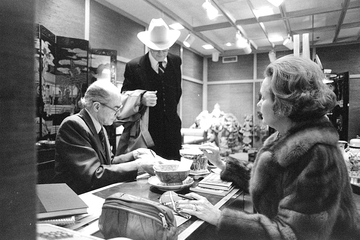
Frederick Wiseman: 'The Store' (1983)

On the one hand (the rich or pretend rich hand): Prada, Saks Fifth Avenue, Escada, Vera Wang, Oscar de la Renta, Dolce & Gabbana, Georgio Armani, Nordstrom, Barneys New York, Bloomingdale's, Net-A-Porter, A'maree's, Bottega Veneta®, Morris & Sons -- Neiman Marcus, and so forth (see also El Corte Inglés in Madrid and Lisbon).

On the other hand (the poor or working class not pretending hand): The Dollar Store, Dollar Tree, Dollar General.

In between, you name it.

All of the above share being stores or product lines, their owners desiring and needing to sell merchandise. All share having customers who in turn desire, want or need to buy stuff with cash money or credit. 

Given this, Frederick Wiseman's in color "observational cinema" documentary The Store (1983) serves as a microcosmic look at all such stores, from the most expensive to the least. 
The Store, along with numerous other Wiseman films, plus a couple of books, is available directly from Zipporah Films -- which is where I acquired a DVD version. Link here: http://www.zipporah.com/

Zipporah's description of The Store

'THE STORE is a film about the main Neiman-Marcus store and corporate headquarters in Dallas. The sequences in the film include the selection, presentation, marketing, pricing, advertising and selling of a vast array of consumer products including designer clothes and furs, jewelry, perfumes, shoes, electronic products, sportswear, china and porcelain and many other goods. The internal management and organizational aspects of a large corporation are shown, i.e., sales meetings, development of marketing and advertising strategies, training, personnel practices and sales techniques.'

Let me add: The Store is also about the architecture and design of massive department stores (rarer now in smaller cities) vs. those of other retailers; anxiety; identity; conspicuous consumption; ennui; desolation; labor; weird, prissy shoppers; changing mores (smoking allowed inside) and fashions (including hideous 1980s outfits, then "the cutting edge" of fashion); depressing store lighting and flooring (the lap of luxury?); the battle for hearts, minds and moolah; and let's not forget The Zodiac® restaurant. 

With no overarching narration and no clear "heroes" to follow, The Store is all the more fascinating to behold.

Today's Rune: The Mystery Rune.