Showing posts with label 1979. Show all posts

Monday, October 08, 2018

Donald J. Raleigh: 'Soviet Baby Boomers' (2012), Part III

Donald J. Raleigh, Soviet Baby Boomers: An Oral History of Russia's Cold War Generation (New York: Oxford University Press, 2012).

Strange phenomenon: making "primitive 78-rpm recordings on used X-ray films." (page 140)

Aleksandr Galich, Bulat Okudzhava, Vladmimir Vysotsky, the latter's songs included "And All Is Quiet in the Cemetery." (pages 142-143)

Voice of America, Deutsche Welle (German Wave) broadcasts (pages 146-147).

Beatles, Rolling Stones, Jazz Hour, etcetera (page 148)

BBC better than Voice of America, to Yelena Kolosova (pages 149-150)

Cuba as romantic inspiration: many of the interviewed Soviet Baby Boomers thought that Castro and the Cubans were cool (just like hepcats and beatniks in "the West" did). "'Cuba, my love, island of crimson dawns.'" (page 151)

Split with China over Cultural Revolution and Damansky / Chenpao Island crisis (page 153), late 1960s. Ready for war, if needed. "'[P]eople think the Chinese are strange.'" (page 155)

As in "the West," Soviet Baby Boomers mostly ignored "the Developing World."  "In 1966 Soviet citizens harbored 'unequivocal disinterest in the 'Third World,' whereas 91 percent of those surveyed were interested in America and admired its technological progress and living standards. Abraham Lincoln and John F. Kennedy were enormously popular, and many believed Americans were much like Russians." (page 158) 

The assassination of JFK was felt as a tragedy and "calamity." Yelena Kolosova: "'Since the assassination, I've had a fierce hatred of Texas. The first time I flew to Dallas, I couldn't overcome that ominous feeling that the tragedy had taken place there.'"  (page 162)

"The Baby Boomers came of age at the zenith of Soviet socialism, only to see the system crumble some three decades later. Ironically, much of this had to do with the Soviet system's very success at effecting social change, whose byproducts included rapid urbanization and a rise in the number of educated professionals." (page 169)

1968 was a turning point of sorts, after the Prague Spring was crushed; things were worsened by the Afghanistan War (1979-1989).

Interesting gender statistics. "In 1970, 86 percent of working-age women were employed (the figure was 42 percent in the United States): 71 percent of the country's teachers were women, 70 percent of its physicians . . ." (page 190). 

Also as of 1970, the divorce rate in the Soviet Union was second only to that in the USA. "Soviet women initiated divorce more than men . . ." (page 201).

Today's Rune: Fertility. 

Sunday, September 25, 2016

'Pilgrim's Progress' (1978) and 'Christiana' (1979)

Ken Anderson made two interesting film versions of John Bunyan's The Pilgrim's Progress from This World to That Which Is to Come; Delivered under the Similitude of a Dream (1678), parts one and two.  He streamlines and slightly alters the story lines and projects the "enemy of your soul" as a semi-comical but still-menacing Devil, aided by three imps in Christiana -- in the simple style of a Medieval morality play. 

Pilgrim's Progress has the whimsical production values of an episode of Captain Kangaroo, with significant improvements however in Christiana

What others might find laughable in technical shortcomings, I find endearing. 

Both movies were filmed in Northern Ireland. Liam Neeson's in his first big celluloid roles is fabulous, providing a calm, assuring presence while mellifluously delivering his lines.

Anderson adopts the use of one actor to play several characters -- the Devil in many guises, and the Good impulse in different people. 

Mr. Great-heart (Neeson) is akin to a bodhisattva (in Buddhism) -- he stays in the world to help people become more enlightened and reach their final goal on pilgrimage.  

Neeson also plays The Evangelist, Help, Mr. Good Will, Mr. Interpreter, Faithful, and even, as in a vision, Jesus Christ crucified. 

I also like Jenny Cunningham as Christiana -- a calm, sympathetic portrayal. Anderson uses her friend Mercy as a representative of the more typical person as she wobbles back and forth between good (moving toward self-actualization) impulses and bad ones (self-sabotage).
The use of one actor to play different characters is sometimes used as a device in soap operas and movies (including The Wizard of Oz), but in these two films Anderson goes full tilt, as if to say that many people are of the same archetype or disposition, avatars of forces "in the world but not of the world."  

What think ye of this strange device? 

Overall, these film "visualizations" are wonderful jaunts that can be seen through several filters ranging from psychology, theology, philosophy, folk tale and mythology. However, beware the creepy use of repetitive voiceover whisperings from time to time.  

Finally, to compare again with The Wizard of Oz, there is a difference in outlook.

Wizard of Oz: there's no place like home.
Pilgrim's Progress: there's no place like heaven.
Wizard of Oz: trek from tornadic whirlwind to the Emerald City.
Pilgrim's Progress: pilgrimage from the City of Destruction to the Celestial City. 

In The Wizard of Oz, Dorothy awakens to herself as if from a dream, at home, with better self-understanding. 

In Christiana, Christiana says good-bye to friends and family and crosses the River of Death to reach the Celestial City, never to return.  

Today's Rune: The Warrior. 

Wednesday, January 06, 2016

Volker Schlöndorff: 'Die Blechtrommel' / 'The Tin Drum' (1979)

It took many years, but I finally consented to re-watch Volker Schlöndorff's Die Blechtrommel / The Tin Drum (1979) -- Schlöndorff's movie adaptation of the 1959 Günter Graß novel. Given the vivid imagery, dark humor, horror and memorably dramatic events depicted in Danzig (Gdańsk) and elsewhere in Europa during the periods before, during and immediately after the Second World War, I found that my memory of the film was in close alignment with how it unfolds during a second look, albeit with the added bonus of a longer director's cut. I can also say more confidently now thanks to more life experience and additional comparison to many other works of art in the intervening years that this is a Schlöndorff masterwork.  
An excellent reason to see The Tin Drum is that it was banned in Oklahoma for many years. Pretty funny considering the film's obvious anti-Nazi illuminations. 
The Tin Drum makes me think of The Pied Piper of Hamelin (Der Rattenfänger von Hameln). You may recall that in the legend, survivors of the Pied Piper's work include a crippled rat and a crippled child, both of whom bear witness to what has happened to their peers. In The Tin Drum, Otto Matzerath, who has decided to stop growing at age three, plays a succession of tin drums until they break and who also likes to shatter glass with a hideous shrieking, is one such character. Another is Musiker Meyn, a trumpet player. Both are themselves part Pied Pipers and part survivors. There is also a madman, a holy fool sort of half-wit, known as Schugger-Leo. In addition, there are observant little people in a circus troupe, particularly Roswitha Raguna and Bebra, their ringleader. All of these fringe characters give much of the story an outsider's perspective that helps spotlight the tribal core's mass psychology -- and mass delusion. 

Finally, let me note the excellent effect on The Tin Drum made by the background music created by Maurice Jarre (1924-2009). Every time I hear wind chimes, I hear echoes of Jarre's work. Hardly an obscure musician, Jarre won three Oscars for original music scores during his career.

Today's Rune: Defense.    

Monday, May 04, 2015

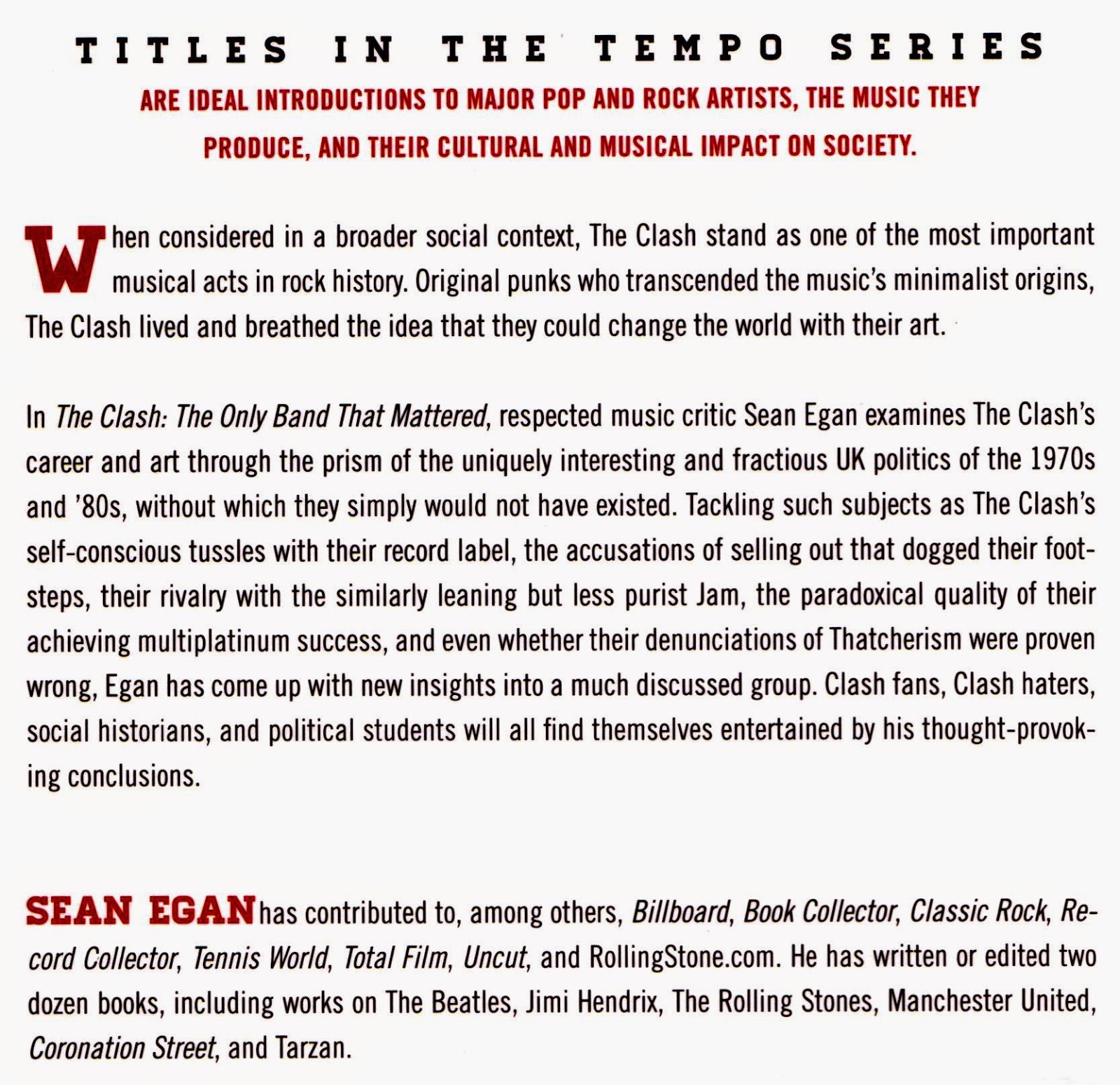
Sean Egan's 'The Clash: The Only Band That Mattered' (2015) - Take Two

Sean Egan's The Clash: The Only Band That Mattered (Lanham: Rowman & Littlefield,2015).

Let's get into some of the nitty gritty. First, the links between reggae and punk. As Egan points out, reggae began to expand globally in the late 1960s and 1970s. One of the big watershed moments of broad consciousness-raising about the style came with The Harder They Come (1972), Perry Henzell's low-budget, mesmerizing Jamaican film starring Jimmy Cliff. "[R]eggae was sometimes a big influence on British punk bands either by osmosis (Johnny Rotten of The Sex Pistols had a long-standing love of the genre) or imitation . . . 'Police & Thieves . . . was The Clash's first foray into the medium, and an unexpected triumph" (pages 35-36).

Next, links with rap, starting in 1980: "'The Magnificent Seven' wasn't quite the first-ever rap recording by a white artist: Blondie's punningly titled 'Rapture' appeared . . . a month before the release of Sandinista!" Egon argues that "'The Magnificent Seven' was the first example of rap being used for social commentary. As it preceded . . . Grandmaster Flash's 'The Message' by two years, it could even be suggested that without [its example], hip-hop would not have embraced the political content from which it is now indivisible" (pages 146-147).

Backtrack, Mr. Egan. Let's not forget James Brown and tracks such as "Say It Loud – I'm Black and I'm Proud" (1968), "Make it Funky" (1971), "Funky President (People It's Bad)" (1974) and so on. How about Sly & the Family Stone's "Thank You (Falettinme Be Mice Elf Agin)" (1969) and Gil-Scott Heron's "The Revolution Will Not Be Televised" (1970-1971)? And back through reggae channels again. Toss in tracks from The Rolling Stones ("Miss You," 1978), Kurtis Blow (1979) and The Sugarhill Gang (1979) and I'd say there's plenty of interplay to spread around, with political content ranging from broad to specific. (Most of these live on through sampling).

What's cool is how memory works: I can remember most of these songs without even playing them again, including virtually every track put out by The Clash. The only true challenge comes when recalling a small bit of music or lyrics, then trying to piece together the origin -- a sort of mix and match endeavor. Can you dig?

Onward!

Today's Rune: Separation (Reversed).

Friday, May 01, 2015

Sean Egan's 'The Clash: The Only Band That Mattered' (2015) - Take One


Sean Egan's The Clash: The Only Band That Mattered (2015) takes an energetic look at the band and its arc. As in another one of my all-time favorites for this kind of book --England's Dreaming, Revised Edition: Anarchy, Sex Pistols, Punk Rock, and Beyond by Jon Savage (St. Martin's, 2002) -- The Clash advances its primary subject across a very comprehensible historical setting. There is thoughtful discussion of the band, its music, paramours, technology, market shifts, vinyl record types and changes in attitudes and reception. It's all in. 

Now that we've been rambling through the first bits of the 21st century, in the USA you can hear music of The Clash being played in supermarkets, bars, restaurants, drugstores, shoe stores, and on digital radio (as I have recently noticed in all these types of venues). Chances are, you will have heard or will hear one of the following tracks: 

"London Calling"
"Rock the Casbah"
"Should I Stay or Should I Go?" (performed live on Saturday Night Live at one point)
"Train in Vain" 

Chances are, you are not hearing one of the following rather more incendiary tracks in public market places:

"Clampdown"
"I'm So Bored with the USA"
"London's Burning"
"Lost in the Supermarket"
"Police on My Back"
"Spanish Bombs"
"White Riot" 

In England, there will be a different public set list, though since the internet came of age, such national market differences have become at least a little less distinctive.


(To be continued . . .)

Today's Rune: Wholeness.  

Thursday, February 27, 2014

Salsa : Latin Music of New York and Puerto Rico

This was originally released as Salsa : Latin Music of New York and Puerto Rico (1979). Part of Jeremy Marre's fantastic Beats of the Heart documentary series, it can now be found in the USA as a DVD on Netflix, Amazon, and elsewhere as Salsa: Latin Pop Music in the Cities. 

As with all of the Beats of the Heart documentaries that I've seen so far, Salsa is fascinating and absorbing. We see and hear vibrant music and musicians set within a wider cultural context. 

Salsa focuses mostly on the Puerto Rican scene. The film's importance has only gained steam since its first release. Consider that as of this post, there are -- according to a plethora of recent census reports and estimates -- about five million souls of Puerto Rican descent living on the mainland US, and another 3.6 million on the US island "commonwealth" of Puerto Rico proper. In other words, in the continental US alone, the Puerto Rican population in 2014 equals that of the entire USA in the year 1800. 

Lest anyone forget, Puerto Rico was seized by the USA as a result of the Spanish-American War of 1898; Puerto Ricans were formally “granted” US citizenship in 1917. The idea of Puerto Rico’s independence, though, has been around since the beginning. Indeed, there is a brief segment in Salsa about the failed pro-independence plot to assassinate US President Harry S Truman in 1950.

Some of the key musicians included in Salsa are: Tito Puente (1923-2000), Charlie Palmieri (1927-1988), Celia Cruz – whose majestic name in full was Úrsula Hilaria Celia de la Caridad Cruz Alfonso de la Santísima Trinidad (1925-2003), Rubén Blades (b. in Panama, 1948), Ray Barretto (1929-2006) and Willie Colón (b. 1950), plus Felipe Luciano (b. 1947) of The Last Poets and The Young Lords.

We also get to see and hear in action special Puerto Rican guitars like the cuatro (I could have sworn they mentioned an “ocho” eight string guitar, too) and syncretized religious themes, particularly Yoruba and Spanish Catholic, i.e. Santería.

Today's Rune: Growth. 

Wednesday, August 21, 2013

Elmore Leonard, RIP

A fond farewell to Elmore Leonard (1925-2013), the writer and the person. It hasn't been but a few days since I unpacked his Cuba Libre (1998) from a box shipped from North Carolina. Oh, yeah. 
And how could I ever forget The Moonshine War (1969)? My sister Vickie took me to see a matinee showing of the 1970 movie version when we were but kids -- Richard Widmark, Alan Alda (yes) and Patrick ("Secret Agent Man" / The Prisoner) McGoohan as the major players -- a sort of foreshadowing of The Omega Man (1971) and Deliverance (1972), which we also saw when they came out. The joys of babysitting. I paid it all forward by taking our younger brother Jamie to see Wise Blood (1979), Apocalypse Now (1979) and The Kids Are Alright (1979). Haha. And the beat goes on. 

Elmore Leonard, RIP.

Today's Rune: Flow.       

Friday, January 18, 2013

The Specials: Dawning of a New Era in the Concrete Jungle


The Specials' first album, produced by young Elvis Costello, came out in 1979; it inspired a lot of musicians in various parts of the world, including in North Carolina, where I lived at the time. The Pressure Boys was one band that comes to mind, right off the top of my two tone head. The Specials album was -- and still is -- an ideal backdrop for social gatherings. The music is wild enough to keep things interesting, quiet enough to keep stray thoughts from evaporating. Particularly in the USA, it's conciousness raising, because the sound draws from the 1960s, fuels it up a notch and mixes in some new stuff. Along with The English Beat (aka The Beat), it's sort of like mixing together some Kinks, ska, reggae, punk and Motown into one holistic milieu.

The Specials' lyrics reflect a sophisticated awareness of British socio-political realities in the 1970s. Just a couple of little samples from "Do the Dog" shows this:

All you punks and all you teds
National Front and natty dreads
Mods, rockers, hippies and skinheads
Keep on fighting 'till you're dead . . .


Who am I to say?
To the IRA
To the UDA
Soldier boy from UK
Am I just a hypocrite?
Another piece of your bullshit
Am I the dog that bit
The hand of the man that feeds it?


(Teds = Teddy Boys; National Front = whites-only neo-fascist party; IRA - Irish Republican Army; UDA = Ulster Defence Association).

And from "Concrete Jungle" (compare with the very different Bob Marley song of the same name):

I have to carry a knife
Because there's people threatening my life
I can't dress just the way I want
I'm being chased by the National Front.


Meanwhile, it's 2013 and Barack Obama is about to be sworn into a second term and on top of that, The English Beat are coming to play Dallas. Yes!

Today's Rune: Signals.

Tuesday, October 23, 2012

Argo


Ben Affleck's Argo (2012) does great work in conveying the sense of dread and volatility surrounding the Iranian Revolution (1979-present) and American and Canadian diplomatic staff trapped in country in late 1979 and early 1980. Beyond this scary milieu, the added excitement is seeing plans conceived and then attempted to extricate six of the Americans without them being killed or imprisoned. I thoroughly enjoyed the ride. Added bonus: learning a little more about the situation then as backdrop to events in 2012 and right on down the pike through 2013 and beyond.


Argo stars Affleck (as CIA operative Tony Mendez), Alan Arkin, John Goodman and Bryan Cranston, among a solid ensemble cast. As additional dramatic backdrop to the events shown in the film, there's Senator Teddy Kennedy's democratic primary challenge to President Jimmy Carter, blamed by Carter himself for his ultimate defeat in the 1980 general election. Kennedy later went on to defeat challenger Mitt Romney in the Massachusetts senatorial race in 1994. Indeed, the ghost of Ted Kennedy (1932-2009) hovers over both Argo and the 2012 presidential election.  


Here's an image of a stamp depicting the original Argo, the mythical ship that transported Jason and the Argonauts during their search for the Golden Fleece. Orpheus went along and saved the crew from the deadly song of the Sirens by playing his own music over them. Orpheus again?  Oh, yes. Argo/argos is derived in its Greek origins from something like "shining," last I checked.

Today's Rune: Joy. 

Tuesday, September 11, 2012

Women Without Men: Behind the Scenes


I keep musing about Shiran Neshat's Women Without Men (2009), made in collaboration with Shoja Azari, based on the 1990 novella by Shahrnush Parsipur and set in Iran in 1953. All the stranger because 1953 is the exact same time frame for the movie discussed in yesterday's post, Next Stop, Greenwich Village. In both films, things are happening against the global backdrop of the Cold War. This is manifested by the Rosenberg executions on June 19, 1953 in the one and in the other, the 28 Mordad coup d'état  (aka "Operation Boot") of August 19, 1953.
The DVD version of Women Without Men (at least the one I saw) includes extras, all interesting. There are samples of other work by Shiran Neshat and Azari, there's a "Behind the Scenes" mini-documentary, and also a Q & A at the Walker Art Center (in Minneapolis) taped on April 16, 2010, featuring Neshat and Azari, both of whom are sharply articulate.  

Here's my jumble of additional notes -- many phrases are direct quotations or paraphrases from Shiran Neshat and Shoja Azari that I jotted down while watching the DVD "extras."
Magic-realism (magical realism)
Parallels, cinematographer Martin Gschlacht
Naturalistic, power of the image
Tableaus -- while keeping the thread of the story
Tracking shots, blocking shots, resurrection shot, from the earth into a pool –
She is a ghost going into the water
Archival footage to recreate the iconic look of the time -- 1953
She could see everyone but they couldn’t see her
Highly stylized film
Party convergence at end
Displacement and exile
Two realistic characters and two unworldly characters
Jesus-Mary Magdalene evocation
Three classes of society
Lower, middle (traditional) and upper
Encompasses worldly and unworldly, political and spiritual
Struggle for survival
Universal connections
A study of the anatomy of a patriarchy
Burden, “patriarchy is at the core of despotism in Iranian society”
The dilemma of freedom
Changes to novella
Munis conceptual -- novella more as stories
A world – inner and outer worlds
Space
Timeless
Tehran 1953 / timeless garden/orchard  Eden / sanctuary, could be life after death
Orchard/garden exile/refuge, uncanny/otherworldly
1953 coup and installation of the Shah by UK and US --- Pivotal moment laying groundwork for Islamic Revolution of 1979
A remembrance of pre-coup Iran
Politicians live by discontinuity
“if you don’t have any location in history you wouldn’t know” the context – the present situation anywhere seems eternal but it is not, it's based in history and subject to change, differing perceptions
Iran was more cosmopolitan, connected to the world culture -- this has been decimated by the '79 Revolution and its aftermath


Film shot in Morocco
Nomadic artists (Shiran Neshat, Shoja Azari, Shahrnush Parsipur, and many others) because denied basic human rights in Iran
Command and clarity, closer to truth – artists still living in country
Hybrid artists – memory, removed from source
Exodus 
Iran in 1953, a nation struggling for egalitarian democracy
Balanced approach
Radio as symbol
Farsi language
Imagery rooted in Persian Islamic literature, art -- and Western (such as Ophelia)
Divided between two worlds
Nomads – a state of in between
An otherworldly place is the orchard garden
Next project may include The Palace of Dreams (Albanian setting)
Today's Rune: The Mystery Rune.   

Wednesday, June 13, 2012

The Ray Bradbury Chronicles


The big push in my Ray Bradbury absorption came as "extra reading" during the year of Mrs. Barlow's Ninth Grade English class, with R is for Rocket, S is for Space and The Martian Chronicles, all of them from home. Before that, I devoured Something Wicked This Way Comes, Fahrenheit 451 and The Ilustrated Man. With friends, there were repeat showings of the movie versions of the last two named books, and a final flourish in 1979: the TV mini-series broadcast of The Martian Chronicles, featuring Darren McGavin of The Night Stalker. I loved it all!

Having not reread any of the books nor rewatched any of the adaptations since the mini-series, they've all remained floating around in my psyche like phantoms, right back to the very first Bradbury book I picked up, Something Wicked This Way Comes. If all books were burned in the near future, these would all be good tales to pass on orally to the next two or three generations. 

The original order of publication hardly mattered to me at the time, but for what it's worth and out of sheer curiosity, I looked them up and found that it goes like this:

The  Martian Chronicles, 1950 (including stories first published in the 1940s).
The Illustrated Man (1951).
Fahrenheit 451 (1953).
Something Wicked This Way Comes (1962).
R is for Rocket (1962).
S is for Space (1966).
Fahrenheit 451 movie directed by François Truffaut, with Oskar Werner and Julie Christie (1966).   
The Illustrated Man movie directed by Jack Smight and starring Rod Steiger (1969).
Michael Anderson's The Martian Chronicles mini-series (1979) -- same director as for Logan's Run (1976 -- a good deal of it, by the way, filmed in Fort Worth, Texas).

Has Ray Bradbury (RIP) done anything similar for you over the years?

Today's Rune: Fertility.  

Wednesday, March 07, 2012

Marianne Faithfull: Dreaming My Dreams, Part II


"I left everything for Mick." So notes Marianne Faithfull of ending things with husband John Dunbar and moving on to the next phase. A trumped up drug bust in 1967 made her notorious in the hands of the tabloid press. How could the pop princess have fallen so low as to hang out with "ponce yobs" like the Rolling Stones?

For just a few years, Marianne and Mick were one of the great couples of the greater music scene. Both worked on songs and also tried movies -- she did The Girl on a Motorcycle (1968) and he did Performance (1968) and Ned Kelly (1970). Marianne also did theatrical work: Anton Chekhov's Three Sisters and Shakespeare's Hamlet, playing Ophelia in the latter. By then, heroin had "helped me become a blank" -- and helped make her Ophelia very convincing, apparently. One of the creative high points of this period was co-composing "Sister Morphine" with Jagger, something she found "particularly lovely."

Faithfull muddled through heroin years and solo recording in the 1970s on into the 1980s. Like Keith Richards, she was resilient and lucky, considering the other casualties among the ranks of their peers. The music played on. It's no coincidence when Richards notes, "She's got some guts, that one."  Though vilified in England, Marianne's music and persona were adopted in Ireland. Her version of "Dreamin' My Dreams" was a hit there, its meaning doubled by the ground situation in Northern Ireland known as the Troubles.

An artistic and critical breakthrough came in 1979 with her album Broken English. One musical peer notes that Marianne Faithfull is a "great lyricist because she reads a lot." She also choose cover songs with care and precision.

By the mid-1980s, Faithfull realized that she wanted to live into the future, and she has, continuing to record and perform music right up to the 2012 present. She also happens to be a good writer and actor.

Today's Rune: Flow.

Saturday, August 06, 2011

Ten Year War to Nowhere


Chinook Down: Earlier today, guerillas shot down a US helicopter in Afghanistan, killing thirty-one Americans and seven Afghan government soldiers. Eight insurgents were also killed in related fighting, according to a Taliban press report. Other guerillas attacked and destroyed sixteen NATO fuel tankers near the Khyber Pass. These incidents are nearly identical to ones reported thirty years ago, only they were Soviets who were killed in the previous incidents, and the insurgents then were more commonly called "freedom fighters" and Mujahideen in Western press reports.

Consider this: In the Soviet War that lasted from 1979 to 1989, Afghan guerillas suffered more than 150,000 killed; civilian losses topped that by several times. The Red Army lost more than 14,000 killed and 50,000+ wounded. That war (or that phase of the meta-war) helped bankrupt the Soviet Empire, leading to its collapse.

The Soviet Union's Afghan allies lost approximately 20,000 killed in the first ten year cycle -- then many thousands more in the Afghan Civil War (Phase I) of 1989 to 1992. The 1992-1996 Afghan Civil War (Phase II) brought the Taliban into power. More fighting continued into 2001; then began the US/NATO phase that has lasted from October 7, 2001 through this very August 6, 2011 post -- and off into the future. Note: Osama bin Laden was killed on May 1, 2011 in neighboring Pakistan. US/NATO killed to date exceed 2,600, with 13,000 plus Americans wounded (the highest in the NATO group).

Finally: The only forces who can/will keep fighting at this cost in terms of casualties and finances are the guerillas. For them it is a cheap war, and there are plenty of recklessly macho volunteers in a permanent pipeline that cost little to train and maintain on the job. The population of Afghanistan is too large to "pacify." It's now pushing close to thirty million -- nearly double the population since 1979, when the Soviets moved in for their long shot at pacification.

Like its predecessors, the 2001-2011 conflict has been a long road to nowhere for all parties involved, but only the Afghans themselves, in all their factions, will decide if and when to end the fighting. I am dubious of a peaceful settlement, let alone a "successful" one. How about you?

Today's Rune: Fertility.

Tuesday, July 12, 2011

Tomorrow Show with Tom Snyder: Once More Into the Mix


Ah, what a treat! Joan Jett, then of the Runaways, sparkles among the talking heads (though Kim Fowley is sharp, as well) during a fraught 1977 discussion about how to receive "Punk and New Wave." In shows from 1981, these three guests come off as erudite and charming: Elvis Costello, Iggy Pop and Wendy O. Williams (Plasmatics). Tom, despite his hangups and preconceptions, gives them their due, and all perform live. Elvis' appearance comes just a couple of weeks after he played in Chapel Hill. Iggy has a tooth missing and a cut lip, drinks a little wine and schools Tom about Apollonian and Dionysian energies. That is, in between frenetic performances of "Dog Food" and "Five Foot One." The show ends with "TV Eye."

Today's Rune: Strength.  

Monday, July 11, 2011

Yesterday's Tomorrow Show with Tom Snyder


Especially since a teen and starting with Johnny Carson, I've occasionally watched late night talk shows most of my life. In the late 1970s and early 80s, I'd come across Tom Snyder's Tomorrow. Now as a little treat, I've been catching some of his interviews with musicians from those years compiled on a two-disc set released in 2006. Snyder sits back with his seventies' vibe, smoking cigarettes and coaxing his guests. The set is intimate, cameras drawn close and tight -- nothing like the glitz of the bigger programs then or now; Shatner's Raw Nerve is the only really comparable venue like it that I can think of, though Charlie Rose and Tavis Smiley take a similar approach. 

So far, Patti Smith (in 1978) has described Johnny Carson as a "human parachute," landing safely on his feet after gaffes and missteps. She is strange and adorable with Tom, who likes her. Then on another night, in an interview I remember having seen at the time in Chapel Hill: Snyder in 1980 sparring with John Lydon (Johnny Rotten) and Keith Levene of Public Image Ltd., which they describe as "a company," not a band. Finally, guest host Kelly Lange (now a novelist) interviews the Ramones -- and they also play a few songs. Great stuff -- raw and entertaining. Iggy Pop and more still to watch. 

Today's Rune: Joy.    

Monday, March 21, 2011

Smoke Signals


Above shot: poster for a 2007 screening of Chris Eyre's Smoke Signals (1998), based on parts of Sherman Alexie's interconnected short story collection The Lone Ranger and Tonto Fistfight in Heaven (1993).  My sister Linda was among the panelists discussing it. Seeing this on a tour of her office at the University of North Carolina at Greensboro recently thrilled me, not only because I like the movie and the book, but also because I've included both in Macomb College English classes -- yeah, synchronicity! Ideal for class discussions and response essays. Highly recommended.

Another good indie film with overlapping themes is Jonathan Wacks' Powwow Highway (1989), based on David Seals' novel The Powwow Highway (1979). Seals also wrote a sequel to the novel and movie, Sweet Medicine (1992).

Today's Rune: Wholeness.