Showing posts with label Buñuel. Show all posts

Thursday, May 10, 2018

Gwynne Edwards' 'Lorca: Living in the Theatre' (2003). Part II

Gwynne EdwardsLorca: Living in the Theatre. London and Chicago: Peter Owen, 2003.

The PublicEl público (1930) -- first professional production, 1987, Madrid: 

"[T]he effect was a remarkably ghostlike setting, the characters existing in some disembodied world, and this was further heightened by the angles of lighting, which often illuminated only the sides of faces or created elongated shadows -- a mysterious, haunting, inner world, the darkened corner of the mind's recesses" (page 57).

When Five Years Pass / Así que pasen cinco años (1931): "Lorca was, for a variety of reasons, highly conscious of the passing of time and the inevitable consequences of this" (page 68). 

"' A great hand's taken her. / It must be the hand of God. / Don't bury me!'" (page 72).

". . . Lorca's play is much more sophisticated and polished than the Buñuel-Dalí film [Un Chien andalou, 1929], however much praise has been lavished on the latter. It [When Five Years Pass] illustrates Lorca's notion of a work of art as a journey, in this case a journey from day-dream and fantasy to bitter disillusionment. And in that respect it also has a coherence and a sense of the author's controlling hand which is at odds with [André] Breton's definition of Surrealism as spontaneous expression, free from the control of reason" (page 75).

Quoting Jan Fairley on the Edinburgh Fringe Festival production of When Five Years Pass in 1989: "Friends and phantoms intermingle so that there is no distinction between reality and fantasy. We are drawn into a constantly shifting present which re-plays itself through the past" (pages 82-83).
Blood Wedding / Bodas de sangre (1931): 

". . . Lorca was acutely conscious, through personal experience and cultural background, that the individual finds himself in an uncomprehending universe and at the mercy of a hostile fate in the face of which his deepest aspirations come to nothing and very often prove to be the source of his own downfall.  His vision is, of course, pessimistic, suggesting a world without hope, but in that sense it is typical of the twentieth century and places Lorca firmly alongside such dramatists as [Eugene] O'Neill, Arthur Miller and Samuel Beckett" (page 112).   

Today's Rune: Initiation.

Friday, May 04, 2018

Jan Němec: 'A Report on the Party and the Guests' (1966)

Jan Němec's O slavnosti a hostech  / A Report on the Party and [the] Guests / The Party and the Guests (1966).  Banned in Czechoslovakia! Director exiled! Such facts make this film all the more compelling. In 2018, brutish leaders are in style again, randomness rules, and all bets are off. In short, this film breathes surrealism with a touch of parable concerning social expectations, management, fear and control. 
A small group of friends are enjoying a picnic in the country. They see a wedding party pass by. Then, a group of men led by an apparent psychopath arrive and make them do absurd things, until a higher up appears and next directs them to a lakeside celebration. However, one of the guests prefers not to stay. He escapes, and is then hunted by a mob while some guests remain at table, putting out candles. 

There's an eerie, unsettling feeling watching this film, the kind you might get reading Flannery O'Connor's "A Good Man Is Hard to Find." Jan Klusák as Rudolf (pictured above) is the most effective actor, projecting volatile menace through buffoonery. He reminds me of the Rip Torn character in Sweet Bird of Youth (1962), an adaption of the Tennessee Williams play, as well as "The Misfit."

Today's Rune: The Self. 

Saturday, January 27, 2018

Henry Fielding: 'The History of Tom Jones, a Foundling' (1749), Part VII - Finale

Henry Fielding (1707-1754), The History of Tom Jones, a Foundling. London: Andrew Millar, 1749.

In which, for now, we end our exploration of Fielding's language, including expressions still employed in the 21st century.

[The novel is divided into eighteen "books" (sections), each with its own chapter numbers starting with "i." References will be made to book number followed by chapter number; parenthetical page numbers correspond to the Modern Library edition published in 1985.]

“Beauty never looks more amiable than in distress.” (XV: ii) (page 785). Compare with Luis Buñuel’s El ángel exterminador / The Exterminating Angel (1962): “Your disarray becomes you.”

“’The Fault is not mine, Madam. It lies in the Dulness [Dullness] of the Age that doth nothing worth talking of. –O la! tho’ now I think on’t, there hath a terrible accident befallen poor Col. Wilcox. – Poor Ned.’” (XV: iii) (page 791)

Mrs. Western: “’Have I not often told you, that Women in a free Country are not to be treated with such arbitrary Power? We are as free as the Men, and I heartily wish I could not say we deserve that Freedom better.’” (XVI: iv) (page 846)

Mrs. Western: “’Lord have Mercy upon all Affairs which are under the Directions of Men. The Head of one Woman is worth a thousand of yours.’” (XVI: v) (page 848)

Mrs. Western: “’Do you think yourself at Liberty to invade the Privacies of Women of Condition, without the least Decency of Notice?’”  (XVI: vii) (page 861)
 “Reverse of Fortune” (XVII: viii) (page 900)

Jenny Jones, assuring Tom Jones that he has not killed Mr. Fitzpatrick in a duel, only wounded him a little: “’Pugh,’ says she, ‘you have pinked a Man in a Duel, that’s all.’” (XVII: ix) (page 911)

“’I tell thee ‘tis all Flimflam. Zoodikers!’”  (XVIII: xii) (page 974).

Today's Rune: Fertility. 


Wednesday, June 07, 2017

'The Complete Stories of Leonora Carrington' (2017)

The Complete Stories of Leonora Carrington. Inroduction by Kathryn Davis. Translations from the French by Kathrine Talbot (and Marina Warner), and from the Spanish by Anthony Kerrigan. St. Louis: Dorothy, a publishing project, 2017. 

Published on the occasion of the centenary of the birth of Leonora Carrington (April 6, 1917-May 25, 2011).

As the back cover quip by surrealist Spanish filmmaker Luis Buñuel notes of Leonora Carrington's stories: "Her delirious fantasy reveals to us a little of the secret magic of her paintings." 

The collection is divided into three main sections: 
THE HOUSE OF FEAR (six stories)
THE SEVENTH HORSE (sixteen stories)
PREVIOUSLY UNPUBLISHED (three stories)

These strange tales are made stranger still by Carrington's understated approach to the macabre. We are invited into her dreamscape and become as if characters in her visual art. Is this a dream or a nightmare? 

Here's a brief snippet from "Monsieur Cyril de Guindre."  Make of it what you will:

     '"Precious mummy," he murmured, laughing. "Who knows? Won't you have fun after all?"
     Slowly he went down the marble staircase.' (page 82).

One of the eeriest stories is "Pigeon, Fly!" There is supposed to be a song with this title, but so far all I can find along these lines is Elton John's (and Bernie Taupin's) "Skyline Pigeon." I'll keep looking. 

But here is a sentence from the story version: "I followed the enormous walking wig like a sleepwalker." (page 66). Who knows? Maybe soon, you will, too. 

Today's Rune: Flow. 


Saturday, December 31, 2016

Akira Kurosawa's 赤ひげ / 'Red Beard' (1966)

Akira Kurosawa's 赤ひげ / Red Beard (1966) is a meticulously crafted film, an example of cinema as a masterful art form in its own right that includes elements of fiction, poetry, visual art and architecture but is also distinctive. The aesthetics of black and white film (this was Kurosawa's last before shifting to color) allow one to focus on shadow and form as well as sound. Kurosawa is a master filmmaker and one need not understand Japanese to appreciate his works. Indeed, as in the most moving silent films, many of Kurosawa's shot compositions illuminate the power of facial expressions and, in particular, the look of a person's eyes. Kurosawa's work is very satisfying aesthetically and I'm learning a great deal about technique in reviewing his films.
I have never really understood modern medical doctors, their motivation or disposition, but Red Beard makes me wish we had in the everyday now many more such as these doctors from 200 years ago, working hard at a Japanese medical clinic. 

The title character, Dr. Kyojō Niide (played by the always memorable Toshiro Mifune), frequently strokes his beard which is, though we see him in black and white film only, red. One can readily compare his character with Atticus Finch, as played by Gregory Peck in To Kill a Mockingbirdan American film made in the same decade as Red Beard, though the good doctor is a bit gruffer than the lawyer. Just as Atticus takes up a rifle to shoot a threatening rabid dog, Red Beard has a scene in which he opens up a can of whoop-ass on a threatening group of hooligans in a courtyard outside a brothel.

Red Beard approaches his patients, most of them poor, in a holistic manner, strengthening the body, mind and spirit of each when it's still possible to help. He works patiently and effectively with people afflicted by fevers, alcoholism, mental illness, "spiritual scalding," and physical wounds. His holistic approach could be put to good service in the 21st century.
Blanket airing on left is of the same pattern as the one in the top image
Red Beard is based on Shūgorō Yamamoto's The Tales of Dr. Redbeard (1958), plus an additional thread from Fyodor Dostoevsky's Humiliated and Insulted (1861).
Red Beard has heft as well as breadth. In flashback sequences (which sometimes remind me of surrealistic Luis Buñuel flashbacks), there is a landslide and the aftermath of an earthquake. In one sequence, we can see a character stumbling around in the foreground while at the top of the screen a line of people exit the "stage." Having experienced firsthand the nightmarish devastation of the Pacific War that ended with Hiroshima and Nagasaki, and having earlier lived through a massive earthquake, Kurosawa is deep diving through these scenes.
There's another sequence that begins with a strange chanting, a beckoning to the underworld to spare an imperiled young boy's life, that ends with a visual shot from the perspective of the bottom of a well, a water-reflection of the people shimmering above -- a mind-blowing achievement. 

Today's Rune: Harvest.

Sunday, March 29, 2015

The Eyes of Texas: T Bone Burnett at the Lone Star Film Festival (2010)

In remembering that T Bone Burnett had brought up Marshall McLuhan during the 2010 Lone Star Film Festival in November, 2010, I dug up my notes from his talks. Saw him at three different venues on or around November 13, 2010. These scribbles were made during T Bone's interview with Bobbie Wygant. 

T Bone has worked on many projects, ranging from his own albums to the music for Coen Brothers' films (The Big Lebowski, O Brother Where Art Thou?, Inside Llewyn Davis) to Walk the Line and Crazy Heart.

Bobbie Wygant asked T-Bone about his inspirations while living in Fort Worth, Texas.

There was a place called the Capri Theatre and they showed [Luis] Buñuel films and [Jean-Luc] Godard films and [Federico] Fellini films and [Sergei] Eisenstein and [Akiro] Kurosawa . . . these incredible foreign films in Fort Worth, Texas, & it was like a portal into another universe . . . I appreciated it so much. I learned. I would say it was through these two places, the Capri Theatre and Record Town, that I sort of learned everything I've lived my whole life on.

[My 2015 update]: The Capri (which also went by other names) was torn down I think in the 1980s. Nothing has replaced it. Fort Worth needs independent "art house" theatres -- at least one, for God's sake. Fort Worth's three major art museums are wonderful resources, and "Magnolia at the Modern" screens independent and international movies on weekends. However, new art does better in less controlled, contained or restricted environments; that is, via more free-wheeling & Bohemian focal points.

At another venue in 2010, T Bone Burnett spoke of his agreement with Marshall McLuhan, that a new medium envelopes an old medium and lifts elements of the old medium into higher art forms.

Examples: TV becomes more engaging when eclipsed by the internet (The Sopranos, etc.); analog music (vinyl record technology) becomes more absorbing when made obsolescent by digital music. 

Let's be mindful that we are surrounded by an electronic envelope of many layers. 

There's more, but that's a taste of it.

Today's Rune: The Self. 

Sunday, November 16, 2014

Fernando Meirelles and Kátia Lund: Cidade de Deus / City of God (2002)

Cidade de Deus / City of God (2002), Fernando Meirelles and Kátia Lund's film based on Paulo Lins' novel -- both grounded in historical and contemporary reality -- causes chills (and evokes empathy) in its observations of life and death in the vortex of drug-and weapons-fueled urban street warfare. Set in the favela of Cidade de Deus that straddles Rio de Janeiro, Brazil, it's an excellent, if often horrifying, film, spanning the latter 1960s to the early 1980s.    
Cidade de Deus / City of God (2002) is like a combination of Lord of the Flies (the 1954 novel and subsequent movies) and A Clockwork Orange (the 1962 novel and later film) - only with heavier weaponry and more widespread violence. Above all, it has the feel and texture (albeit in full color) of a Luis Buñuel masterwork released in 1950 - Los Olvidados [The Forgotten Ones]. 
Age is no barrier to becoming a trigger-happy monster like Li'l Dice here. As Li'l Zé Pequeno, he grows up to become an Al Capone of the favela.

I saw, too, Notícias de uma Guerra Particular / News of a Private War (1999) -- the accompanying documentary by Kátia Lund -- which is also excellent. It brings us up to date to the end of the 20th century. 

Both films remind me of comments made by Frederick Douglass in 1886:  

"Where justice is denied, where poverty is enforced, where ignorance prevails, and where any one class is made to feel that society is an organized conspiracy to oppress, rob and degrade them, neither persons nor property will be safe." 

Today's Rune: Harvest. 

Sunday, September 14, 2014

Pedro Almodóvar: Hable con ella / Talk to Her (2002)

Pedro Almodóvar's Hable con ella / Talk to Her (2002) gives us a vivid, offbeat tale revolving around four main characters -- a matadora, a travel writer, a ballet dancer and a male nurse. It's a strange one. Lydia González (played by Rosario Flores) is the bullfighter (reflecting reality: there have been several, for example Conchita Cintrón, 1922-2009, and Cristina Sánchez, b. 1972). Marco (Darío Grandinetti), the writer, develops a romantic relationship with her and a friendship with Benigno (Javier Cámara), the male nurse who also happens to be a sort of "weirdo" and is now caring for Alicia (Leonor Watling), who in turn had already been "that obscure object of (his) desire," as Luis Buñuel donned such fetish-making for the title of his final film in 1977.   
What I particularly like about Talk to Her is its incisive demonstration of Spanish manners and social relationships; that and a memorable visit to Córdoba, during which Almodóvar pays meticulous attention to Lydia as she suits up for her final bullfight. All in all, it's a wild journey through time and place, roaming right into a plazas de toros of not always quite predictable results. 

Today's Rune: Gateway. 


Thursday, April 25, 2013

On the Road/Off the Road: Susan Elizabeth Phillips and Andrew McCarthy


I had the good fortune of attending the opening author session at the Texas Library Association conference in Fort Worth, a luncheon held at the Omni sponsored by the Library Friends, Trustees, and Advocates Round Table. Featured one after the other were Susan Elizabeth Phillips and Andrew McCarthy, both of whom were sharp, engaging and charming.


Phillips quipped that Texas is a great gift to writers -- she can make her characters do just about any crazy thing and readers will find it believable. McCarthy told, among other things, of being inspired by Jack Hitt's Off the Road: A Modern-Day Walk Down the Pilgrim’s Route into Spain (1994, 2005) to head off on a multi-faceted existential journey, resulting in The Longest Way Home: One Man's Quest for the Courage to Settle Down (Free Press, 2012).

Today's Rune: Journey.   

Thursday, February 28, 2013

Michelangelo Antonioni: L'eclisse / Eclipse (Part I)


Michelangelo Antonioni's  L'eclisse / Eclipse (1962) is an excellent antidote to the speed of life. Everything, even the Italian stock market, is slowed down and looked at with observant eyes. Antonioni seems to particularly enjoy contemplating rustling leaves, the way the wind moves things around, the way a fan blows air onto a woman's hair, a person's clothes. Fantastic black and white shot compositions, deliberately slow pace, intense interactions among people and architecture and space, both interior and exterior. You soon come to realize this is reminiscent of a horror film, only without horror, unless by horror you mean human existence itself. This is David Lynch country without any physical violence. Wonderful stuff so far. 


As far as plot, not much has happened yet. Vittoria (Monica Vitti) leaves Ricardo, her compadre (Francisco Rabal -- who is terrific as the title character in Luis Buñuel's 1959 outing Nazarin, among many other films). Ricardo tries to change her mind and seemingly fails. She wanders around, shows up at the stock exchange, a noisy madhouse -- until a long moment of silence is delivered for a stock broker who has just died of a heart attack. Vittoria's mother is there, absorbed by stock trading and money. So is Piero (Alain Delon), a stock broker aquaintance who wins a gamble. They go outside, and Vittoria wanders through a section of Rome.

[To be continued].

Today's Rune: Partnership.

Sunday, December 23, 2012

Domingo Martinez: The Boy Kings of Texas


I'm about halfway through The Boy Kings of Texas: A Memoir by Domingo Martinez (Lyons Press, 2012). So far, it covers the author's family milieu near Brownsville, Texas, through his own teen years. There's a lot to take in.

With this kind of memoir, the reader (this reader, specifically) bounces off the narrator's stories and observations with memories from personal experience, family experiences, upbringing, geography and culture. What is not at first recognizable becomes a learning experience, paralleling the arc of the narrator as his own conciousness expands, as he comes to know more about the wider world.

There are plenty of vibrant (and sometimes grotesque) real-life characters in The Boy Kings of Texas. The grandmother is a real pisser, tough as nails, in some ways a connection to the rural past, in others, going with the flow of new ways and means of living. For the narrator and his siblings, there's a lot about identity -- American? Mexican American? Part of a group, individual agent, or how much partly both? Stay or go far away? Deal with various family crises or flee out of self-preservation?

To some extent, I'm reminded of several of Luis Buñuel's Mexican films of the late 1940s through early 1960s. Like Buñuel's work and no matter how else you cut it, The Boy Kings of Texas is interesting, and revealing. I'm digging it.

Today's Rune: Journey.

Wednesday, September 19, 2012

Lina Wertmüller: Ciao, Professore!


Lina Wertmüller's Ciao, Professore! / Io speriamo che me la cavo (1992) takes a mostly comic look at a classic situation in which cultures and socio-economic classes collide in Arzano, a small city just north of Naples in Southern Italy. It's based on Io speriamo che me la cavo. Sessanta temi di bambini napoletani, a non-fiction book compiled and edited by Marcello D'Orta, first published in 1990, that revolves around actual grade school essays written by several of D'Orta's pupils. Some of these make their way into the film. The kids are super-worldly for the most part, way more street wise than the typical third grader, one suspects.* A lot of them have to work because of home situations, many out of necessity in the black market.


In the movie, Professore Sperelli (Paolo Villaggio) arrives in Arzano from Northern Italy and then strives to do his job well locally. He ends up learning as much (or more) from his students as they from him while we all learn more about Italy and the modern world.

There's almost always a built-in storyline when cultures collide. There's so much rich material that lends itself to comedy in movies and books like Ciao, Professore! -- and tragedy in other works -- just as in life throughout history and around the globe. Here we have North and South Italy, but it could just as easily be set in the USA, or even within an individual state like Michigan ("Up North" contrasted with "Southeast Michigan" aka Detroit and its environs, or as opposed to "Western Michigan."). It could be set in England (London, the South and the North Country) or Germany (Bavaria and the Baltic or North Sea coast). Luis Buñuel inserts jokes about South-North differences in several films, whether set in Mexico, Spain or France. Clearly, cultural nuances and varieties make for a lot of interest. Why else would we travel? Indeed, why else would immigration and migration be such a big deal if such were not the case? 

*To quote from one pupil's essay on Switzerland:

Switzerland sells arms to the whole world so they can kill each other, but Switzerland doesn't ever have even a small war. They build banks with all their money. But not good banks. The banks are for bad persons, especially drug addicts. Criminals from Sicily and China put their money in these banks. The police go and ask, Whose money is this? and they say I don't know, I'm not going to tell you, it's none of your damn business, the bank is closed. But the bank is really open!!  (For the whole essay, see http://www.napoli.com/english/blog26.php)
  
Today's Rune: Protection.  

Saturday, September 08, 2012

Luis Buñuel's Subida al cielo / Ascent to Heaven, Take II


Surreal scenes in Subida al cielo are peppered throughout, but the most dramatic ones include a sequence involving Oliverio Grajales (Esteban Márquez), his new bride, Raquel (Lilia Prado) the "Bible vixen," and various members of the bus, including the man with a peg leg, on musical instruments. In this vision, Oliverio's mother is literally perched atop a pedestal -- while Oliverio fantasizes about throwing his wife in a lake (in a comical, not harmful way) and hooking up with Raquel in the lush Edenic garden sprouting inside of the otherwise empty bus.

Another surrealist strand is carried by the Congressional candidate. In one scene, he is expecting to meet a parade that he thinks will bestow upon him victory, but is instead met by an advancing parade led by the opposition -- like a scary anxiety dream, or a Mob scene (a mobster thinks he's about to be promoted and is instead attacked).

Newlyweds are proceeding by boat to an offshore island to consummate their marriage when they are suddenly interrupted by a brother on a larger boat carrying an urgent message from their Mamá.

Jovial bus driver Silvestre (Luis Aceves Castañeda) takes his passengers on a detour to fete his Mamá (who is expecting them), and they are later joined by a passing tour bus filled with Americans donning Shriner hats and carrying cameras.

The main passenger bus itself occasionally looks like a toy bus teetering in the mountains -- deliberate surrealism or a lucky accident due to modest budget?

Today's Rune: Movement.   

Friday, September 07, 2012

Luis Buñuel: Subida al cielo / Ascent to Heaven, Take I


Pleased to have gotten a copy of Luis Buñuel's Subida al cielo / Ascent to Heaven / Mexican Bus Ride (Mexico 1952; USA 1954).  It's a wonderful small budget film, so matter-of-fact, so low-key, yet a microcosm of the entire world.

The film begins and ends in a small Mexican coastal village. In between is an existential bus ride to a distant city across wild terrain. The bus is populated with archetypal characters such as a congressional candidate, a pregnant woman, a callow new husband, a Bible vixen, a jovial driver, a veteran mother and kids, a man with a peg leg and a variety of farm animals. Despite its billing as such, Subida al cielo / Ascent to Heaven / Mexican Bus Ride is not a comedy, exactly, although there are strong elements attendant to the tradition of the comedy of manners. Overall, though, it takes in the whole human condition, including acknowledgement of tragedy and absurdity, primal actions and random chance.

There is also a central story arc: Oliverio (the earnest newlywed), at the behest of his bedridden mother, must make an epic bus trek in order to secure her dying wishes, thereby preventing his greedy brothers from taking everything against her will. Oliverio's bride has been left with his mother and little cousin, while he faces the seductions of the Bible vixen and a race against time.

Here in Buñuel is a man who knows his Bible stories well, thanks to a Jesuit education. Of course, familiarity with these stories in the hands of such a subversive visionary make for some interesting threads and twists to look out for.

Today's Rune: Movement.            

Monday, August 27, 2012

Shirin Neshat: Women Without Men, Take II


Shirin Neshat's Women Without Men (2009) reminds me in a good way of the work of several other favorite filmmakers, including Luis Buñuel, Costa-Gavras, Deepa Mehta and Gillo Pontecorvo. Intentionally or not, it seems as if Women Without Men is paying homage to, having a dialogue with and picking up from where these others left off in past films, while adding additional concerns.  

 This scene could be captioned Men Without Women. Here, uniformed men with guns chase men in white shirts with knives and a flag. "What immortal hand or eye / Could frame thy fearful symmetry?" It's a scene very reminscent of something from a Costa-Gavras or Pontecorvo film, with detailed emphasis on composition and contrast. Comparative examples: La battaglia di Algeri / The Battle of Algiers (1966), Z (1969), Queimada / Burn! (1969) and Missing (1982).      


Here, Faezeh (Pegah Ferydoni) walks alone down a deserted road, a scene that's repeated in variations during the course of the movie. Anyone familiar with Luis Buñuel's 1972 Academy Award-winning surrealist masterpiece Le charme discret de la bourgeoisie / The Discrete Charm of the Bourgeoisie would recognize very similar imagery in that film. But there is a key difference, and the clue is in the titles: Shirin Neshat's Women Without Men emphasizes women and gender roles while Buñuel's is emphasizing socio-economic class. Also, Buñuel employs humor and satire whereas Neshat employs forlorn beauty and stark tragedy. The sensual feel of Neshat's film is more akin to Deepa Mehta's Fire (1996) Earth (1998) and Water (2005).  

Today's Rune: Initiation.           

Monday, August 06, 2012

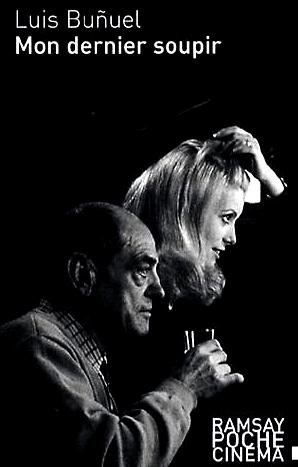
Luis Buñuel: Mon dernier soupir


Thorougly enjoying Luis Buñuel's Mon dernier soupir (1982) / My Last Sigh (1983). The version I'm now reading is the University of Minnesota Press edition, Abigail Israel translation, 2003. "Jean-Claude Carrière . . . An attentive listener and scrupulous recorder during our many long coversations . . . helped me write this book" -- from the preliminaries. 

Buñuel (1900-1983) comes at things from an interesting perspective. He was born in a Spanish village that retained Medieval rhythms for many centuries. He experienced that lifestyle, followed by the bulk and tumult of the 20th century, starting with the Great War of 1914-1918, proceeding through the Spanish Civil War, the Second World War and the Cold War. He was a boy at the dawn of the cinema and eventually became a master at making movies right into the 1970s, stopping just long enough for this "last sigh" of a memoir. The things he saw and the changes he lived through must have been astonishing -- luckily he goes into some of them here.  

Another thing that becomes clearer from Buñuel's description is how much the Spanish Civil War seems remarkably like the Greek Civil War and the Russian Revolutions and Civil War, how like the Mexican Revolution, the Irish Civil War and also how like today's Syrian Civil War. People like to divide and fight. We're digital people with analog dreams. Buñuel gets at this also in La mort en ce jardin / Death in the Garden (1956) and Jean-Luc Godard does it in Les Carabiniers / The Carabineers (1963). Beyond the artists, though, as George Santayana put it, "Only the dead have seen the end of war" (1922).  

Today's Rune: Protection.    

Sunday, August 05, 2012

The Eyes Have Wings


I'm not big on making lists of top this or that, Jimi Hendrix vs. Guitar Player X, yadda yadda yadda, but if I did have to list three of the "most interesting" directors "in the world" since the beginning of film, motion picture shows, cinema and the movies, I'd place Luis Buñuel (1900-1983) in there, Jean-Luc Godard (b. 1930) and Werner Herzog (b. 1942). As of right here, right now. And I do have reasons. There may be others as worthy, but if so I haven't seen enough (or any) of their films yet. Am I missing anybody?  


Today's Rune: Fertility.