Showing posts with label 1992. Show all posts

Tuesday, September 09, 2014

Lee Smith: The Devil's Dream

Lee Smith's The Devil's Dream (originally published by G. P. Putnam's Sons in 1992) covers an Appalachian family's multi-generational arc from from the 1830s through the 1960s or thereabouts.  

The main dilemma for many of the characters is: 


Should I stay or should I go?


And, closely related: 


Should I adhere to music, or shun it?


And:


Should I follow the belief system I was born into, discard it, or modify it as I go along?


Around the world -- then and now and most likely well into the future -- many say "Music is the Devil's work. A sin." Frown. Some will say, "gospel music -- good." All other kinds of music -- "bad." Add alcohol and whatnot into the matrix, and you hear more of the same, only in even more outlandish tones. In some places, your very head is at risk depending on what you do or believe. 


I knew a Dunker from West Virginia who said that salt was sinful, alcohol evil, but NASCAR ok. This was his interpretation of the gospel life, as guided by the Holy Ghost. 

The Devil's Dream (which is also the name of a fiddle tune going back maybe 200 years) inspires me to think of various social archetypes that address that existential quandary, "Should I stay or should I go?" It's almost comical when you think in terms of such identifiable archetypes.

In no particular order, there are:


a. Those who stay in one place and never leave.


b. Those who stay in one place but travel some, near or far (including perhaps a stint of military service or some such).


c. Those who stay in one place but annually or seasonally migrate to another place or two, such as live in the mountains but migrate to the seaside or vice versa.


d. Those who migrate from place to place, travel around and periodically visit the old places.


e. Those who leave their place of origin and never come back.


I know and have known all of these archetypes, in the guises of real people. I'm pretty much of the "d" variety. How about you? 


Another thing I want to tackle thanks to The Devil's Dream is race and ethnicity in the Appalachians -- from the Melungeons to the Black Dutch, from the Black Irish to the Cherokee Nation -- and beyond. Brace yourself.


Today's Rune: Fertility. 

Monday, September 02, 2013

Frida Kahlo: A Ribbon Around a Bomb

Checked out a wild and engaging one hour film, Frida Kahlo: A Ribbon Around a Bomb (1991). It consists of a vigorous and vividly colorful combination of documentary, paintings, music and theatre, befitting Frida Kahlo's extraordinary arc.
The verso of the DVD notes: The film is based on the life of Mexican painter Frida Kahlo, who lived from 1907 to 1954, and has become an international cult figure. Weaving excerpts from Teatro Dallas' production of Abarham Oceransky's play, The Diary of Frida Kahlo, with poetry, music, interviews with Kahlo's students and friends and, most importantly, her artwork, the film transcends straight biography to create a passionate, impressionistic portrait of an artist whose life and work, both tragic and triumphant, increasingly speak to the sensibilities of today.

Note: dainty people (especially kids) may find some "earthy" language and content disturbing.

Starring: Cora Cardona and Quigley Provost. Director: Ken Mandel. Itzcuintli Films.

Today's Rune: Wholeness.  

Sunday, July 14, 2013

Zen in the Art of Writing (Take I)


Ray Bradbury's Zen in the Art of Writing (1990, 1992) provides an entertaining and energetic primer for just about any interested party. It's infectious. Read a handful of pages and you come away brimming with ideas, rearing to go.

Try this one for size: "You must stay drunk on writing so reality cannot destroy you."  Amen to that!

Q: "What are the best things and the worst things in your life, and when are you going to get around to whispering or shouting them?"

And, apropos of the Martin-Zimmerman encounter: When was the last time you were stopped by the police in your neighborhood because you like to walk, and perhaps think, at night? It happened to me just often enough that, irritated, I wrote 'The Pedestrian,' a story of a time, fifty years from now, when a man is arrested and taken off for clinical study because he insists on looking at un-televised reality, and breathing un-air-conditioned air. . . (page 6).

Finally, there's THE LIST, an unfolding group of nouns (sometimes with modifiers) -- providing a lifetime of evolving ideas . . . not unlike Twyla Tharp's "pretend you're a verb" strategy for the longterm.

Here's to staying drunk on writing. Huzzah!

Today's Rune: Fertility.   

Friday, March 08, 2013

David France: How to Survive a Plague (Part I)


If, as Frederick Douglass put it in 1857, "power concedes nothing without a demand," David France's How to Survive a Plague (2012) shows an immediate demand -- faster, more effective response to the AIDS crisis, more resources for effective treatment --  via well-organized groups ACT UP (AIDS Coalition to Unleash Power) and its 1991 spinoff TAG (Treatment Action Group). Much of this compelling documentary covers the late 1980s and first half of the 1990s. In it, one will see not only the rank and file of ACT UP and TAG and their allies, but also buffoonish conservative enemies like North Carolina Senator Jesse Helms, and let's not forget the mixed response of Pat Buchanan on Firing Line. Also: see George H. W. Bush, Bill Clinton and Charlie Rose, among many others, drawn into the maelstrom. 

How to Survive a Plague is moving, fast-paced and exhilarating all at once. Fantastic!

Today's Rune: Signals.     

Monday, November 26, 2012

Chapel Hill, North Carolina: West Franklin Street 3


Among other places, I ducked into Internationalist Books at 405 West [Benjamin] Franklin Street over Thanksgiving Break. This Chapel Hill cultural institution was founded by Bob Sheldon in the early 1980s, orginally over on Henderson Street above the then-location of Linda's Bar. Hector's, a Greek (and Trojan) hangout, was next door.

Bob moved into a bigger space at 408 West Rosemary Street, behind (north of) Franklin, about a year later. That's the one I worked at while still an undergraduate student at UNC. Bob also graciously permitted the Internationalist to be utilized as a meeting and yakking place and staging point for ad hoc protest groups, such as the one I joined to march and occupy Republican Congressman Bill Cobey's office with in 1985.

Now, in 2012 at the latest incarnation of Internationalist Books, I bought some artwork and chatted to a new worker about more recent goings on, and about Bob. 

To the right on the fringe of the picture above is the front of a record store, another still thriving Chapel Hill tradition.  


On the top shelf of this scanned image from inside Internationalist Books is a photo of founder Bob Sheldon, who was killed on February 21, 1991. The 1992 song "Chapel Hill" by Sonic Youth is loosely based on his death.

A salute to Bob and the Internationalist Books community!

Today's Rune: Journey.   

Tuesday, November 13, 2012

Welcome to Sarajevo


Michael Winterbottom's Welcome to Sarajevo (1997) looks at the Bosnian War (1992-1995) from the point of view of journalists who placed themselves in an up-close position to cover the bloodletting, and from the perspective of "ordinary" Bosniaks caught up in the mayhem. Coupled with Jean-Luc Godard's Notre Musique (2004), I found it to be conciousness-raising and valuable as a testament to recent historical events.

There's no doubt where Winterbottom's film stands on Serbian forces: they are the main aggressors here. Archival footage is interwoven with later filming in an effective way to incorprate some of the atrocities committed by Serbs. We also see a belated international response, with UN peacekeepers making some strides in better protecting civilians. Also, US 1992 Democratic presidential candidate Bill Clinton comes off better than President George H.W. Bush, and for good reason given their differing appraches to the conflict.

As in Syria, Iraq and elsewhere, the Bosnian War is most accurately understood as a painful disaster and human tragedy. In Welcome to Sarajevo, because the war is ongoing, the tram lines are destroyed and there's little thought of rebuilding yet, which is contrasted in the post-war film Notre Musique, when the trams are running again and the Mostar Bridge is nearly restored.


Ensemble acting is solid in Welcome to Sarajevo. Cast includes a couple of American stars (Marisa Tomei and Woody Harrelson) who play it low-key. Also, there's Croatian actor Goran Višnjić, Emira Nusevic, Stephen Dillane, Harriet Fox, Juliet Aubrey, Emily Loyd, Igor Dzambazov and Davor Janjić. Soundtrack is good and includes a well-placed song from the Rolling Stones ("Waiting On a Friend"). 

Today's Rune: Gateway.      

Saturday, November 03, 2012

Jean-Luc Godard: Notre Musique


Jean-Luc Godard's Notre Musique (2004) is set in Bosnia-Herzegovina less than ten years after the Bosnian War (1991-1995), a savage conflict involving three main factions: Bosnians, Croatians (Croats) and Serbians (Serbs). Sounds and images of significant contemporary documentary value depict street scenes in Sarajevo and Mostar. Without getting into the film proper (yet), a primary image that leaps out from the film is the functioning electric tram. Here it is so soon after the bloodletting, yet trams are humming along.

I couldn't help but think how Detroit used to have a major streetcar/trolley system and may again; how in Fort Worth, Texas, there is currently a discussion over reinstalling trolleys along 7th Street and other thoroughfares. In 1907, there were sixteen streetcar lines in Fort Worth. Today, Dallas runs trolleycars and other light rail, as do other North American cities such as Philadelphia, New Orleans, San Francisco, Mexico City and Toronto.

What does the electric tram represent in Notre Musique? I'm not sure, but it's worth remembering that Orpheus is a tram conductor and the god Hermes runs a tram station in Marcel Camus' Orfeu Negro/Black Orpheus (1959). Perhaps the electric tram represents a hope for the reconstruction of a well-woven social fabric after periods of mass violence and destruction, the kind that makes one think of Syria today, or the Gordian Knot of Israeli-Palestinian relations, which is another key topic in Notre Musique. Or perhaps it's simply making some of notre musique -- "our music."  

Today's Rune: Possessions.         

Wednesday, September 19, 2012

Lina Wertmüller: Ciao, Professore!


Lina Wertmüller's Ciao, Professore! / Io speriamo che me la cavo (1992) takes a mostly comic look at a classic situation in which cultures and socio-economic classes collide in Arzano, a small city just north of Naples in Southern Italy. It's based on Io speriamo che me la cavo. Sessanta temi di bambini napoletani, a non-fiction book compiled and edited by Marcello D'Orta, first published in 1990, that revolves around actual grade school essays written by several of D'Orta's pupils. Some of these make their way into the film. The kids are super-worldly for the most part, way more street wise than the typical third grader, one suspects.* A lot of them have to work because of home situations, many out of necessity in the black market.


In the movie, Professore Sperelli (Paolo Villaggio) arrives in Arzano from Northern Italy and then strives to do his job well locally. He ends up learning as much (or more) from his students as they from him while we all learn more about Italy and the modern world.

There's almost always a built-in storyline when cultures collide. There's so much rich material that lends itself to comedy in movies and books like Ciao, Professore! -- and tragedy in other works -- just as in life throughout history and around the globe. Here we have North and South Italy, but it could just as easily be set in the USA, or even within an individual state like Michigan ("Up North" contrasted with "Southeast Michigan" aka Detroit and its environs, or as opposed to "Western Michigan."). It could be set in England (London, the South and the North Country) or Germany (Bavaria and the Baltic or North Sea coast). Luis Buñuel inserts jokes about South-North differences in several films, whether set in Mexico, Spain or France. Clearly, cultural nuances and varieties make for a lot of interest. Why else would we travel? Indeed, why else would immigration and migration be such a big deal if such were not the case? 

*To quote from one pupil's essay on Switzerland:

Switzerland sells arms to the whole world so they can kill each other, but Switzerland doesn't ever have even a small war. They build banks with all their money. But not good banks. The banks are for bad persons, especially drug addicts. Criminals from Sicily and China put their money in these banks. The police go and ask, Whose money is this? and they say I don't know, I'm not going to tell you, it's none of your damn business, the bank is closed. But the bank is really open!!  (For the whole essay, see http://www.napoli.com/english/blog26.php)
  
Today's Rune: Protection.  

Wednesday, July 11, 2012

Ritz at the Bourse: Black Lizard, January 26, 1992

I'm really excited at the prospect of new art house independent film venues in Fort Worth, Texas, because as things are, there aren't any besides weekend and sporadic showings. Otherwise, the big chains have it -- all mega-mediocre, all the time. There is great hope especially in plans for The Citizen, possibly opening next year on Magnolia over near Spiral DIner. 

But hey, Philadelphia. At least when I was living there in the 1990s, the City of Brotherly Love had everything everywhere: movie houses like Temple University's Cinémathèque (aka Temple Cinematheque) and the Ritz at the Bourse, for example. Very civilized, indeed, though I just read this update: "REPAIRS TO THE RITZ AT THE BOURSE. Construction has begun to fully replace the air conditioning system at the Ritz at the Bourse. The theatre complex is currently closed but will re-open for business on Friday, July 13 [2012]!"

In any case, the Ritz at the Bourse (Landmark Theatres) lives on, soon with new AC! Today's triggering artifact, scanned above: a ticket receipt for Black Lizard (1968). Tickets cost a whopping $3.50.   

 
Black Lizard is strange. Based on a 1934 novel by Edogawa Rampo (whose "real" name was Hirai Tarō), filtered through a play adaptation by Yukio Mishima and directed by Kinji Fukasaku, the 1968 movie is like some unholy cross between a James Bond and David Lynch film, with a little John Waters mixed in for bad measure. Cool, though.  


Edogawa Rampo -- get it? Edgar Allan Poe . . . who lived for a spell in Philadelphia, come to think of it. More on that little side adventure at some point, I suspect.

Beware 黒蜥蝪 -- Kurotokage -- Black Lizard -- The Black Lizard!

Today's Rune: Fertility.  

Thursday, May 10, 2012

Patti Smith: Woolgathering


Thoroughly enjoying Patti Smith's Woolgathering (New Directions, 2011; original edition published in 1992). Even read slowly and aloud it can be completed in an hour or less. All the sweeter for repeated delvings. The new edition includes a 2011 note to the reader completed in Barcelona, photographs with end credits and eleven poetry sections bookended by "A Bidding" and "A Farewell." It compliments all of Smith's work, and in some ways gives an inkling of the whole. I really like it. She summons up childhood visions better than anyone else I can think of and that's not all. I remember moments of the kind she conjures and relives: the field with the bats, a fire, praying, the ability to fly. For her it was Germantown, or Woodbury Gardens, New Jersey; for me it was East Stroudsburg, the alleyway, the Catholic Church; an apartment complex in Justice, Illinois; Monarch Hill of Mendota Heights, Minnesota; Ellerbe Creek of Durham, North Carolina. Maybe it's the coming rain, but these memories are reappearing, evoked by Woolgathering. 

In the new intoduction, Smith notes that when she began writing this in 1991, she was living with her husband (Fred Sonic Smith, who died three years later at age forty-five) and two kids "in an old stone house set by a canal that emptied into Lake Saint Clair" (page ix). It's more generally known that they lived in St. Clair Shores, a near suburb of Detroit. In Patti Smith: An Unauthorized Biography (Victor Bockris with Roberta Bayley, Simon and Schuster, 1999, page 234), their abode is described as a century old house situated on an acre lot "somewhat like a small castle . . . dark-brown brick and wood . . . topped by a turret." This intrigues me for a number of reasons, but for one in particular. When seeking a place to live in and around Detroit in 1997, I looked at a small bungalow on one of the canal streets near there. Even then it seemed astonishing for these little homes to be situated on the land edge of the USA, facing Canada across the lake, the same lake that had also been the terminus point for at least one tornado on July 2 of that year, the very day I started to explore the area. Like a daydream, I remember. Via Patti Smith's reveries, renewed images shimmer: the astral weeks, the mystic chords of memory.

Upcoming: Patti Smith at the Detroit Institute of Arts on June 1, 2012.

Today's Rune: Partnership.         

Thursday, March 15, 2012

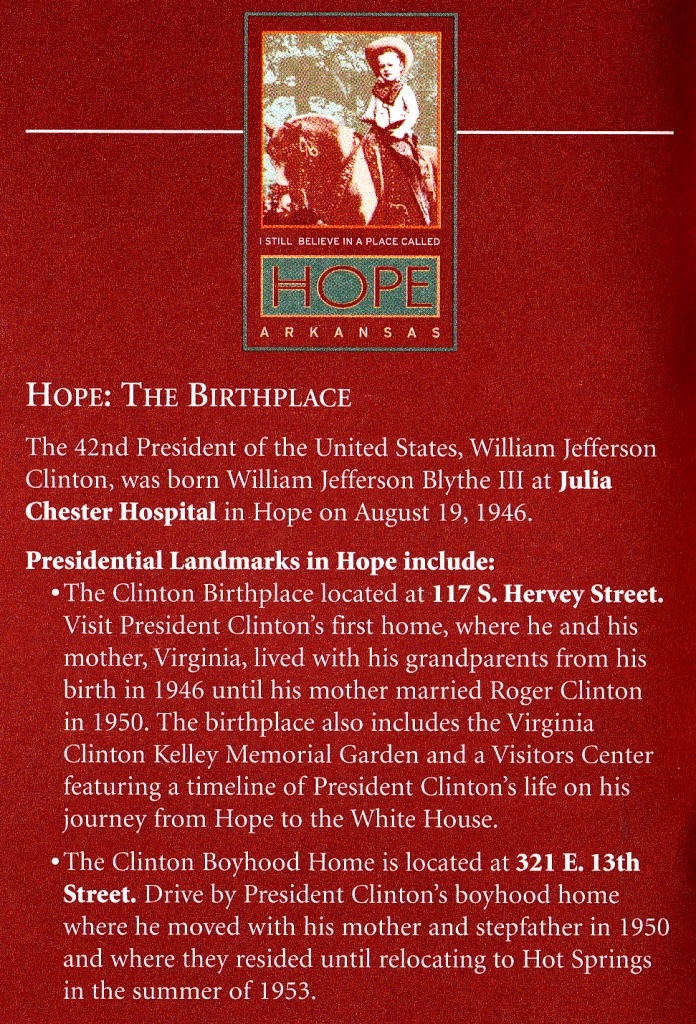
The Place Called Hope


I remember ducking into Hope, Arkansas, back around Elvis' birthday in January, 1993, bound for Austin, Texas, in that surreal period just after the 1992 US national election, right before Bill Clinton actually became 42nd President of the United States.  On the very day of that visit early in 1993, Little Rock had been a hive of activity and Hope was glowing, thanks in part to the memorable "believe" speech Clinton had delivered at the Democratic National Convention the previous July.

Now, in 2012, Hope's old train depot is an easily accessible museum that notes not only the presidency of Bill Clinton but also other folks from Hope who've achieved larger status, including Mike Huckabee. Pretty good work for a town of about 10,300 people. Furthermore, the Bill Clinton birthplace and first childhood home is now part of the National Park Service. At the site, the Park rangers are hospitable and enthusiastic -- one gave a fun tour of the house, which is not too far from I-30, the main highway connecting Little Rock and Texarkana and on down to Dallas-Fort Worth, Texas. Wonderful.

Here's a link for more information: http://www.nps.gov/nr/travel/presidents/bill_clinton_birthplace.html

Today's Rune: Partnership.    

Saturday, July 02, 2011

Red Rock West


John Dahl's Red Rock West (1992) is a small-scale neo-noir treat featuring two now deceased character actors (J.T. Walsh and Dennis Hopper), plus Nicolas Cage and Lara Flynn Boyle, with small but notable roles by Dwight Yoakam and Timothy Carhart. Stylish and peppered with subtle humor, the film has an almost ancient primal-mythic arc but is set in the centemporary American West. Cage's character Michael, a Marine veteran and survivor of the 1983 Beirut embassy bombing, has a bum leg and a lot of choices to make; Hopper's character, Lyle from Dallas, is also a Marine veteran, but of the Vietnam War era; he has been hired to do something nasty in the town of Red Rock West. Boyle's Suzanne (pictured above) is married to Walsh's Wayne. Besides some mordant quips about marriage, Red Rock West rolls out stylish scenes, twists and turns, the kinds of things Oliver Stone later built upon in making U Turn (1997).  

Dahl's subsequent movie, The Last Seduction (1994), features Linda Fiorentino as one of the most entertainingly conniving femmes fatales I've yet seen on a screen.  More recently, Dahl directed several episodes of True Blood and Dexter.

Today's Rune: Fertility.   

Saturday, February 19, 2011

Philadelphia: Rave


Before Google and Facebook, Myspace, texting, or even wide acquisition of mobile devices of any kind, intense social events could still be quickly organized, particularly in urban centers. As recently as 1992, for instance, the "Chutes + Ladders" rave was conceived, planned and carried out with military precision -- and that mostly by students from the University of the Arts along with a few independent entrepreneurs.

First, a theme: Chutes and Ladders. Down the chute w/DJ X LAX and guests . . . Up the ladder to carnival . . . Arrive early and often.

Door charge: $5 to spin 10 til 3. "For Boys and Girls." [no one under eighteen permitted, if memory serves].

Venue: 3868 Lancaster Ave "FAKE HOUSE" (Cool: In 2011, you can look it up on Google Maps and see the building's exterior. It was essentially a vacant warehouse space sort of like the Silver Factory interior of the mid-60s).

Information: 732-9955 "a DIVA Production."  HQ: Café Diva, plus some of the organizing artists lived in my apartment building at 1225 Spruce.

In a city such as Philly, an event could be organized quickly and successfully. The little handbills were distributed just about anywhere and everywhere, for cheap. And it was an open secret. Anti-rave backlash from "squares" came later. Most people could journey to and from the Fake House on foot, by bike, by street car, and by subway. No automobiles required.  I suspect it's the same now in the Middle East, even when the internet is down, albeit for somewhat if not entirely different purposes.

Today's Rune: Separation (Reversed).

Wednesday, September 29, 2010

Czechoslovakia: Orphan of The Great War, 1918-1992


Czechoslovakia is one of the countries that emerged from imperial disintegration in the wake of the Great War of 1914-1918. Another was Armenia. A conflict as large as the Great War has reverberated down through the present, and Czechoslvakia, which came to being in 1918, broke in two in 1992 after the collapse of the Soviet Empire, another child of the Great War. But enough of war. What about Czechs and Slovaks and Moravians and Bohemians and the cuisine and culture they brought to America?


Well, I've eaten at Czech places in Illinois and Iowa and Texas, at Moravian places in Pennsylvania and Norh Carolina; and I've lived like a Bohemian, at least in the adopted sense of the word. You can get koláče / kolaches in many bakeries, Czech and German (stuffed pastries); a lot of the food seems like a hybrid of Germanic and Slavic, which makes sense given the geographic origin. Let's not forget Czech beer, which is among the best in the world (especially when it's on tap and close to the source): Budweiser Budvar (Budějovický Budvar) -- so much tastier than current watery American Budweiser it's off the charts -- and Pilsner Urquell (Plzeňský Prazdroj), "Original Pilsner." There have been breweries in the Czech old country for 900 years, maybe more.

Above poster: Contemporary Czechoslovak Posters, February 23-April 8, 1990, The City Gallery of Contemporary Art, Raleigh, North Carolina, USA.  Synchronicity being what it is, I "broke up with" a Czech American in 1992/93, the same year as the so-called "Velvet Divorce" that split Czechoslovakia into the Czech Republic and the Slovak Republic.   

Today's Rune: Breakthrough.

Thursday, May 27, 2010

The Best of All Possible Worlds (Reprise)


Now seems as good a time as any for a reprise of this post originally dated July 15, 2006:

Oil. Is it worth the price?

Werner Herzog takes a unique approach to oil, war and their combined impact in his "window into another world," Lektionen in Finsternis / Lessons of Darkness (1992). Set in Kuwait (there's a breathtaking aerial view of Kuwait City before the Iraqi invasion and Coalition counterattack), he interviews Kuwaitis about torture and mayhem, then plunges into the desert and the oil fields, many of the them blazing. There are beautiful shots of what looks like an inland sea, a mirage, a massive oil slick, in fact. Herzog provides some trippy narration in English, but the real audio backdrop is provided, as in most of his films, with music. Here, his classical German and Italian selections fit the on screen images mesmerizingly. We see tire tracks, tank tracks, blackened and burned equipment, burning oil wells, operatic destruction caused by human beings interacting with their environment.

The latter sequences let us observe men, looking otherworldly in fire retardant suits, trying to contain and put out these primal fires.


Herzog the visionary simply wants to share his glimpses of the mysterious, arational world, and in the fifty minutes of Lessons of Darkness set in Kuwait, he succeeds.

Today's Rune: Defense.

Wednesday, February 03, 2010

Philadelphia: From the 1992 Campaign


Skimming through the archives, found these artifacts dating to the 1990s. I loved living in Center City Philadelphia -- a wonderful place to directly engage in big things. From the 1992 presidential campaign:

Come hear Governor Clinton
Monday August 10, 1992
1:30 p.m.
Independence Plaza
South Side of Independence Hall
5th and Chestnut

Bill Clinton was -- and is -- a king of charisma. Star power.  We now know there's a downside to that, too.  Doh!


Was given this "VIP" pass by a friend working on the Lynn Yeakel campaign (Yeakel ran a close race against Senator Arlen Specter in '92). Gore was -- and is -- sharp, but obviously he's not Bill Clinton in the easy charm department.

VIP
Senator Al Gore RALLY
SPECIAL GREETING AREA
Wednesday, July 29, 1992
12:00 Noon
JFK Plaza

Background lead-in was an edited version of Stevie Wonder's "Living for the City." Then, he really looked kind of like Christopher Reeve as Superman. 


Finally, here's a test I gave on May 11, 1999.  Evil!  By that time, Bill Clinton was president, and Al Gore VP.  Now, nearly eleven years later, I'd change #3 to: How does war effect the USA? 

Today's Rune: Warrior.

Monday, January 25, 2010

Varieties of the Philadelphia Experience


Dug out a Philly journal. Here's a snippet from my first summer there that gives an idea of Philadelphia's eclectic nature. I was living at 1225 Spruce Street at the time.

Friday, June 5th, 1992

May was mostly cool  and wet; today it's mostly the same. No complaints here.

Two days ago, not receiving an assignment from Kelly, I set out on a pilgrimage to the area of the Kelpius Commune on the Wild Ridge west of Wissahickon Creek. I left at about 1:15 and returned about 8:30 or 9:00. The hike out was 8-9 miles; I took the train back from Allen Lane Station, Mt. Airy.

What I did was this: with a fairly detailed map, I hiked up Franklin Blvd. where all the flags of countries were out in the mostly sunny day, a slight breeze making them flap, including the old Yugoslav flag,  the Czechoslovakian flag, also a strange red and gold flag with a pentangle. By the Art Museum, large tents were being put up on the sidewalks; every so often were temporary bleachers, for what event I don't know. (The Picasso Exhibit begins soon). Beyond the PMA I cut north through a lower middle class, mostly white neighborhood, ragged and slightly dilapidated, with few or no yards but occasional flowers in windows. This was angling north around 27th-29th Streets, moving toward the eastern fringe of Fairmount Park. When I hit Girard, I turned left to pick up 33rd. This was an even more dilapidated neigborhood, mostly poor and lower middle class black. I looked at the Hatfield House with its Corinthian portico, behind which sat a sqad car; walked across tall grass in a short cut to 33rd going north. This was a creepy little walk until crossing the bridge over the railroad tracks (by which I later returned on SEPTA regional rail).

Across the bridge, a crazy woman was playing matador to oncoming traffic; a truck driver jumped out and cussed her out. "Just keep on walking, white boy," she directed at me, as I passed by on the east side of the street. I stuck to this side of the Schuylkill in order to see with my own eyes the First Schwenkfelder Church on Cumberland and 30th. [Picks up June 10, 1992]. Over to the church, a frame building with addition, painted white, with a wooden belfry. A simple church, possibly late 1800s, in a mostly black neighborhood. For about half a block north of the church, all was well, but beyond that, entropy and decay, as if the power of the church could extend only so far.

Up up & away, over the Schuylkill and sharp right turn on a broken pavement bike trail. Bikes every five minutes.


With the help of a map, I found the area of the hermits, although who knows how they really lived, over time. Supposedly in rude huts and in caves. There are all sorts of ridiculous stories about them. I checked out Sachse over the weekend, apparently he wrote a work expressly on the hermits, but then even he's a little nutty. I couldn't find the old monastery, east of the Wissahickon, coming on a horse farm and a pack of snarling dogs instead. Tim Mixter lives near this spot in West Mount Airy. I emerged from the trail further up and walked all the way up to Chestnut Hill, then back down to Allen Lane Station, where I picked up a train for Market East, and ended with a pint of Guinness at the Irish pub on Walnut East, before returning home.

This was the first serious excursion out since I've been here, on foot. Driving the Japanese film crew around opened things up, going to Ephrata Cloister and Wilkes-Barre.  Sat. I took the subway down to Roosevelt Park and, walking through a gathering of maybe 2,000 Southeast Asians, reached the Swedish Historical Museum where about fifty Swedes celebrated Midsummer's Day. They had a May Pole, colorful ribbons in the light blue and yellow known to Swedes everywhere, and cheap baked goods. I got a candleholder and walked up Broad Street past the Naval Hospital, an imposing Art Deco structure that looks like the Dark Tower of Sauron.

Today's Rune: Protection.

Saturday, January 23, 2010

South Philadelphia: Melrose Diner


If you like diners and go to Philadelphia, why not check out Melrose Diner?   Open for business since 1935, it's at 1501 Snyder Avenue (not far from where Passyunk Avenue intersects), Philadelphia, PA 19145.   Used to frequent it late at night (open 24/7) during graduate school years at Temple University, 1992-1995.  The uniformed staff at the time was composed largely of very efficient Melrose long-timers.  One of the oddities of the place: booths with partitions allowing two parties to sit when the place fills up.  All sorts of people come in for the coffee, food and atmosphere.

As an aside, in September 1993, Frank Baldino, Sr., a presumed affiliate of organized crime, was gunned down in the parking lot by members of a rival faction.  Police tape marked the spot.

Today's Rune: Flow.  Photo by G. Widman.

Sunday, January 10, 2010

Pligrimage to Waterloo II


As Jodi ponted out in response to yesterday's post, ABBA had a big hit with "Waterloo" in 1974, applying the battle's outcome to a romantic disaster. As Mark (Walking Man) noted, the battle's name has become synonymous with defeat. Waterloo connects to so many things it may equal the Six Degrees of Kevin Bacon.


Here's a shot of Waterloo Station taken by my Dad in 1992, not too far from the Belgian battlefield.  There's a much bigger Waterloo Station -- named after Wellington's victory -- in London; it's heralded in the 1967 Kinks song "Waterloo Sunset," which has been covered by all sorts of artists and bands ranging from David Bowie (2003) to Def Leppard (2004).  


Waterloo keeps on giving, spilling even into contemporary American politics. Last summer, Jim DeMint of South Carolina -- one of the most right wing senators in the USA -- declared about Health Care reform: "If we're able to stop Obama on this it will be his Waterloo. It will break him."  Above fish-eye shot of the battlefield taken by my Dad in 1992.

Finally, here's ABBA rolling out "Waterloo" at the Eurovision Song Contest in 1974. ABBA plus (Iggy Pop and) The Stooges will be inducted into the Rock and Roll Hall of Fame on March 15, 2010, along with Jimmy Cliff, The Hollies and Genesis. Crazy, huh?


Today's Rune: Signals.

Wednesday, December 09, 2009

Time Rediscovered: Le Temps Retrouvé


Hey folks, it's my birthday. Time to dig out the big Marcel Proust book of time again. In this case, a few more photos.


Hard to believe, but here I am about ten years old wearing a Washington Redskins pajama top. Yes, there was a time in the early 70s, soon after we moved from St. Paul, Minnesota, to Durham, North Carolina, when I was a fan. They were the nearest NFL team at that particular time, also hard to believe now.


Manhattan. In front of the Hotel Chelsea, winter time, a couple years ago.  Must get back there! They already had wifi in the lobby by that time.  Have also stayed there in the summer, which is more ideal for walking miles and miles and miles . . .


Philadelphia, Logan Square (Logan Circle). During graduate school, probably early 1993. This is another of Philly's great spaces. Behind me is Alexander Calder and Wilson Eyre's Swann Memorial Fountain, finished in 1924; the building is the Free Library.  Wearing my VMI garrison jacket from 1978/1979 and Siouxsie & the Banshees t-shirt from London, 1991.  Every picture tells a story, don't it?