Showing posts with label 1999. Show all posts

Wednesday, May 23, 2018

Jim Jarmusch's 'Ghost Dog: The Way of the Samurai' (1999)

Jim Jarmusch's Ghost Dog: The Way of the Samurai (1999), shot in New Jersey with Japanese dreams. Stars Forest Whitaker in the title role, as a retainer of low-level mobster Louie (John Tormey). 

The film is a most excellent fantasy piece revolving around Ghost Dog, the quiet assassin; aging gangsters; Raymond, a French-speaking Haitian ice cream truck man (Isaach De Bakolé); Pearline (Camille Winbush), a very young reader of books; and active carrier / messenger pigeons, also known as war pigeons.  
The character Ghost Dog filters the world through Yamamoto Tsunetomo's Hagakure / Hidden Leaves (from the early 1700s), which strictly and philosophically lays out the samurai way of life.  Many of its "leaves" are read aloud by Ghost Dog over intertitles that show the corresponding text, in English. 
Ghost Dog: The Way of the Samurai. Totally hip flick with a groovy soundtrack courtesy of RZA of the Wu-Tang Clan. Throughout the film, there are lots of allusions to books, other movies, mixed genres and alternate codes of naming and living. There may be a sequel forthcoming. 
Today's Rune: Protection. 

Sunday, September 13, 2015

Raoul Ruiz: 'Le temps retrouvé, d'après l'oeuvre de Marcel Proust' (1999) - Take II

In this second post inspired by Raoul Ruiz's beautiful film Le temps retrouvé, d'après l'oeuvre de Marcel Proust / Marcel Proust's Time Regained (1999), I want only to make three points.

First, Marcel's biggest epiphany comes in the library of the Guermantes (lbibliothèque du prince de Guermantes). Thus, the key in understanding Proust is The Library! 

(Indeed, any good library contains a multitude of magical powers, and its contents sure to startle you with intense memories from time to time. You may recall that in Andrei Tarkovsky's Солярис / Solaris (1972), the space station library plays a similarly important role in triggering both alien and human epiphanies -- and for even experiencing zero gravity.) 
Second, in addition to Raoul Ruiz's work, there are two other very good films based on Proust that I have seen: Percy Adlon's Céleste (1982) and Volker Schlöndorff's Un amour de Swann / Swann in Love (1984). These films, combined with Proust the actual person and the writings (texts) of Proust, all serve to illuminate each other from different angles. 
Third, while in the past, upon my early reading of it, I surely caught many of the poignant elements in Proust's À la recherche du temps perdu / Remembrance of Things Past / In Search of Lost Time, but over time, and more and more in time -- thanks in part to Raoul Ruiz's Time Regained -- I am really digging the many subtly comic elements in Proust. . . those even beyond the already observed satirical mockery of socio-economic class distinctions and the foibles of social interaction. 

In the Ruiz movie, Marcello Mazzarella plays Marcel in a way that reminds me a lot of Peter Sellers -- a masterful blend of the Peter Sellers we see in Dr. Strangelove or: How I Learned to Stop Worrying and Love the Bomb (1964), the Pink Panther movies, and, as Chance the Gardner (aka Chauncey Gardiner), in Being There (1979). 

Look for the comical and you will see it, for surely it's better to laugh than to cry -- more fun, at any rate.    

Today's Rune: Partnership.

Friday, September 11, 2015

Raoul Ruiz: 'Le temps retrouvé, d'après l'oeuvre de Marcel Proust' (1999) - Take I

The 1999 Raoul Ruiz film Le temps retrouvé, d'après l'oeuvre de Marcel Proust / Marcel Proust's Time Regained is a dazzling adaptation and synthesis of Proust's À la recherche du temps perdu / Remembrance of Things Past / In Search of Lost Time from the vantage point of its final volume.  

Admirers of Proust's work will want to see this if they haven't already; while those who haven't yet read Proust's novel -- the longest in history and probably the greatest novel written since the year 1900 -- might want to get cracking. Otherwise, the movie would thoroughly mystify rather than edify. 

Ruiz's movie version works hand in hand with the novel, made possible by Proust's meticulous use of visual art, architecture, music, fashion and focus on social manners as well as memory devices. 
If you can dig and grok this, you'll have reached the mountaintop, no doubt. If not, no extra lost time to remember or forget, I suppose. 
Certainly, it's a beautiful looking film, with clever and important scenes rendered with true surrealistic flair.

Today's Rune: Fertility.  

Wednesday, May 20, 2015

Albert King: "A Big Legged Woman Gonna Carry Me to My Grave"

Albert King (1923-1992), like Wilson Pickett, hit the big time with Stax Records in Memphis. Both musicians, backed by Booker T. & The MG's, took off in the mid-1960s -- Pickett with "In the Midnight Hour" in 1965, King in 1966 with "Laundromat Blues." King's knockout signature song came in 1967 with "Born Under a Bad Sign:"

"If it wasn't for bad luck, I wouldn't have no luck at all."
King was a big guy and a biting, singing guitar player -- like the just passed B. B. King (1925-2015). 

From this 1999 Rhino Records anthology -- The Very Best of Albert King (Blues Masters series), I particularly like:

"Born Under a Bad Sign"
"Cold Feet"
and "Cadillac Assembly Line" 

Thank you, Albert King (and B.B. King, while giving thanks), thanks also to Rhino Records for this anthology. And now, adieu, adieu -- this CD now off to someone new.

Today's Rune: The Mystery Rune. 

Monday, May 18, 2015

The Dardenne Brothers: 'Rosetta' (1999)

In Rosetta (1999), another independent Belgian Walloon film gem by the Dardenne Brothers, there's a woman in trouble. No, there are two women in trouble: the 17-year old title character Rosetta (played by Émilie Dequenne, who won the Palme d'Or for her efforts) and her mother. They live in a Belgian trailer park sadly called "The Grand Canyon;" Mommie Dearest gives mended clothes to Rosetta to sell in town while she trades sex for booze, rent and utilities with the trailer manager and other "friends." Rosetta wants out of the situation -- i.e., she wants to save her mother and herself -- by finding a stable job. For various reasons, this proves to be an elusive goal.
Several details of the film stick to mind. Rosetta has specific ways of getting through each day despite suffering stomach aches. Some of them are crafty, some of them self-defeating. She catches fish in a large, mud-slicked pond with a broken glass bottle, hook and bait -- very clever. She hides her wading boots in a dirty little culvert (dubious). She wears the same town clothes pretty much every day, hand washing them outside the trailer. She drinks water from the same dirty little water bottle. She always runs across traffic to get to and from her trailer park, via a creepy wooded area. She has a terrible temper and a propensity to fight. She projects onto a temporary co-worker, the waffle-maker Riquet, the ways of her mother's male "friends." Maybe she's right to do so, but she needs to make friends, some kind of social connection, or she will either go crazy or worse. What's gonna happen? 
The Dardenne Brothers are cool filmmakers. Above all, Rosetta is in no way a sentimental movie; in fact, it's quite visceral and absorbing -- the Zen of Purgatory. They seem to enjoy showing patterns of daily life; they are not afraid to show habits and repeated processes for emphasis.

Finally, it's worth noting that Olivier Gourmet, who plays the waffle kingpin in Rosetta, also appears in other Dardenne films. Here, his character is that of a slightly smarmy boss.

Today's Rune: Strength.   

Saturday, September 27, 2014

Pedro Almodóvar: Todo sobre mi madre / All About My Mother (1999)

Pedro Almodóvar's Todo sobre mi madre / All About My Mother (1999) won top film awards in Spain, France, the UK and the USA, and it was a financial success, too, with a relatively small budget and big payout.

It's mostly about women, gender identification, motherhood and existential choices. Set primarily in Madrid and Barcelona, with nods to earlier movies, plays (Tennessee Williams' A Streetcar Named Desire in particular), and other cultural touchstones. Very colorful in all senses of the word.
In All About My Mother (1999), taking a train back and forth between Madrid and Barcelona is a major plot point --  a "geographic." 

In the synchronicity department, a key date -- the only calendar date shown during the film -- is September 26. Without having any idea of this beforehand, I happened to watch it on September 26, 2014. The odds of this occurrence -- unless someone can better determine such things -- are one in 365.2425.

Today's Rune: The Mystery Rune. 

Thursday, November 28, 2013

José Luis Cuerda: La lengua de las mariposas / Butterfly (1999)

José Luis Cuerda's La lengua de las mariposas / Butterfly / Butterfly's Tongue (1999) is another thoughtful and excellent film set during the Spanish Republic and Civil War period of the 1930s. This one, based on stories by Manuel Rivas, takes place in lush northwestern Spain, in Galicia. And like other tales about this period, there is a contemporary feel in the tensions fraught between modern diversity, free thinking and progressive outlook vs. traditional one-way-must-fit-all conservatism, here tinged with the brutish fears and accelerated activities of fascism.
Butterfly is a coming of age story involving a boy ("Sparrow," or Moncho, played by Manuel Lozano), his family, teacher, friends and their surroundings, but surely the image of the butterfly is also a stand-in for the highest ideals of the Spanish Republic before (and after?) Francisco Franco's German and Italian-backed Falange Española de las Juntas de Ofensiva Nacional Sindicalista took over all of Spain and then remained in power for close to forty years.

Don Gregorio (Fernando Fernán Gómez), Moncho's kindly teacher and supporter of the Spanish Republic, has a number of pithy observations, including this: "Hate, cruelty are Hell . . . At times . . . we ourselves are Hell." And: "You read much? . . . It's time you start reading . . . Books are like a home . . . In books our dreams take refuge so as not to freeze to death."
La lengua de las mariposas / Butterfly / Butterfly's Tongue is R-rated for some nudity. The DVD version I checked out gives the choice of Spanish or French language with English sub-titles. Included are cool glimpses of an almost medieval nature with fairs, music and Catholic feast days. Well worth it, my friends.

Today's Rune: Fertility. 

Friday, September 06, 2013

Seamus Heaney in Michigan, 1999

Seamus Heaney (1939-2013) was a Nobel Prize-winning poet, but he was also a real person. On November 15, 1999, we shook hands and he graciously autographed a copy of his Opened Ground: Selected Poems, 1966-1996. On that date he was sixty years old, but with his craggy features and his eyes squinting from the wind and sun of Ireland, he could have been Methuselah. He also resembled, at least somewhat, the actor Christopher Plummer.
Lecture
Getting the Picture: Reflections on Art and Artists in Ireland
Seamus Heaney
Monday, November 15, 5 pm [1999]
Rackham Hall Amphitheatre,  915 E. Washington Street
The celebrated poet and Nobel-Prize winner will speak on Irish culture.
Rackham Hall Amphitheatre at the University of Michigan, a venue that seats about 225 people, was not full, but Heaney was wonderful, choosing his words with care and in a courtly manner, delivering them sonorously and with an unmistakably Irish inflection. I loved it. 
Not uncoincidentally, earlier that year I had travelled around Ireland for a stint with Jen and Sarah. Funny to think, but "Livin' la Vida Loca" was at the top of the pops just about everywhere in the world that summer -- including Ireland.

I found a slip of paper in my copy of Opened Ground the other day. On it was written a line of Heaney's poetry I'd scrawled out: "Of falange and piston pitched along the ground." A nice snap to that. 

Farewell, Seamus Heaney, RIP.

Today's Rune: Separation (Reversed). 
   

Wednesday, January 09, 2013

Office Space


I've seen all or parts of Mike Judge's Office Space (1999) several times over the years, and every time it gets better, more nuanced. Despite (and because of) changes in communications technology, this irreverent sendup of "modern" office work holds up well. Despite smart phones, flat screens and the ubiquity of digital technology, in all too many places of employ, little of essence has changed. If you have one, a mind is a terrible thing to waste.

Speaking of, what does "hold up" mean?

Like beams keeping a roof in place, preventing it from crashing down.

Hold up can also mean: slow down, pardner.
A holdup is: stop everything -- this is a robbery.
Wholed up -- bunkered down, by choice or necessity.
Hey man, what's the holdup?

Office Space covers every aspect of the aforesaid.


I've learned recently that Office Space was filmed in Texas, not only in Austin but also around Las Colinas (another local source adds Plano to the mix) in the Dallas-Fort Worth Metroplex. I can see that clearly now -- from traffic patterns to land use.  

Today's Rune: Signals.   

Friday, June 08, 2012

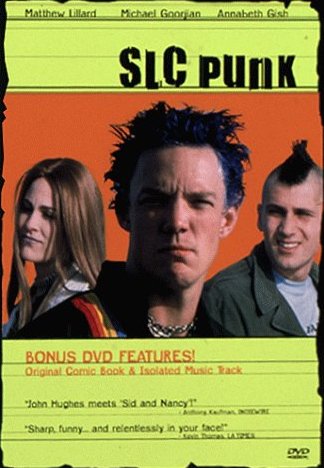
SLC Punk!


James Merendino's SLC Punk! (1999) evokes certain music-based subcultures of 1985 in the US and UK, but more specifically in Salt Lake City. It centers around Stevo, Heroin Bob (who doesn't actually do heroin) and various aquaintances. The soundtrack, including songs that are not included in the "official" soundtrack, is a good one, and includes three well-placed songs from The Stooges (1969), plus individual tracks by Roxy Music, Blondie, Velvet Underground, and other thematically connected bands.

The narrative technique is sort of an out-of-time remembrance in which the main character (in this case Stevo) tells the story in retrospect, but also by commenting on action seemingly as it occurs -- sort of like in Woody Allen's Annie Hall (1977) and Martin Scorsese's Goodfellas (1990). Considering it was shot on a very modest budget, SLC Punk! has some neatly executed scenes, and it breathes life back into the mid-1980s.    

I was working at Algonquin Books of Chapel Hill (North Carolina), in 1985, and was pretty aware of the various music genres and various "tribes." To me, Stevo and Heroin Bob are more like the local "hardcore" music scene of North Carolina, of which there were several bands carrying the torch. There was also a ska-tinged eclectic scene inspired by the English Beat, the Specials and bands like that. 1985 was, too, the year the Pogues released Rum, Sodomy & the Lash. Punk as in the Sex Pistols or even the Clash was long over, or so it felt. Even Dead Kennedys and the Cramps had almost burned out by then, as far as producing exciting new material. But SLC Punk! got me to thinking, and remembering. What else can one really ask of an indie flick?

Today's Rune: The Mystery Rune.             

Thursday, June 07, 2012

Wonderland UK


Set in late 20th century London, Michael Winterbottom's Wonderland (1999) -- not to be confused with the 2003 James Cox true crime film of the same name that's set in early 1980s Los Angeles -- follows the members of a troubled family over Guy Fawkes night carnivale weekend.


Going by this and some of his other films, and mostly taking an indie film approach, Winterbottom appears to be steeped in literary tradition. Wonderland seems to telescope something like Anton Chekhov's Three Sisters (1900).  He combines literary with cinematic devices -- vivid reds and an overall palette that may be inspired by Jean-Luc Godard. The social aspects bring something from realistic British "kitchen sink" dramas. Rather than Godard's socio-economic analysis, we're delivered a slice of life from within the London working class milieu that's a little like a condensed version of the TV series East Enders.


With Wonderland, we see life in London among fairly ordinary people. The family is not very supportive, beginning with parents who seem to despise each other. The mother is miserable, the father henpecked. Their son has left home and is having fun with a free-spirited woman, but keeps his family issues in mind as a burden. The three daughters operate within limited horizons. One is pregnant, and her husband is in panic mode, ready to flee. The other two find this funny. One of them is divorced with a son and works as a hairdresser -- she's the family mischief-maker. The other haphazardly dates various men and wanders around with a peculiar hairstyle through the London wonderland, a real mixed bag. There's more, but that's the basic set-up.

Today's Rune: Signals.     

Tuesday, May 10, 2011

Artifacts, Memory, Ace of Heart


It's funny, that which survives. Is it random, is it luck of the draw? 

Above is a scan of a simple postcard bag -- or, as Texans say, little sack -- made of crinkly paper. I'm glad I kept it, but how did it make it intact through so many physical and psychic moves?  Now that it's been scanned, why keep the original? Objet de mémoire.  

As de cœur -- literally, ace of heart. Albi, a UNESCO treasure, let's not forget the Albigensian Crusade against Cathari "heretics." Albi, beautiful little city in the south of France.


This one seems like from another epoch, pre-internet. This could have been in currency a century ago. A beautiful object now especially because of its scarcity. Memory gold.

Bickleigh Cottage Country Hotel. Nr. Tiverton, Devon.  Bickleigh 230. Mr. & Mrs. S. Cochrane. Room No. 4. Name Mr. France. Date 15-6-88.  Room & Breakfast 29.00
Deposit £ 10.00   £ 19.00 due

Tracking this down now on the internet, let's add a tighter location: "Whitnage, near Sampford Peverell."  "16th Century Cottage Bed and Breakfast." South West England, near Cornwall. Inland from the Scilly Isles.  Different women, different planet.


Today's Rune: Separation (Reversed).

Sunday, April 03, 2011

Angela Y. Davis: Blues Legacies and Black Feminism


Already with her in spirit despite differences in gender and race, I learned a lot from Angela Y. Davis' Blues Legacies and Black Feminism: Gertrude "Ma" Rainey, Bessie Smith, and Billie Holiday (Vintage, 1999, Random House, 1998). Building as it does on Daphne Duval Harrison's Black Pearls: Blues Queens of the 1920s (Rutgers, 1988), this work has deepened and broadened my perspective, certainly. In addition to rendering a compelling analytical study of the three major recording artists enumerated in the subtitle (who were also very popular live performers, all with enduring impact) -- and with due consideration and attention given to race, gender and class -- Davis also provides her own very helpful transcriptions of the lyrics of Ma Rainey and Bessie Smith.


Davis' introduction concludes:

"Finally, I hope this study will inspire readers to listen to the recordings of Ma Rainey, Bessie Smith, and Billie Holiday both for pleasure and for purposes of research, and that it will occasion further interdisciplinary studies of the artistic and social contributions of blues and jazz women." (p. xx).

Toward these goals, I've been working on two St. Louis and Chicago-based blues singers of the 1920s and 1930s, Luella Miller and Mary Johnson, mostly listening to their recordings and transcribing their lyrics as sung. Some of the initial results have been posted on this blog. The work of Davis, Harrison and others gives these kinds of studies impetus, direction and added relevance.  

Today's Rune: Breakthrough.  


Wednesday, February 03, 2010

Philadelphia: From the 1992 Campaign


Skimming through the archives, found these artifacts dating to the 1990s. I loved living in Center City Philadelphia -- a wonderful place to directly engage in big things. From the 1992 presidential campaign:

Come hear Governor Clinton
Monday August 10, 1992
1:30 p.m.
Independence Plaza
South Side of Independence Hall
5th and Chestnut

Bill Clinton was -- and is -- a king of charisma. Star power.  We now know there's a downside to that, too.  Doh!


Was given this "VIP" pass by a friend working on the Lynn Yeakel campaign (Yeakel ran a close race against Senator Arlen Specter in '92). Gore was -- and is -- sharp, but obviously he's not Bill Clinton in the easy charm department.

VIP
Senator Al Gore RALLY
SPECIAL GREETING AREA
Wednesday, July 29, 1992
12:00 Noon
JFK Plaza

Background lead-in was an edited version of Stevie Wonder's "Living for the City." Then, he really looked kind of like Christopher Reeve as Superman. 


Finally, here's a test I gave on May 11, 1999.  Evil!  By that time, Bill Clinton was president, and Al Gore VP.  Now, nearly eleven years later, I'd change #3 to: How does war effect the USA? 

Today's Rune: Warrior.

Monday, December 28, 2009

Gone Digital: Information Mass and Movement


Where are we going, where have we been?  It's strange thumbing through my copy of James L. Baughman's The Republic of Mass Culture: Journalism, Filmmaking, and Broadcasting in America Since 1941 (2nd edition, 1997).  It becomes clear that things have shifted significantly since its publication (and even since the 3rd edition, 2005).  Baughman looks particularly at how television changed mass media from the end of the Second World War through the second half of the twentieth century.  Radio and newspaper were displaced to more secondary roles, corporate mergers and aquisitions accrued power to centralized organizations, and so on. 

But in the last ten years, things have shifted even more wildly from analog to digital: everything from photography to publishing to music and correspondence. What we have now seems increasingly strange to me.  I remember when reading newspapers, magazines and letters were features of every day life, when phone calls were a big deal (especially "long distance"), when folks planned meals around daily news broadcasts at set times. There was more structure, more orientation based on time and place.  Now we must think differently, act differently.

The first glimpse I saw of today's rather disoriented and disorienting world of communication and culture was in Spain in 1999; specifically, in Barcelona, where many people walked around jabbering on mobile phones.  This was not the case in the US: only some used cell phones in this way, and almost every household had access to a land line -- anything from rotary to push button phones.  In the US, it was only around 2001 when things started to become more like what I'd seen in Barcelona; now, on the verge of 2010, people seem way out of the loop if they don't have access to some form of wireless device: such has been the staggering speed of change.  In a couple of decades, we've jumped from answering machines to voice mail, from wondering who is calling to screening incoming calls with digital ID, so that our social forms of communicating are radically changed in ways I have yet to absorb or fully understand.

What we have is a great deal more freedom and flexibility, but also a certain amount of bewilderment and, perhaps, a sort of mass hypnosis combined with some loss in social space for reflection and solitude.  Where are we going, where have we been . . . What do you think? 

Today's Rune:  Strength.

Thursday, September 24, 2009

Another Post About Buildings and Food


As a follow-up to the last post, more about Woolworth's and its history. First, there's Remembering Woolworth's: A Nostalgic History of the World's Most Famous Five-and-Dime by Karen Plunkett-Powell (1999, 2001). Lots of photos included.


For a more recent examination, check out Jean Maddern Pitrone's F.W. Woolworth and the American Five and Dime: A Social History (2007), which also includes photos.


And a little more about Woolworth's and the American Civil Rights movement.

Soon after the Greensboro sit-ins, Martin Luther King, Jr., arrived in Durham, North Carolina, and paid a visit to the Woolworth's downtown, February 1960. Photo by Jim Thornton, Durham Herald-Sun. For more on King and Civil Rights activities in Durham, see: http://www.durhamcountylibrary.org/dcrhp/mlk.php

Today's Rune: Protection.

Friday, August 07, 2009

Black Hawk Down


Finally saw Ridley Scott's Black Hawk Down, which came out in 2001, after 9/11. I don't know what to think about it. Scott makes impressive epic films, and this is certainly epic in showing modern urban warfare, more comprehensively than Stanley Kubrick's Full Metal Jacket (1987). The visuals and sound effects are superb. Furthermore, the 1993 street warfare and chaotic battle scenes in Mogadishu, Somalia (a city larger than Detroit), portend urban fighting in Iraq, only without the IEDs and suicide bombers.

This film dovetails perfectly with a book I just finished and will post about soon: James Hillman's A Terrible Love of War (2004). Black Hawk Down is based on Mark Bowden's 1999 nonfiction work, Black Hawk Down: A Story of Modern War.


Today's Rune: Possessions.

Wednesday, July 29, 2009

Mein Liebster Feind


I. Mein liebster Feind - Klaus Kinski / My Best Fiend / [My Dearest Enemy] (1999, 2000). Intense documentary about Werner Herzog and Kinski's explosive relationship, and the über-films they made together. "I never thought it possible that someone could rave for hours," Herzog observes. "[Kinski] was impulsive, unpredictable, half-mad. He was not quite normal." More like a force of nature. Kinski is the kind of person you might want to know, but he'd be hard to take, too. With Kinski, you knew he was alive, you knew you were alive. But making a movie with him was like going through trauma. Give me shelter. Enjoy on DVD, either by itself or as part The Herzog/Kinski Collection, a magnificent box set.


II. Premier Nikita Kruschchev (USSR) and VP Tricky Dick Nixon (USA) spar in the Splitnik fifty years ago (Moscow, July 24, 1959) -- the great Kitchen Debate. Both dudes later had their official careers cut short, first Nikita, then Dick. I wonder what they'd have to say about today's scene?

Today's Rune: Protection.

Sunday, February 22, 2009

Holy Smoke, Batman


Thoroughly enjoyed the Academy Awards. An elegant show, and civilized. Winners include: Kate Winslet (pictured here from Holy Smoke, 1999); Penélope Cruz via Woody Allen's Vicky Cristina Barcelona; Sean Penn via Gus Van Sant's Milk; Heath Ledger; and various for Slumdog Millionaire, directed by Danny Boyle (compare with his Iggy Pop-fueled Trainspotting, 1996, a darker classic).

Today's Rune: Opening.

Thursday, August 21, 2008

Clockwatchers


A lot of people are familiar with Office Space (1999). How many have seen Clockwatchers (1997), directed by Jill Sprecher? If you've ever been or known an office temp, it's easy to empathize with the plights of characters played by Parker Posey, Lisa Kudrow, Toni Collette and Alanna Ubach. Sprecher, who has also since produced HBO's Big Love, captures the ennui and desperation of temps in their working environment. It's more realistic and sadder than Office Space, but has definite comic touches, too. All the key actors are superb.

Driving along Big Beaver Road in Troy, Michigan, one can spot the world headquarters of Kelly Services, Inc. -- for me, triggering memories of working as an office temp for Kelly and as an all-purpose temp for Manpower, Inc., mostly in North Carolina, Virginia, and Philadelphia, and in London. Clockwatchers really reminds me of working long stints at places like Family Health International in the Research Triangle -- lots of people in the same boat, plotting to bust a move to somewhere, anywhere else. By any means necessary! Just thinking about it brings back a million memories for future blog post digging. . . . .

Meanwhile, Barack Obama seems to have picked a VP and I've picked five more people for an Arte y Pico Award, as charged by Johnny Yen. More will be revealed on both counts soon, I suspect -- no later than this coming Saturday!

Today's Rune: Flow.