Showing posts with label Sputnik. Show all posts

Wednesday, October 03, 2018

Donald J. Raleigh: 'Soviet Baby Boomers' (2012), Part I

Donald J. Raleigh, Soviet Baby Boomers: An Oral History of Russia's Cold War Generation (New York: Oxford University Press, 2012).

An absorbing look at the world through the hearts and minds of the Soviet high school graduating class of 1967. Specifically, via two elite high schools, one in Moscow and one in Saratov, a city on the Volga River that is about 850 kilometers / 528 miles southeast of Moscow. From the perspective of "the Sputnik Generation," one also gets at the entire arc of the Soviet Union, from beginning to end, and then onward right into the Vladimir Putin era. 

Their grandparents' generation, generally speaking, experienced the First World War, Bolshevik Revolution and Russian Civil War; and their parents, the Joseph Stalin (1878-1953) era, including mass repression, the Second World War, and the Nikita Kruschev (1894-1971) "Thaw" after Stalin's death. 

The Baby Boomers benefited from the Thaw, were excited by Sputnik and Kruschev, but eventually became embittered during the Leonid Brezhnev era (1906-1982), especially toward its end; then on to Mikhail Gorbachev (born 1931), glasnost, perestroika, the breakup of the USSR, Boris Yeltsin (1931-2007) and Putin (born 1952).

Most of the interviewed boomers were the children of "third tier" elites -- those immediately below nomenklatura and second tier elites -- that is, they were children "of the mass intelligentsia -- professionals (doctors, research scientists, professors, engineers, architects, artists, teachers, librarians, etc.)," the kinds of bourgeois specialists who tend to help maintain a semblance of civil society (not only in the Soviet Union but also in 'The West'). (page 22)

Stalin, a brutish nationalist and proponent of the Cult of Personality (namely his own), turned against those with a more internationalist sensibility, and aimed, almost right up to the time of his death in 1953, "to root out 'cosmopolitanism,'" partly a code word for Jewish intellectuals, sophisticated urbanites and their "fellow travelers."  (page 32) Luckily for most, in the wake of Stalin's death came "the Thaw," which relaxed the atmosphere a bit.

As for attitudes and actions over time, Raleigh notes: "Within any historical situation, people pick their fates and live their lives both as passive objects and as active agents." (page 64)

Teachers were very important to the elite Baby Boomers: they "'had very colorful personalities' and played an enormous role in shaping their charges' worldviews' . . . 'They taught us to think, not only to learn things by heart' . . . 'Actually, all of the teachers were excellent! Except for a few individuals, they were all interesting.'" (page 91)

[To be continued.] 

Today's Rune: Signals. 

Tuesday, March 29, 2016

"Look Out Honey, 'Cause I'm Using Technology!" (Part 2 of 2)

Additional inspiration from Douglas Brode's Fantastic Planets, Forbidden Zones, and Lost Continents: The 100 Greatest Science-Fiction Films (Austin: University of Texas Press, 2015).

More favorites already seen include: 

Things to Come (1936)
Eternal Sunshine of the Spotless Mind (2004)
Village of the Damned (1960 version) 
The Day of the Triffids (1963)
Still to see:

Earth vs. The Flying Saucers (1956)
This Island Earth (1955)
Conquest of Space (1955)
Five Million Miles to Earth (1967)
The Thing from Another World (1951)  
Them! (1954)
The Fifth Element (1997)
New to me, still to see:

Queen of Outer Space (1958)
Starcrash (1978)
Dr. Cyclops (1940)
Sky Captain and the World of Tomorrow (2004)

Do any of these jump out at you?

Today's Rune: Signals. 

Wednesday, January 26, 2011

In Dreams Begin Responsibilities II

Something to consider. Excerpts from US President Barack Obama's State of the Union address last night:

Meanwhile, nations like China and India realized that with some changes of their own, they could compete in this new world. And so they started educating their children earlier and longer, with greater emphasis on math and science. They're investing in research and new technologies. Just recently, China became home to the world's largest private solar research facility, and the world's fastest computer. . .

So yes, the world has changed. The competition for jobs is real. But this shouldn't discourage us. It should challenge us. . .

The future is ours to win. But to get there, we can't just stand still. As Robert Kennedy told us, "The future is not a gift. It is an achievement." Sustaining the American Dream has never been about standing pat. It has required each generation to sacrifice, and struggle, and meet the demands of a new age. . .

This is our generation's Sputnik moment. . .

Good spech. Not sure about the Madison Avenue sports/war metaphor, "The future is ours to win,"* but the idea of having a better rail system, stronger insfrastructure, more jobs, and some thought about the future seems better than anything the GOP has in mind.

*(Reminds me of "The Future is Now at Honeywell.")


Obama's ideas are undoubteldy more on the mark than this July 1968 Kroger ad, "JOIN THE KROGER REVOLUTION." If I'm not mistaken, that's no Molly Pitcher there. On the other end of the macho spectrum, I recently saw -- during the NFL playoffs -- an equally ridiculous ad featuring George Washington in a Dodge Challenger swooping down on a line of British redcoats -- who stampede and run away cowering. "There's a coupla things America got right. Cars -- and freedom." People seem to love it. If only life was so simple for some. The past is ours to win? Pitiful, man. Here it is:


Today's Rune: Defense.


Friday, November 02, 2007

Satellite of Love


Sputnik Sweetheart / Spūtoniku no koibito by Haruki Murakami, Japanse, 1999; Philip Gabriel, English translation, 2001).

Compelling novel that at first seems simple, but is actually complex. "K" adores Sumire, who falls for Miu. K is a male teacher in his mid-20s who eerily has the same birthday as I do (December 9); Sumire is an aspiring writer in her early 20s, a bit lost, influenced by Jack Kerouac and other American writers. Miu, fortyish, is an independent wheeler-dealer platonically married to an offstage husband. Each is a satellite of love, alone in the universe but connected to each other so not entirely alone after all. K has married girlfriends (one, the mother of a student) but he really has his hopes set on Sumire, who agrees to go on an open-ended trip to Europe with Miu as her "special assistant," leaving K wondering.

Later in the novel, Miu calls K and asks him to come to a small Greek island near the Turkish mainland. Sumire is missing.

In the preliminaries, there's a note about Sputnik II carrying the first cosmonaut on board -- Laika the dog -- launched on November 3, 1957 (fifty years ago tomorrow) -- "but the satellite was never recovered." More is made of Sputnik meaning "travelling companion," and there's a passage about a misunderstanding between Miu and Sumire over Sputnik, Beatnik, and Jack Kerouac.

Once K arrives at the island, the novel dramatically wanders into David Lynch territory.


Birthday: Kim So Yeon.


Birthday: Marisol Nichols.

Today's Rune: Harvest.

Annyong-hi kashipshio!

Thursday, October 04, 2007

Sputnik Sweetheart


October 4, 1957: successful launch and orbit of Sputnik I by the Soviet Union, initiating the space race and, after the 1960 election, JFK's "ten years to the Moon" speech. Before long, Belka and Strelka became the world's first (dog) cosmonauts, and pseudo-secretaries Fiddle and Faddle became friends with JFK in the White House. Crazy times -- just like today, only different. For more, check out Paul Dickson's Sputnik: The Shock of the Century (2001). The word beatnik was derived from Sputnik in 1958. In all, there were more than forty Sputniks launched, right into the 1960s. Fifty years.

Sputnik (Satellite Girl) -- Jerry Engler and the Four Ekkos (1957)

Well, I say the fun has just begun
We're on Sputnik Number One
A'flyin' through Outer Space
At a rockin' rollin' pace
Oh! We're gonna get our kicks
On a little ole thing called a Sputnik
I said spoo-spoo-spoot-a-nick-a-chick
Isaid spoo-spoo-spoot-a-nick-a-chick
Flyin' all around the world
With my crazy satellite girl

Well ever since the satellite’s birth
We've been circlin' 'round the Earth
A-just-a-my baby and me
And that spoot-a-nik makes three
Flyin' at a fantastic height
On a little ole thing called a satellite
I said, sa-sa-sat-a-lat-a-lite
I said, sa-sa-sat-s-lat-a-lite
I said, sa-sa-sat-a-lat-a-lite
Flyin' all around the world with my crazy satellite girl!


Haruki Murakami, Spūtoniku no koibito (1999) / Sputnik Sweetheart (2001). Sputnik, beatniks, the whole shabang. 23 skidoo and pitch some woo . . . . .

Today's Rune: Breakthrough.

Thursday, June 07, 2007

All The Critics Love U In New York


We've all observed this at one moment or another, but time is a strange thing, indeed. As noted before, this fall will be the 50th anniversary of the publication of Jack Kerouac's On the Road and also of the launch of the first Soviet Sputnik. But it will also already be the 25th anniversary of Prince's massive breakthrough album, 1999, which mystical year -- in 1982 -- seemed quite a little way off.

Now we in the USA have spent our entire 21st century experience under the Bush-Cheney Republican nightmare machine. Party like it's 1999, horrible people are coming to take over the country. "Mommy, why does everybody have a bomb?"

Between 1982 and now, Prince has gone through various transformations (David Bowie comes to mind as a like artist orbiting out there and coming back again to Earth). A lot of Prince stays in mind: I don't need to break out the album to hear the cover song in my head, "Let's Pretend We're Married," "Lady Cab Driver," "All The Critics Love U In New York," or any of the other tracks on 1999. It was different. it was raunchy. It was cool. It also carried a lot of musical tradition, duly noted and celebrated on Prince's Musicology (2004), the most recent of his many works I've listened to over the past quarter century. I love "Kiss" (1986) and "U Got the Look" (1987) and various other funk-laced tracks.

A salute to Prince on his 49th birthday, just ahead of the Kerouac/Sputnik half century mark.


Today's Rune: Opening.

Birthdays: Beau Brummell, Amelia Edwards, Elizabeth Bowen, Jessica Tandy, Gwendolyn Brooks, Dean Martin (b. Dino Paul Crocetti), Tom Jones (Woodward), Yolande Cornelia Nikki Giovanni, Jenny Jones (b. Janina Stranski), Louise Erdrich, Prince aka The Artist Formerly Known as Prince (TAFKAP) aka The Artist (b. Prince Rogers Nelson), Gia Carides, Song Yun-ah , Anna Sergeyevna Kournikova.

2000 zero zero party over, oops, out of time. Ciao!

Wednesday, June 06, 2007

Sigue Sigue Sputnik - Love Missile (Westbam Remix)

This is about how weird the world has gotten. Dada meets reality.

Tuesday, May 29, 2007

The Half Century Mark


I was going to deconstruct Patrick Henry's "Give Me Liberty or Give Me Death" speech, the later printed version that he never gave in reality, or the other great fairytale line, after (really truly) suggesting the assassination or overthrow of George III -- "If this be treason, make the best of it." Along similar lines, it could have been JKF's "Ask Not What Your Country Can Do For You" speech, but that's no good these days, either. So, instead, a nod to the Beat Generation plus Sputnik equals beatnik, Fiddle equals Faddle, and a happy birthday (why not?) to Brazilian model Ana Beatriz Barros (yes, that's her below -- not Patrick Henry).

The big Jack Kerouac craze begins this summer -- fifty years after the initial publication of On the Road. In the fall, I'm guessing we'll hear all about the multiple Sputnik launches and the dog cosmonauts Laika ("Muttnik"), Belka and Strelka, among other things.


Today's Rune: The Warrior.

Birthdays: Patrick Henry, G. K. Chesterton, Oswald Spengler, Josef von Sternberg, Bob Hope, T. H. White, John F. Kennedy, Danny Elfman, John Hinckley, Jr., Annette Bening, Ana Beatriz Barros (pictured above), Casey Sheehan.


Até a vista!

Saturday, April 28, 2007

The Dream Life


J. Hoberman, The Dream Life: Movies, Media, and the Mythology of the Sixties (2003). A fun-filled book that looks at "the Sixties" -- covering from Sputnik 1957 to Watergate 1973, with a B movie coda, "Freedomland 1981: Ronald Reagan and the Last Sixties Movie."

All in all a biting analysis of the conflicted American psyche as reflected through mostly American movies. Some of the films covered to varying degree:

Spartacus
The Alamo
The Manhurian Candidate
Seven Days in May
Easy Rider
The Green Berets

Zabriskie Point
Coogan's Bluff
Bonnie and Clyde

The Wild Bunch!
Butch Cassidy and the Sundance Kid
Little Big Man
Myra Breckinridge

Patton
Night of the Living Dead
Hey Joe
Dirty Harry
Shampoo
The Candidate

Blowup/Blowout

Hoberman sees the inner American struggle for direction mirrored by movies that are set within a framework of cultural politics and the Cold War.


I've not seen Hey Joe. I wonder how much Shampoo holds up? I never really saw the appeal of Warren Beatty; Faye Dunaway, on the other hand, sizzles in Bonnie and Clyde.

Today's Rune: Strength.

Birthdays: Alistair MacLean, Harper Lee, Saddam Hussein, Ann-Margret (Olsson), Penélope Cruz, Jessica Alba .

Adieu!

Friday, April 07, 2006


Downfall, American Style

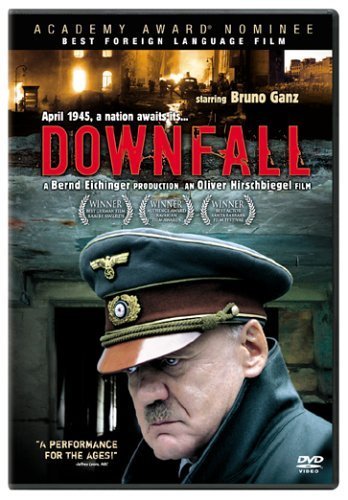
April 2006, a nation awaits the downfall of the Junior Bush regime. . . . .

It's coming. The Bush presidency is crumbling, and short of an oil hall putsch, we will be rid of them by early 2009 regardless of Scooter, Abramoff and the rest of this den of thieves.

This is the way of American presidents. Since 1900, two have been assassinated, two more died in office "naturally," and all the two timers suffered major crises in their second terms.

If we start with Eisenhower, he had to deal with Sputnik and the Gary Powers U2 spy incident. His tricky little VP, Richard Milhous Nixon, lost to JFK in the tight and nasty 1960 election. JFK was assassinated not even three years into his tumultuous first term. LBJ withdrew in 1968 thanks to the Tet Offensive and general Vietnam fiasco. Nixon made his infamous comeback, only to have to resign in the wake of Watergate. Ford pardoned him and promptly lost to Jimmy Carter, who because of a bizarre combination of personal honesty, national "malaise," and the Iranian hostage crisis, lost in 1980 to Ronald Reagan, who found himself losing his mind and grip on power thanks in part to the Iran-Contra scandal (remember the great idea of sending cakes, Bibles and missiles to the crafty Iranians? While sending missiles and other equipment to Saddam Hussein, and Stinger missiles to the Afghan guerillas, who included among their number Osama Bin-Laden?) Senior Bush, of course, had been immersed in all the same messes, as well, and had been a CIA friend and supporter of Manuel Noriega. As President, he ordered the invasion of Panama and toppled Noriega, dropping the unfortunately pockmarked man into a Florida prison cell for the rest of his life. Some friend. Next, he organized the grand invasion of Kuwait, hurling Hussein's Iraqis back and inflicting heavy casualties. But then he managed to bungle an alarmingly high approval rating via his inept handling of the economy and aloofness from the common people, leaving the door open for Bill Clinton, who of course got himself into heaps of trouble over his various skanky girlfriends and general dissembling. He managed to survive, but in early 2001 the Republicans swept back into power with their boy Junior, one of the most stupid and wreckless men to ever hold office (moral: never trust a recovering alcoholic with power.) Finally, thanks to the Iraq disaster and intertwining corruption scandals, this wicked and imbecilic group of plundering buffoons are losing their grip,too. Of course, they get to crawl from the wreckage -- leaving the rest of us poor slobs to deal with their toxic garbage dump for God knows how long -- maybe until the world collapses in shock from the collective ravages of humankind.

The main point being, people have been tricked and fooled forever, but leaders are leaders, and they all go away eventually. Small comfort, but it's good to remember.

Two intense and excellent film treatments of this topic are Werner Herzog's Aguirre, the Wrath of God (1977) and Oliver Hirschbiegel's Downfall (2004). Anyone who sees these and has a pulse has to see the folly of trusting megalomaniacs. These movies depict downfalls in epic German style, of course. Americans, if not any less violent than Germans, are mercifully less disciplined and less organized, and so the inevitable downfall of our leaders does not automatically bring the downfall of the entire nation. Too, we have a simpleminded but workable Constitutional system in place to ensure a relatively smooth transition of power -- or at least we do until now. Thanks to 9/11 and the Patriot Act and the war with radical Islam, not to mention the disasters wrought by global warming, all bets are off from here on out.

Auf Weidersehen . . . . .

Thursday, March 23, 2006


The Real McCoy?

1957 saw the publication of Nevil Shute's On the Beach, Jack Kerouac's On the Road, and the successful launch of two Soviet Sputniks. That's right -- there was a whole fleet of the little things, perhaps better called Baby Sputniks. Not only did they usher in today's age of the communication satellite and everything that goes with it, but they also sent the US into panic mode. On November 3, 1957, Laika (a husskie mongrel) became the first cosmonaut in space inside Sputnik 2. She also became the first "space martyr." The Russians went on to successfully bring back alive two other dogs, Stelka and Belka, three months before JFK beat Richard M. Nixon in the 1960 US national elections (with Fiddle and Faddle already in the wings, no doubt).

If On the Road is about freedom of movement, so is "Waltzing Matilda;" On the Beach is about the end of movement, thanks to the Cold War becoming a hot one. Everything has a context. San Francisco columnist Herb Caen launched the term "beatnik" on April 2, 1958 (and he also later created the term "hippie"). Sputnik itself translates into English as "fellow traveller."

Though it all may seem comical and ridiculous now, the Cold War kept the world hostage to destruction, and on a very short leash.

When the movie version of On the Beach appeared in 1959, it naturally created quite a stir. How it explores the aftermath of nuclear war is what makes it fascinating. It shows, for instance, the breakdown of infrastructure. Imagine today the sudden ending of all air travel, followed by power outages, rationing, and bad coffee. In mythical 1964 Australia, people start riding horses again, pool resources, use horse and buggy for transportation. And people ramp up their lifestyles, drinking, boat racing, and, in one scene, racing cars as furiously as Mad Max will later in the Road Warrior movies. Few want to die "naturally" of radiation sickness, and the government will issue cyanide pills "when the time comes."

The movie made Nevil Shute one of the most famous authors of his day, but he hated it, especially because the Gregory Peck character does fall for the charms of Ava Gardner's Moira after his return from the reconnaissance cruise. Shute's version has Captain Towers keep things platonic, preferring the English stiff upper lip to Stanley Kramer's cinematic version. Shute died less than a year after the movie's release. Coincidence? You can check out his foundation (his full name was Nevil Shute Norway) here:
http://www.nevilshute.org/

The key players of the film version came from backgrounds outside the then-dominant self-proclaimed heterosexual WASP elite. Stanley Kramer was Jewish; Fred Astaire (Austerlitz), Catholic-Jewish-Protestant; Anthony Perkins, gay/bisexual; Gregory Peck, Catholic; Ava Gardner, North Carolina Catholic. They bring an urgency to the film, and a feel for complexity. There is no enemy in the film except, perhaps, radiation and death, and the human psyche.

These celebrities could give the current ones a run for their money. During the shooting of On the Beach, Veronique Passani, Peck's second wife, stayed with him in a well-stocked villa; they regularly entertained Ava Gardner and others. How fun! As for today's crew, it'll be interesting to see how Brad Pitt and Angelina Jolie handle their films from here on out -- especially when Angelina tends to fall in love with every leading man she works with, as she herself freely admits. More scenes of Brad weeping, I'm guessing. He's already back to smoking, poor man.

More on Ava and company soon. On the Road will finally be adapted to the big screen, too. Stay tuned for details on this . . . and on the titillating connection between On the Beach and Jonestown.


Until then, arrivederci!