Showing posts with label Syria. Show all posts

Thursday, September 26, 2013

The Roman Stone of Lady No'om

No'om, wife of Haira. "Alas." She walked the Earth 1850 years ago, residing in Syria. Specifically, in the great trade and cultural center of Palmyra / Tadmur, smack dab in the middle of Syria. 

During the terrible fighting of now, the extensive archaeological site at Tadmur is exposed to looting and other damages by the warring factions and outside opportunists.

Luckily for the memory of No'om, her Roman sandstone relief is ensconced on a wall in the Ackland Art Museum of The University of North Carolina at Chapel Hill. Score!

The details are pretty amazing. Is she (was she) left handed? 

Additional deets here

Today's Rune: Journey. 

Tuesday, September 24, 2013

Defining Lines at the Nasher

Much to see at three thoughtful, absorbing exhibits at the Nasher Museum of Art at Duke University in Durham, North Carolina. "Lines of Control: Partition as a Productive Space" is one of them. ". . . [C]o-curated by Iftikahr Dadi and Hammad Nasar, brings together art across many genres . . . that have their common theme a preoccupation [pun intended?] with borders, boundaries and lines that divide and demarcate. . . " The British Empire, for one, "brought in its wake the geographic and cartographic division of much of the inhabited world . . ." Obviously, we're still living in the fallout zones from "the Middle East" to Africa and everywhere else in the world as we know it -- or really know it not. 
"Defining Lines: Cartography in the Age of Empire" takes a similar look at dividing lines, focusing on maps as cultural artifacts that carve up the world in ways that favor certain groups over others. "No matter . . . their claims to 'objectivity,' 'accuracy' and 'authority,' maps never simply show the world as it is; they are . . . 'a construction of reality, images laden with intentions and consequences.'" In the end, it's mostly about culture, power and economics. 

A third exhibit revolves around Doris Duke's spectacular "Shangri La" project in Hawaii, replete with beautiful Islamic-themed signs and wonders.

Very impressive all.

Today's Rune: Journey.   

Wednesday, August 14, 2013

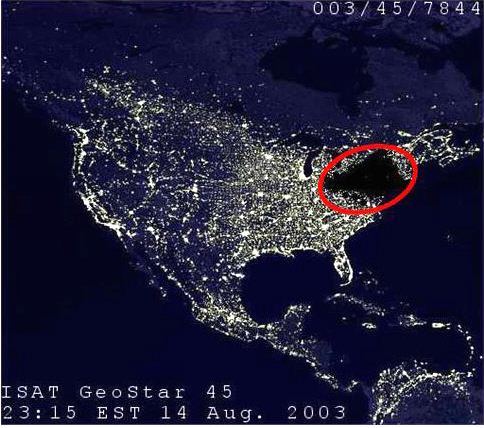
The Great Blackout of 2003 in the US and Canada

For those who found themselves on this date ten years ago located within any swath of North America ranging from Detroit to Toronto to Manhattan, here's an oft-evocative writing prompt: "How did you respond to the Great Blackout of 2003?"
I've already gotten more than 100 responses so far, forming a mosaic of tales tall and short, muted and loud. The folks trapped in an elevator when the power failed. The heat. The food sizzling on grills in backyards and alleyways. The mad dashes from place to place grand and small. Generators. Boozing. Car radios. Dancing in the streets. Bartering by flashlight. All of it and more! How about you? 


Of course, some folks ain't never even done heard of nothing like such a thing. But there ya go, that's the way of the world and all the people in it. Go ask them that's stuck in Cairo or Aleppo on this date today, in the year 2013. Or in the parlance of our day:

***What?***

Today's Rune: Journey.   

Friday, July 26, 2013

When You Do Have to Live Like a Refugee


People tend to move or migrate for several reasons, including work opportunity or survival and sometimes to find hope within a nested support system. 

People are refugees or forced into relocation because of the effects of war, revolution and persecution -- the latter including slavery and religious or other cultural attacks on a scale ranging from harassment through coercion to genocide.   

As of mid-2013, the biggest mass refugee movements radiate from just a handful of countries. That is, more than half of all new and recent refugees have been displaced by upheavals in Somalia and Sudan (plus South Sudan), Afghanistan (still), Iraq (still) and Syria. (Source: United Nations High Commissioner for Refugees (UNHCR), Displacement: The New 21st Century Challenge. Global Trends 2012 [2013]).

All refugees have stories to tell. Anyone can become a refugee. In addition to wild variables such as effects of war, revolution and persecution, we can add natural disasters, global warming, climate change and mass toxic events, or even slow seepage.


Today's Rune: Signals.  

Saturday, June 29, 2013

The Ottoman Empire and the Great War of 1914-1918

In developing a mock online class on The Great War and the 1920s for training purposes, it's been interesting to connect the dots between the end of the Ottoman Empire -- and the intention of the Allied Powers to divvy up its territories -- to today's political and cultural developments throughout these same areas. Notice that Syria is smack-dab in the middle of this map of the Middle East.

For starters, all one need do is look at these maps to see the jigsaw puzzling impact of the Great War of 1914-1918 and its aftermath in the region, and on the world.

Here are some of my notes for such a class so far:

Unit 1, Lesson 2. The Ottoman Empire in Context.

Objectives:
To understand what was at stake for the Ottoman Empire in 1914.
To understand why the Ottomans allied themselves to the Central Powers.
To analyze why the Allied Powers sought access to Ottoman territories.
To analyze the strategic importance of geography and natural resources to all players.

Read G.J. Meyer, A World Undone: The Story of the Great War, 1914-1918 (Delacorte Press, 2006), pages  74-79.

What was at stake for the Ottoman Empire in 1914?

Why did the Ottomans ally themselves with the German and Austro-Hungarian Empires?

Why did the British, French and Russian Empires want access to territories under the control of the Ottoman Empire?

Consider resources and geography. Petroleum and waterways.

Unit 1, Lesson 3. Gallipoli.

Objectives:
To understand the Allied campaign to capture Constantinople/Istanbul.
To analyze how the Ottoman Turks contained the Allied attack at Gallipoli.
To understand the political and cultural impact of the Gallipoli Campaign.

Gallipoli Disaster. Read G.J. Meyer, A World Undone: The Story of the Great War, 1914-1918 (Delacorte Press, 2006), pages  265-272.

What was the Allied plan to knock the Ottoman Empire out of the war?

How did the Ottoman Turks contain the Allied attack at Gallipoli?

Additional reading (primary sources): James Hannah, ed., The Great War Reader (College Station: Texas A & M University Press, 2000), pages 151-164.

Unit 1, Lesson 4. Armenian Genocide.

Objectives:
To understand why the Ottoman leadership conceived of its Armenian population as enemies.
To analyze the role of the Russian Empire in Ottoman calculation.
To understand the essential details of the Armenian Genocide.
To understand the aspirations of the Armenian and Kurdish peoples.
To analyze the longterm political and cultural impact of the Armenian Genocide.

Read G.J. Meyer, A World Undone: The Story of the Great War, 1914-1918 (Delacorte Press, 2006), pages  289-291.
Why did the leadership of the Ottoman Empire scapegoat the Armenian population?

What was the role of the Russian Empire in Ottoman calculations?

Unit 1, Lesson 5. Palestine Front. Read G.J. Meyer, A World Undone: The Story of the Great War, 1914-1918 (Delacorte Press, 2006), pages  538-541.

Unit 1, Lesson  6. Mesopotamia Campaign, 1915-1918.

Lieutenant General Frederick S. Maude after Allied capture of Baghdad in 1917: “Our armies do not come into your cities and lands as conquerors or enemies, but as liberators."

Critical thinking. What were the main objectives of the Allied forces in Mesopotamia?

What was the role of disease and the medical corps in the Mesopotamia Campaign?

Unit 1, Lesson 7. Treaty of Versailles, Treaty of Sèvres,  Mandate System. Emergence of Modern Turkey (Greek War, Smyrna). Syria and Lebanon, Palestine, etc. 

Today's Rune: The Mystery Rune. Maps: UK National Archives.   

Thursday, June 13, 2013

Syria's Turn


Today marks a significant turning point in the Syrian Civil War (2011-present) because the USA will now officially supply armaments to the rebels fighting Syria's Bashar Hafez al-Assad-led government forces. 

Above is an ethnoreligious map courtesy of Wiki Commons (from 2012).

To compare scale, Syria has many more people involved than did the American Civil War of 1861-1865, in which more than 600,000 died. Syria's population (including refugees) is about 23 million strong; so far, probably more than 100,000 people have died in its current civil war (about 93,000 is the official UN estimate as of today, mostly civilians).

A closer equivalent might be the Spanish Civil War (1936-1939) -- Spain had a population of about 24-25 million people at the time. An estimated 500,000 died in the course of that internecine war; I'm not sure if the total number includes 150,000 or so executed by the government of Generalissimo Francisco Franco in its wake, or if the total rises to 650,000.

As with Spain, so now with Syria also in the sense of drawing in other nations, volunteers, weapons and additional supplies.

The Spanish Civil War is often depicted as a technological testing ground and precursor to World War II. The Syrian Civil War may be seen within the larger context of the "Arab Spring;" as for other effects, they will unfold with time.  

Today's Rune: Strength.    

Sunday, May 26, 2013

The Syrian Basilisk


One of my grandfathers had a volume of writings by Voltaire, and one of my early favorites in this volume was (and still is) Zadig, or Fate / Zadig ou la Destinée. Histoire orientale (originally published in 1747).

Rather than delve into today's Syrian Civil War -- with its chemical weapons, torture of prisoners, indiscriminate bombardments or rebel commanders literally eating portions of dead Syrian government soldiers (sadly, all true and happening in 2013) -- here's a snippet from the Roger Pearson translation included in Candide and Other Stories, Oxford University Press, 2006, page 153:

On coming to a fine stretch of meadowland, he saw several women busy looking for something. He took the liberty of going up to one of them and asking her if he might have the honour of assisting them in their search.

"You'll do no such thing," replied the lady, who was from Syria. "Only women may touch what we're looking for. . ."

Why the search? Because: "Lord Ogul is ill. His doctor has ordered him to eat a basilisk cooked in rose-water, and as it's a very rare animal, which allows itself to be captured only by women, Lord Ogul has promised to take as his beloved wife whichever one of us brings him a basilisk . . ."

Without further ado, Zadig let the Syrian woman and the others carry on searching for their basilisk, and continued on across the meadow. . .

As Zadig responds to the Syrian woman's and the others' search for a basilisk, I am responding to the factions of the Syrian Civil War. How about you? 

Today's Rune: Journey.  

Thursday, May 02, 2013

Syriana: Send Lawyers, Guns and Money?


Well, folks, the violent chaos in Syria continues. Most reading this have some idea of what's going on, though about one in five American adults have not heard of, not seen footage of or even know of the existence of Syria. On the other hand, about the same number of American adults do have a pretty decent idea of what's going on. 

Syria has a population of about 23 million people, with a density of circa 307 people per square mile/118 per square kilometer. By comparison, Texas has about 26 million people and a density of 98 people per square mile/38 per square kilometer. Like people in Texas, people exist in Syria, too. 

As a result of the Syrian Civil War (2011-present), refugees flee, casualties mount. What next?

According to a Pew Research Center for the People & the Press report released just a few days ago, "Modest Support for Military Force if Syria Used Chemical Weapons/Americans Express Little Interest in Syrian Conflict." 

"Since the Syrian conflict began in 2011, it has never drawn much attention from the U.S. public. At most, only about one-in-five have tracked developments in Syria very closely."

Nonetheless, according to the same Pew survey: "By 56% to 24%, Republicans favor the use of military force against Syria if the charges that it used chemical weapons are proven. There is less support among Democrats (46% favor vs. 34% oppose) and independents (41% favor vs. 36% oppose)." 

Link to full overview: http://www.people-press.org/2013/04/29/modest-support-for-military-force-if-syria-used-chemical-weapons/

Another very recent survey concluded thusly: "Most Americans are not following the conflict in Syria very closely. In the HuffPost/YouGov poll, only 34 percent of respondents said they had heard a lot about the conflict. Another 48 percent said they had heard a little, and 18 percent said they'd heard nothing at all."

Link to full article: http://www.huffingtonpost.com/2013/05/01/syria-poll_n_3194927.html 

Should outside powers send arms shipments to the Syrian rebels? 
Should outside powers increase humanitarian aid? 
Should the US intervene as it did in Libya, with mostly air and naval support as part of a multi-national effort? 
Should a US-led "coalition" invade and occupy Syria as was done in Iraq and Afghanistan?
Should the "Great Powers" "facilitate" a "regime change?"

One thing we can all be sure of: something more is gonna happen regarding Syria in 2013 and it ain't gonna be pretty.

Today's Rune: The Self.

Tuesday, November 20, 2012

The First and Last Casualties


Coverage of wars and poverty, of competing ideas and political conflict is all over the map.  Attention Deficit Disorder and entropy on one hand, pre-existing ideological prejudices and Obsessive Compulsive Disorder on the other.  Avoidance on the one hand, oversaturation on the other.

Some of the most memorable wartime investigative journalism can be epitomized by the work of Seymour Hersch, who has, during his career, written a number of penetrating stories for United Press International (UPI), the Associated Press (AP), The New York Times, The New Yorker, and more. Prime examples: exposing the My Lai Massacre (1968). Investigating the context of what led to the shooting down of Korean Air Lines Flight 007 (1983). Digging into the false pretenses and cynical manipulation of public perceptions by the Bush-Cheney Administation that led to the Iraq War (2003-2011). Delving into the ghoulish facts of the Abu Ghraib POW scandal. And so forth. This is not to say that Hersch is always completely accurate in his reporting, but rather that he's done more good investigative work relating to war and abuse of power than most. Under the banner of the First Amendment, we need more people doing this kind of work.

Today's Rune: Flow.

Wednesday, November 14, 2012

Blood and Rockets


Here we go again. No negotiated settlement, endless bloodletting -- in cycles. Without the will for successful negotiations, there can be no successful negotiations. Without a live-and-let-live attitude on all sides, there cannot be a live-and-let-live reality on the ground, in the air or on the high seas. And the destruction continues.  A tit-for-ten-tats, ten eyes-for-an-eye, another slaughter in the making for the "Holy Land."  Way to go, peoples.


Today's Rune: Gateway.

Tuesday, November 06, 2012

The Forest and the Trees


I've been aware of history and politics long enough to know that this a big deal: the re-election of Barack Obama to a second presidential term despite an almost exactly split body politic. The fact that this election has proceeded through the intricate ways and obstacles of civil society rather than the main alternative -- civil war -- is heartening in the longterm.                                                                                                                                                            


With history and politics and in life itself, it's best to see both the forest and the trees -- the big picture and the details embedded within that big picture.

North America has endured many wars over the centuries. In Mexico, the Revolution was underway a hundred years ago. In the USA and especially in its breakaway states, the American Civil War raged 150 years ago. 200 years ago, the US and Canada were battling it out in the War of 1812. Overseas in Syria now, in 2012, violent, destructive civil war rages at this very moment, and will until it burns itself or most of Syria out.

These alternatives, between civil society competing for power and policy direction in relatively peaceful political ways or battling it out with heavy weapons in a vast, merciless and patricidal bloodletting, are the choices.

Rejoice in democracy at work. Rejoice in civil society. Look for common ground.

Surely most will agree that infrastructure must be shored up, that it's a good thing to do that.

Surely most will agree that there must be a sustainable ecosystem in order for us to survive.

Whatever our feelings are, surely more of us can seek out and find more common ground.

Now, under the shade of sturdy trees in the great forest, let's get to it!

Today's Rune: Signals.   

Sunday, November 04, 2012

The Bridge


Jean-Luc Godard's Notre Musique (2004) devotes a fair amount of screen time to the Stari Most (Old Bridge) in Mostar, Bosnia-Herzegovina, which was heavily damaged (i.e. effectively destroyed) by Croatian tanks and artillery fire. Built in 1566 under the aegis of the Ottoman Empire, the original bridge met its end on November 9, 1993. After the Bosnian War and a global outpouring of support, the bridge was rebuilt between 2001 and 2004, incorporating salvaged stones from the Neretva River. In Notre Musique, even a trio of American Indians (aka Native Americans) show up for the reconstruction efforts.

The Stari Most and entire historic heart of Mostar's "Old City" comprise a UNESCO World Heritage Site. According to the UNESCO description: "The reconstructed Old Bridge and Old City of Mostar is a symbol of reconciliation, international co-operation and of the coexistence of diverse cultural, ethnic and religious communities."* Here's to hoping. For now, the chaos of war has moved on to Syria and other lands, still greedily devouring people and places as it roams.

Photo credit: Stari Most (Old Bridge) by Jason Rogers, November 11, 2006. Wikimedia Commons.
*"Old Bridge Area of the Old City of Mostar:" http://whc.unesco.org/en/list/946

Today's Rune: Warrior.

Monday, October 22, 2012

The Iliad Becomes An Iliad


A little more about the Undermain Theatre production of An Iliad in Deep Ellum. Bruce DuBose does the talking and Paul Semrad plays most of the instrumental mood music.

As you can see from the theatre card pictured above via the electrical outlet, this version of The Iliad has modern connections. Most of them are subtle, but two stand out from what I saw this past weekend. First, when the Poet (DuBose) begins reeling off where the Greek contingents arrayed against Hittite Troy (Ἴλιον aka Ilion or ILIUM) come from, it dawns on him (his persona): the audience may not be familiar with these ancient lands or peoples. So he updates them to different locales around today's USA -- the more to drive home the universal relevance of the epic story, song and poem of the Trojan War. The audience immediately connects the Trojan War to, say, the Afghanistan War, or the Syrian Civil War. And indeed, later on the Poet reads the names of wars from a long scroll, a representative sample only of what seems like a hundred of them from the Trojan War right up to Syria and the burning of Aleppo. The audience winces during this litany, chilled to the bones, and for good reason. It would seem that humankind is doomed to keep clawing itself to pieces down through the ages and right off into the future. Or as George Santayana noted in 1922, between the Great War to End All Wars and WW2: "only the dead have seen the end of war." But we were and are and will be human all the way. An Iliad also reminds us to live life while we can, because mischief awaits us at every turn. Be hospitable to poets and other artists, Homer seems to be saying, and they will make the way more palatable in return. Good one.

Today's Rune: Separation (Reversed).         

Wednesday, December 14, 2011

Is it Over?


And so the US is seemingly pulling its last combat troops out of Iraq after nearly nine years of invasion and occupation. It's been so long many were born into this debacle and have no idea how it all happened.

After the Persian Gulf War of 1990-1991 -- in which Iraq's military was badly defeated in response to its invasion of Kuwait -- no fly zones (NFZ map above courtesy of wikimedia) were created by the US, UK and France to keep the battered Saddam Hussein regime's remaining armed forces in check. One aspect of the NFZ: Kurds were to be more protected in the north and Shiites in the south from continued Hussein regime revenge attacks. Hussein's Iraq had earlier fought a brutal eight-year war with Iran and was still its primary enemy, so its eastern flank had to be covered, too. 

Into this mix -- which had the effect of keeping Hussein's government penned in while remaining a counterbalance to Iran -- came the events of 9/11/2001. The George W. Bush administration decided to invade Iraq, even though there was no direct link between Iraq and 9/11; the attacks had been devised and managed from Afghanistan, where bin Laden was based under the auspices of the Taliban. 

France, Turkey and several Arab states refused to participate in the invasion of Iraq (France did and does participate in Afghanistan operations). The US-led invasion of Iraq by a "coalition of the willing" removed Saddam Hussein from power, but emboldened (and made nervous) the Iranian government, which is still even now moving toward a nuclear weapons capability and engaged in a shadow war with its opponents.

Was the 2003 invasion of Iraq a wise move? Could the US afford such an adventure? Was it worth the cost in blood and treasure? Five and half years after the start of the invasion, the US economy took a nosedive, as did the economies of many of its allies. Today, the Obama Administration welcomed home some of the last US troops to be pulled out of Iraq.

Looking back, Turkey's position has risen. Some may not now remember or know that Turkey refused to allow US ground forces to invade northern Iraq through its territory. Now the Turkish government is in a stronger position to influence events in the entire region, including Syria, Israel-Palestine, Egypt and Iraq. The Turks and Kurdish elements continue to fight along the borderlands, as well. The Iraq War -- wiser to avoid than to plunge into.

I was opposed to an invasion of Iraq in 2002 and 2003, protested in the streets along with many many others to no avail and continue to think it was a terrible decision.

Today's Rune: Strength.
    

Tuesday, November 15, 2011

Freedom of Assembly in Action and Contested


The Occupy Wall Street movement -- or civil uprising -- has been unfolding for a couple of months now, spreading around from NYC. It's mostly peaceful. Responses have been mixed. Legal skirmishes have been ongoing -- city ordinances, permits, tents, parades, signs, police raids, social media, celebrities, writers, bread and circuses. It's gone global.  

So far, compared to simultaneous protests in Syria, Yemen or Somalia, there has not with the OWS movement been much violence from either direction. Compare, so far, to the 1960s -- when there were countless bombings, assassinations, and numerous instances of police and vigilante brutality.  Around the OWS happenings, constitutional rights are more or less intact and well-defended. But it's a big game of hit or miss so far. Some of the protesters are goofy, and some of the "official" response is heavy-handed at the local level. I dread the possibility of vigilante violence.

My impressions are not strictly from the perspective of a distant observer. I have participated directly if moderately, carrying signs, talking with OWS people, giving encouragement, that kind of thing.

It's clear what the movement is saying: social priorities are important and they are presently askew.  Improvements can and should be made. It's really that basic. The message is more important than the messengers, or even the tactics.  

Today's Rune: Breakthrough.    

Monday, November 14, 2011

Serious Midnight


So many conflicts, so little time. If you're in the line of fire, knives and bombs, so much time. The situation in Syria pits protestors against the Bashar al-Assad regime, civilians against soldiers and internal security forces.  Yes, there is war all over the planet, from Sudan to Somalia and spinning all around the globe, and this is just one of them. 

The countries neighboring Syria are being sucked into this particular disaster, too. Syria's population: 23 million -- more than live in New York, fewer than in Texas.


How this Syrian cycle ends, nobody knows yet; but more will be killed by the next sunrise, and, by the following midnight, more will be killed after that. There but for the grace of God or luck or kismet go the rest of us.   

Today's Rune: Joy.

Thursday, September 29, 2011

I Love Banned Books!


In the USA, George Carlin was the man when it came to pointing out the absurdities of word censorship, with nods to Nat Hentoff and many others.

As a librarian and writer, I love banned words. I love banned books displays, too. And of course, I love banned books.

Taking on censorship is a piece of cake -- unless that censorship has government and secret police backing. Unless that censorship is enforced by Italian fascists, North Korean "communists," Iranian Basij, Puritan freaks, Ku Klux Klansmen, Nazi brutes, Syrian interior ministry stooges or totalitarian/authoritarian goon squads in general. Even then, crackdowns add weight to the importance of words, texts, art of all kinds, even more so -- precisely because made rare and precious, subversive and free.

Back in 1997 while doing research, I visited the Special Collections at UVA's Alderman Library in Charlottesville, Virginia, which had amazing displays, things like William Faulkner's typewriter, coat, chair and other accessories; if memory serves, it had samples of Thomas Jefferson's red hair, too, and artifacts from US and Confederate General Joseph E. Johnston. UVA's Special Collections also had on display banned materials like S.C.U.M. Manifesto and William S. Burroughs' (aka William Lee's) Junkie. Hell, even Homer's The Odyssey was banned by morons somewhere on Earth.

Love it: the Power of the Word.

Today's Rune: Movement. [Adapted from an earlier post dated July 18, 2009].

Saturday, September 03, 2011

Buñuel: Simon of the Desert


In Luis Buñuel's Simón del desierto / Simon of the Desert (black and white, 1965), a saintly ascetic lives atop first one pillar, then another, where he is thrice tempted by the Devil (in the guise of Silvia Pinal). Third time's the charm.

Simon as Holy Fool and Wise Man (played grandly by Claudio Brook) could represent any religious tradition in his primal existential ascetic stance, but he is in fact based on a real person, a Syrian Christian saint now known as Symeon the Stylite (ca. 390-459 A.D.) and also Saint Simeon Stylites the Elder; there were other stylitoe ("pillar-hermits"), too. Maybe we'll see more of them in the throes of the 21st century? 

The central dramatic conflict in Simón del desierto -- Simon vs. the temptations of the Devil -- is largely unseen or ignored by various pilgrims and other visitors to Simon's pillar-shrine. Below the pillar, priests, various monks, Simon's mother (who lives in a nearby hut), a foul-mouthed dwarf, hungry poor and even a possessed monk seem more concerned about what Simon can do for them than anything else. Yet when a miracle occurs -- a man whose hands have been chopped off for stealing bread has his hands restored -- the crowd seems ho-hum or even pissed off about it. Such ungrateful people.

I won't even go into the nice little twist at the end of this short masterpiece.


Silvia Pinal, whose 80th birthday is coming up on September 12, 2011, here plays the Devil, just about to pop out of a casket to tempt Simon anew.

Today's Rune: Gateway.

Sunday, August 21, 2011

Downfall: Collapse of the Qaddafi Regime, 1969-2011


The 2011 Libyan War is coming to a sudden crescendo in Tripoli. The government of Muammar al-Gaddafi / Qaddafi is disintegrating as rebels roll through the Libyan capital.   Things are happening so quickly this year that the Syrian government may collapse next. Turkey, with a military show of force, could precipitate the change. Turkey, along with a significant number of other countries, may also pressure Israel to accept the formation of a Palestinian state. A wild year, to be sure. Four months to go.

The map above is already obsolete: the majority of the people of South Sudan declared their independence from Sudan on July 9, 2011, an act which has been internationally recognized.


Today's Rune: Strength.

Saturday, August 20, 2011

Blood and Oil: The Middle East in World War I


Blood and Oil: The Middle East in World War I: A Film by Marty Callaghan (The Minutes of History Series, 2006) gives a rare and helpful overview of the catastrophic human disaster called variously the Great War, the First World War and World War I -- from the perspective of the "Middle East" and "Near East." With so much ground to cover, it focuses on the Turkish Ottoman Empire and its regrouping as modern Turkey; the British Empire; the Russian Empire; the Arab revolt; the geo-strategic fight over resources (Suez Canal, Dardanelles, Persian Gulf, fresh water sources, petroleum); and to a lesser extent, the French Empire, the German Empire, Persia-Iran, the Kurds, Greeks, Italians, Armenians, Jews and Indian troops.


Even a cursory watch will help viewers trace the connection of 1914-1918 and continued warring into the 1920s as set-up for today's turmoil in Iraq, Iran, Syria, Israel, Gaza, Libya, Egypt and so on, including Kurdish guerilla activity. Blood and Oil does a fine job showing why Turkey remains an important regional power, though it never directly deals with the Armenian Genocide, and it might have been expanded to include North African fighting in places like Libya. 

Today's Rune: Possessions.