Showing posts with label New Orleans. Show all posts

Monday, July 10, 2017

Dan Trachtenberg: '10 Cloverfield Lane' (2016)

Jack be nimble,
Jack be quick.
Jack jumped over
The candlestick.

Jack jumped high,
Jack jumped low,
Jack jumped over
And burned his toe.

Dan Trachtenberg's 10 Cloverfield Lane (2016) buzzes along with Mary Elizabeth Winstead as protagonist and John Goodman as antagonist in a cool, intelligent indie-style film, just my cup of coffee. Situated somewhere in the same universe as those crazy tales from the Coen Brothers as well as that of The Americans, Breaking Bad/Better Call Saul, the first season of True Detective and even Twin Peaks, it considers the kaleidoscopic possibilities of good, evil and also, from a human perspective, dimensions that may be indecipherable. 

"Sometimes you eat the bear, and sometimes the bear eats you." (The Big Lebowski). 
10 Cloverfield Lane has more than a passing connection to the Coen Brothers: Mary Elizabeth Winstead stars in the latest season of Fargo and John Goodman has appeared in five Coen films (six including his voice as an announcer).

There is a distinction in magnitude between premeditated mass evil, seemingly random evil, and situational evil. However, for anyone on the receiving end of evil (or even just a hungry bear), these distinctions may be moot. The key is in how one responds -- having to make existential choices, large or small, in the face of it. See Flannery O'Connor for more on that score. In all such cases, this is compelling stuff.

Today's Rune: Protection.  

Sunday, November 22, 2015

Roy Lichtenstein: New Orleans and Madrid

When you first come across this, you might think, "Aliens!"  At least I did -- looks like some kind of gigantic artifact from outer space. The setting is inside the vast covered courtyard (Nouvel Patio) connecting the old and new wings of the Museo Nacional Centro de Arte Reina Sofía in Madrid. Snapped this in the summer of 2014. It's a gigantic Roy Lichtenstein (1923-1997) sculpture called Brushstroke.

In New Orleans, there's a tall marauding demon creature carrying the exact same vibe -- or is that but a masked man striding around on stilts? Your choice. Go and see.
Last month, came across this sculpture and made the Madrid connection immediately. Here, Five Brushstrokes presides in front of the New Orleans Museum of Art (NOMA) -- as it has since December 8, 2013. 

Today's Rune: Fertility.  

Tuesday, November 17, 2015

France and Spain in New Orleans: Part II

La Nouvelle-Orléans, founded in 1718, formally remained part of the Empire of France until near the end of the Seven Years War, in 1762; from 1762 until 1803, it became Nueva Orleans of the Empire of Spain. New Orleans was briefly ceded back to France under Napoleon I, at which point it was sold to the USA.

Whether under French, Spanish or American control, New Orleans never fell to the British Empire. 
Cathédrale Saint-Louis, Roi-de-France / Cathedral-Basilica of Saint Louis, King of France / Basílica de San Luis. Pictured here circa 1838 in the Spanish Colonial style (flanked by turrets). Since the beginning, there has been a Catholic Church on this site.
Same cathedral in October 2015, with accentuated spires, significantly modified. (Photo courtesy of SAB).  
In the Cabildo: portrait of Antoine Jacques Philippe de Marigny de Mandeville.
Butterscotch house in the Quarter.
Portrait of Napoleon I (1769-1821) at the New Orleans Museum of Art (NOMA).
Mosaic in front of the Napoleon House, 500 Chartres Street -- in the Quarter.

To me, after traveling between Madrid, San Francisco and New Orleans, the Spanish, French and Catholic flourishes became very evident and interconnected. All of these cities are tributes to architecture and design, and all (in their centers) are quite walkable.

Today's Rune: Fertility.  


Monday, November 16, 2015

France and Spain in New Orleans: Part I

Joan of Arc: A Gift of the People of France. Present location: by the French Market, Peters and Decatur. Joan of Arc served with the victorious French forces defending "Old" Orléans (in 1428–1429) against English attackers during the Hundred Years War, which France ultimately won as well.
Fleurs-de-lis can be seen all over the Vieux Carré, the "old square" or French and Spanish Quarter.
A little map of the Quarter put out by the US National Park Service.
Barefoot bride in a wedding procession in the Quarter, close to the Place d'Armes, / Plaza de Armas / Jackson Square, October 2015. (Photo courtesy of SAB).
The jaunty primary colors of another house in the Quarter.

Today's Rune: Harvest. 

Tuesday, November 03, 2015

New Orleans: The Old Ursuline Convent

When visiting New Orleans, I pay at least one visit to the Old Ursuline Convent, the oldest sections of which date to the 1750s, and even before then by way of some of its interior artifacts. The main buildings have survived city fires, floods and war. The Ursuline nuns eventually moved to other locations in the area, but these convent buildings and grounds still remain under the auspices of the Catholic Church and now serve in the specific role of Catholic Cultural Heritage Center. 
This is the vantage point from the front (formerly the back, until about 1825) entrance to the Old Ursuline Convent. The little building pictured in the middle here is a sort of gateway to the grounds, accessible at the 1112 Chartres Street entrance; there's a cute little gift shop inside. You can just barely see the peak of the front roof of the Beauregard-Keyes House that's on the other side of Chartres Street. 
Inside of Saint Mary's church, a mid-1840s addition to the Old Ursuline Convent.
One of the mysteries to be found inside the Old Ursuline Convent. Note young Jesus rotating what looks like a bowling ball that's painted light blue and decorated with gold stars. What's He up to here?
Saints inside Saint Mary's Church include Saint Lucy, with supernatural eyes on a platter. She is patron saint of writers, salespeople and the blind, among other things.  
Lush vegetation and oranges, or orange-like fruits, grow inside the interior courtyard of the Old Ursuline Convent. Pictured here is a similar scene across the street, in the Beauregard-Keyes House garden.

Today's Rune: Fertility. 

Monday, October 26, 2015

Language of the Fan: The Beauregard-Keyes House (New Orleans)

BEAUREGARD-KEYES Historic House & Gardens: A French Quarter Landmark. Built in 1826. Pierre Gustave Toutant Beauregard (1818-1893) lived here for a time after the American Civil War. Prolific author Frances Parkinson Keyes -- rhymes with "eyes" -- (1885-1970) purchased and restored it after World War II. 
Interior hallway.  They rarely make hallways or ceilings like this anymore! Then again, central air conditioning and heat wasn't an option yet in the 19th century.
"Language of the Fan."  There's quite a collection of hand-held fans on display, including one formerly deployed by Doña María Eugenia Ignacia Augustina de Palafox-Portocarrero de Guzmán y Kirkpatrick, Empress Eugénie de Montijo (1826-1920), consort of Napoleon III. 

Fans could be used to communicate silently in code when one was assigned a chaperone, or if busybodies were in earshot of the holders.   
A cool tiled skylit area with Catholic touches.
More tiles with a burst of religious iconography. 
Courtyard in the back with additional working spaces. Looks and feels like a nice place to live and work. 

Today's Rune: Harvest. 

Tuesday, October 20, 2015

Across The Bridge: The Old Live Oak Trees of New Orleans

One of the best places in the world to see a concentration of great hoary and ancient live oaks is City Park, New Orleans. This past Saturday (October 17, 2015), two compadres and I made a little pilgrimage to behold them. When we asked a cop for directions, he pointed and suggested, "For those old trees? Try across the bridge" (-- a little bridge that takes tiny Anseman Avenue in the direction of City Park Avenue. I think the water the bridge spans is a sort of "oxbow" remnant of Bayou St. John.) 

City Park itself is larger than Central Park, and slightly older (1854 vs. 1857). Part of a greater parks movement supported by thoughtful civic leaders, City Park joined the ranks of other grand American locales such as the squares of Philadelphia and Savannah. In Chicago, Lake Park soon sprang into being (in 1860), later to be renamed Lincoln Park. On the West Coast, San Diego park space was set aside as early as the 1830s, while the great Golden Gate Park in San Francisco (which I sauntered and gamboled though in June) was developed in the 1870s.   
At play under the live oaks of City Park during the Union occupation of New Orleans, 1863. No matter what, the show must go on. From years ago, I remember stumbling across a petition by NOLA citizens to save the live oaks during wintertime in this period -- Union officers were apparently swayed not to let their men cut them down for firewood.  
The flooding of New Orleans after Hurricane Katrina in 2005 did great damage to the denizens of City Park. Hundreds of trees were lost, as well as the contents of the botanical garden. However, most of the ancient live oaks live on a rise that was not drowned by the flooding. The bigger ones that remain in 2015 range in age from about 150 to 800 years old. For more information about City Park (including efforts to restore it after Katrina) here is a link.  
The oldest and biggest live oaks in City Park have names: for example, the McDonogh Oak, Anseman Oak, Allard Plantation Oak (the tract had been part of this plantation), Colony Grove Oak, Dueling Oaks and Suicide Oak (don't ask, don't tell).

The woman in this picture is relaxing in a massive low-lying branch of (I'm almost certain) the McDonogh Oak, just beyond the Owen/Butler Memorial Fountain (1910, 1929). She's reading a book, for sure, but I didn't ask her which one. The green-bronze statue in the foreground is Chloe, a nymph - i.e., Chloé, the water nymph. Can you dig?   

Today's Rune: The Mystery Rune. 

Wednesday, March 18, 2015

Saint Synchronicity


"I was just thinking about you," you say, answering the phone. Happens often. In the words of poet Léon-Paul Fargue, "It's only natural," though it often feels tingly and supernatural.

Yesterday, Saint Patrick's Day, I had three distinct shimmers of synchronicity, time-shift experiences that seem to go beyond routine cognition.

Behind the first curtain. Just before lunch at Yogi's -- ordering a customized concoction I refer to as a "Greco-Mexican" omelette -- the strong image of a Mardi Gras face came to mind. Yes, it was Saint Patrick's Day, but it was definitely Mardi Gras green tinged with other festive colors that I saw in my mind's eye.

Imagine my surprise when fifteen minutes later, I came across the above (here courtesy of a mobile phone camera) image. Tingle. Precognition? Memory? Time flip? Gestalt or field perception? A combo of some or all? 
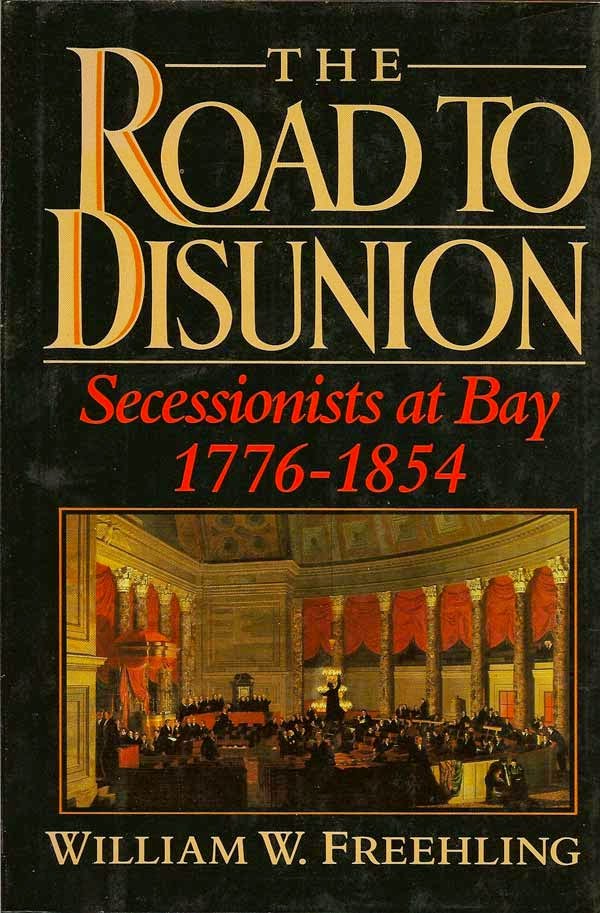
Behind the second curtain. Just hours later, the image of a specific book came to mind -- this book: William W. Freehling's Road to Disunion, Volume I: Secessionists at Bay 1776-1854 (1991).  I actually scanned my office bookshelves to see if I still had it from graduate school. No sign or trace except in the mind's eye.

Imagine my surprise when, not fifteen minutes later on a different floor of the same library, I see a professor type carrying the exact same book title with the same cover that I had "seen" internally.  I asked him about it -- a part time instructor whom I had never previously met or even seen before. I told him of the coincidence. He probably thought I was a bit touched. 

Third curtain. A short while later, I was speaking with a peer about a long-term student who had transferred to another college in January. Within five minutes, that same student strode into the library.     

Finale. What's the point? Nothing in particular. But I wanted to point out how these things happen often, even when we blow them off, or chalk them up to "coincidence" -- whatever that is.

Today's Rune: The Mystery Rune. 

Thursday, January 08, 2015

Chalmette 200: The Battle of New Orleans, 1815-2015

Chalmette plantation: today's the 200th anniversary of the Battle of New Orleans, fought at the very end of the "War of 1812," which might better have been named the War That Began in 1812. Or, Another Human Folly Played Out in North America.

After British, Canadians and First Nations (aka Indians) fended off an ill-conceived, half-assed American invasion of Canada earlier in the war, the British high command thought it would be fun to bag New Orleans for the Empire. On January 8, 1815, the "poor bloody infantry" charged with this task -- as "boots on the ground"  -- were ordered to launch a frontal assault against a fortified American defensive position that covered the approach to New Orleans, under the command of Andrew Jackson (who became a national hero.) 

This date, which also happens to be the birthday of Elvis (USA) and David Bowie (UK), became a national holiday in the USA after 1815 -- a big drinking day full of toasts and boasts. Besides July 4 -- Independence Day -- there wasn't much else to celebrate yet.   
At Chalmette/New Orleans, the British had about 10,000 troops, the Americans, half that number -- but behind a canal and barricades. The attackers, out in the open, lost some 2,000 casualties, including many officers, while the defenders lost maybe 300. 

Some of the surviving British soldiers made it through this nightmare only to die, about six months later, at the Battle of Waterloo. 

Today's Rune: The Self. 

Wednesday, December 31, 2014

Farewell, 2014!

Did a fair amount of walking the Earth in 2014, plus travel by air, rail and four-wheeled automobile. No ships this year, no bus, but one horse and buggy team. Madrid was a highlight, plus around Spain by rail and via London and New York City by jet. Walked Center City Philadelphia in cold weather in January (including Northern Liberties -- great name), plus visits to New Britain and Stroudsburg, Pennsylvania; afterwards, Memphis and Shiloh, Tennessee; Corinth, Mississippi; Hot Springs, Arkansas; North Carolina's Research Triangle area (where I began the first day of the year), plus Greensboro and Fayetteville; and New Orleans for quick sorties (much easier to fly in and take a taxi than drive, I've learned). Wanting to get to back to Detroit and Spain and also on to Cuba for the first time, maybe even Portugal. Interesting year, for sure. Got to spend time with lots of family and friends along the way, another benefit of traveling.
Saw many things while walking, and took photographs from time to time. One of the gifts of pictures is being able to see details that may have been missed or overlooked in person. The little red and gold hammer and sickle symbol embedded in this scene, for instance: it must have caught my eye, but if so, I would have forgotten were it not for this image. Turns out that it's the logo for ePartido Comunista de los Pueblos de España (PCPE). Probably wouldn't see that in Kansas -- which is just another excellent reason to see places far from home base. Finally, people and places change with time, so return visits are equally eye-popping.
Happy trails, y'all! A salute to 2014!

Today's Rune: Fertility. 

Tuesday, December 30, 2014

'Call Me Burroughs: A Life' / Barry Miles (2014)

Clocking in at 718 pages divided into fifty-two chapters, endwords, notes, bibliography and index, Barry Miles' Call Me Burroughs: A Life (New York: Twelve, 2014) delivers a treasure trove of biographical detail, cultural history and social context. One of my favorite big reads of 2014. 

Within this hefty tome, we find everything from little William S. Burroughs' childhood visions (a la William Blake) of a green deer; his calling of the toads; and instrumental collaborations with other artists -- Allen Ginsberg of course, Jack Kerouac for a time and Brion Gysin, among many others. 

In 1937 while in Prague, Burroughs had an emergency appendectomy and remained in hospital for seventeen days: "before antibiotics, peritonitis was lethal, so he was fortunate" (page 65).  The same year, he married Ilse Herzfeld Klapper, who was Jewish, in order to help her escape to the USA from the encroaching Nazis. 

That's "just a little taste." 

By the 1970s, the period when Burroughs was living at "The Bunker" in New York City and also associated with the Hotel Chelsea, he was befriended by Debbie Harry and Patti Smith, in the burgeoning music scene (which I've always found interesting). They remained friends, too. 

In his final years based in Kansas, Burroughs was visited by Kurt Cobain, a highly emotional "Burroughs fan." Given how weird Burroughs himself could be, one can't help but want to laugh or cry in response to his quip, after Cobain drove off from their meeting in October 1993: "There's something wrong with that boy; he frowns for no good reason" (page 620). Cobain committed suicide about six months later, a member of the so-called twenty-seven club.

There are lots of other precious tidbits peppered throughout Call Me Burroughs. I hadn't realized that Arthur C. Clarke (2001: A Space Odyssey, 1968) was gay, for instance. Nor had I quite grasped just how dramatically Jack Kerouac had broken off from Burroughs and Ginsberg, for so many of his last years, largely because of Kerouac's (and his mother's) freak-outs. 

Thank you, Barry Miles!

Today's Rune: Breakthrough.    

Monday, July 21, 2014

The French Quarter Revisited

I thoroughly enjoyed both Herbert Asbury's The French Quarter: An Informal History of the New Orleans Underworld (New York: Basic Books, 2008; originally published in 1936) and The Accidental City: Improvising New Orleans (Harvard University Press, 2012), Lawrence N. Powell's masterful history of French, Spanish and early American New Orleans. Both books render a fascinating overview covering the 1700s and early 1800s, with The French Quarter carrying forward right into the early 1930s.

From these works and exploring on the ground, you can fathom how much structurally the first century set up the ethos of the city and surrounding areas. More narrowly, you can see the architectural design courtesy of the Spanish administration overlaying the initial French settlement in and around Jackson Square aka La Plaza de Armas aka La Place d'Armes in the Vieux Carré. Because of major fires and repair work, many of the visible structural flourishes that remain have a definite Spanish flavor. 

Asbury exaggerates only somewhat with this statement: "The old part of New Orleans is still called the French Quarter, but all of the buildings which date from colonial times are Spanish in design and architecture." (The French Quarter, page 59).  Indeed, walking around the center of Madrid this summer has reminded me very much of the "old part of New Orleans," only Madrid's "old part" is bigger.  

New Orleans is particularly interesting for this reason also: it is and was the only major strategic coastal town or city trading via the Atlantic Ocean in what is currently the USA that was never formally controlled by the British Empire. In fact, the British never managed to capture it at all, and not for lack of trying, even when the Empire controlled East and West Florida (including what is now southern Mississippi and Alabama) -- from the end of the Seven Years War (1763) until the Spanish drove them out during the American war of 1775-1783. French, Spanish, American -- but never British!  

A last gasp of an attempt by the British was made in late 1814, early 1815, and was repulsed at the well-noted "Battle of New Orleans" (Chalmette).

New Orleans clearly has a rich and complex history; it has frequently, through the centuries, suffered mightily from fires, floods and pestilence; yet it persists, with flair. 

Or, as Powell puts it: "New Orleans was never for the faint of heart, not when calamity, cyclonic and otherwise, seemed just around the corner. Yet somehow the town always managed to muddle through" (The Accidental City, page [197]).  Indeed it has. 

Today's Rune: Partnership. 

Wednesday, December 25, 2013

The Mosaic of the Search

Truly digging the writings of Michel de Montaigne (1533-1592). He is like a conduit between the present and his time of some 400-500 years ago, and between his time to the classical writers of "antiquity" (notably Roman and Greek). Dig into Montaigne and you pick up a lot that is of enduring relevance.
"Put into his head an honest curiosity to inquire into all things; whatever is  unusual around him he will see: a building, a fountain, a man, the field of an ancient battle, the place where Caesar or Charlemagne passed . . . He will inquire into the conduct, the resources, and the alliances of this prince or that. These are very pleasant to learn and very useful to know."*
*Michel de Montaigne, The Complete Works: Essays, Travel Journal, Letters. Translated by Donald M. Frame (Everyman's Library 259. New York: Knopf, 2003), page 139 (from essay 26). 
Pictures from an exploration of New Orleans' French and Spanish quarter.
How to pronounce Montaigne? Here's a link.

Today's Rune: Breakthrough. 

Tuesday, September 17, 2013

The Moviegoer

Last time I read -- and then wrote about -- Walker Percy's The Moviegoer (1961) was about two years ago. Before that, I hadn't read it since high school. In between the first two reads, Katrina struck. What I see now is  how much I've taken to heart Percy's existentialist idea of "the search." The search is about funding the now with meaning -- "significant moments," as San Antonio Bill would say, "energy exchanges." Social media conveys these sporadically, theatrically maybe. Theatre of the Absurd much of the time.

I should point out that I'm a Catholic convert, and very much dig Pope Francis for telling it like it is. Percy was a Catholic convert, too. You don't have to be Catholic to be an existentialist, though; you don't have to be religious at all. It's more like karma -- it's there and it works. The search. Not "finding oneself," more an active, open-ended, open-minded seeking, and finding of significant moments, exchanging "real" energy, not flagging half-ass energy. This can be done in solace, alone, or with another person or with other people -- strangers, friends, frenemies, guests, enemies, acquaintances, immediate family, extended family -- the quantity and specifics are less important than the momentous quality.

Percy: "The search is what anyone would undertake if . . . not sunk in the everydayness of [one's] own life . . . To become aware of the possibility of the search is to be onto something. Not to be onto something is to be in despair" (page 13). 

One must be watchful of complacency and laziness, of losing one's sense of curiosity and wonder, of sinking or slumping into what Percy calls "everydayness" (a sort of "vegetable torpor," as Woody Allen once put it).

And so Binx Bolling notes later in Percy's novel:

"But, good as it gets, my old place is used up . . . and when I awake, I awake in the grip of everydayness. Everydayness is the enemy. No search is possible. Perhaps there was a time when everydayness was not too strong and one could break its grip by brute strength. Now nothing breaks it -- but disaster. Only once in my life was the grip of everydayness broken: when I lay bleeding in a ditch" (page 145).

The key is to keep searching, not for "the one key" but for (adopting a Stevie Wonder idea) "songs in the key of life." 

Today's Rune: Wholeness.  

Wednesday, August 21, 2013

Elmore Leonard, RIP

A fond farewell to Elmore Leonard (1925-2013), the writer and the person. It hasn't been but a few days since I unpacked his Cuba Libre (1998) from a box shipped from North Carolina. Oh, yeah. 
And how could I ever forget The Moonshine War (1969)? My sister Vickie took me to see a matinee showing of the 1970 movie version when we were but kids -- Richard Widmark, Alan Alda (yes) and Patrick ("Secret Agent Man" / The Prisoner) McGoohan as the major players -- a sort of foreshadowing of The Omega Man (1971) and Deliverance (1972), which we also saw when they came out. The joys of babysitting. I paid it all forward by taking our younger brother Jamie to see Wise Blood (1979), Apocalypse Now (1979) and The Kids Are Alright (1979). Haha. And the beat goes on. 

Elmore Leonard, RIP.

Today's Rune: Flow.