Showing posts with label Egypt. Show all posts

Friday, September 22, 2017

Alaa Al Aswany: 'The Yacoubian Building' (2004)

Allaa Al Aswany, The Yacoubian Building. Cairo: The American University in Cairo Press, 2004. Originally published in 2002 as 'Imarat Ya'qubyan.

Egypt is in "the news" every single day, usually a piece about some violent incident presented with little context. The Yacoubian Building goes a long way in providing a better context to understand what's going on -- historically and socially. (It was, by the way, an international best-seller and has been made into a movie and TV series.) 

The novel's interweaving plot is cleverly constructed around a building in Cairo financed by an Armenian and completed in 1937 (eighty years ago), giving Aswany, a dentist originally, a literal architectural framework with which to consider changes in time, socio-economic structure, and individual arcs. 

Egyptian society (the "present" being mostly during the Gulf War, 1990-1991) is depicted as corrupt and rough, with huge disparities between the super-rich and powerful and the vast majority of Egyptians. It is a police state with some freedoms, but not many. There is an Islamist alternative that is pitted against the generally Islamic status quo, providing a tight, competing structure for the down and out.

The rich use their power to get their way with luxuries, people and property. The military and police enforce the status quo, using violent suppressive force, including torture and intimidation. Islamist militants counter in kind. 
Even though it's now 2017, the basic dynamic of Egypt today seems about the same as when The Yacoubian Building first came out, despite the fifteen intervening years of upheaval.

One thing has changed, adding more pressure to all systems. If in 1991 Egypt had a population of about 59 million people, as of this post, it has risen to 98 million! Median age in Egypt is about 25 years old. By comparison, the median age in the USA is about 38. Think about the implications.

Another interesting facet: Egypt is socially conservative by layers. The dominant society looks askance at alcohol, recreational sex, etcetera, and Islamists are even stricter and more Puritanical. The layered culture is riddled with hypocrisy and most "non-conformist" activities continue, albeit often in a distorted way, underground, in the shadows or under cover of the night. The richest and most conservative are, not surprisingly, usually among the biggest hypocrites. Within this framework, what hope for the average person?

Curious about modern Egypt? Check it out!

Today's Rune: Strength. 

Monday, May 15, 2017

Anne Trubek, 'The History and Uncertain Future of Handwriting' (Part I)

Anne Trubek, The History and Uncertain Future of Handwriting. New York: Bloomsbury, 2016. 

I. Trubek seems ambivalent about the loss of the ability to write, pointing out that for most of human existence, no one could write; that even from the time of the first written historical records, most people still could neither read nor write; and that, indeed, people in vast numbers didn’t learn how to read and write until the late nineteenth and twentieth centuries, a mere blip in the long record.

I disagree, however, with this seeming ambivalence. To me, it’s important to keep some sort of redundancy, a manual analog back-up system. As recent events illustrate, people in the contemporary world are at the mercy of a fragile interconnected electronic envelope subjected to electricity failures and cyber-attacks.

Keeping the knowledge and skill of writing is a practical back-up. Having hand-cranked word processors might be another option – and there’s always the manual typewriter, though such "writing machines" still need ink, ribbons and maintenance. Finally, we need to maintain archives and special collections, much as seed vaults are maintained in case of global catastrophe, at least to retain representative samples.

To me, cursive lettering is a key component in freedom, providing a certain measure of self-autonomy. If you include reading with writing, Frederick Douglass knew this. Upon reflection, anyone must understand why both reading and writing are important. 

President Donald Trump provides a cautionary tale as to why we don’t merely want to tweet or text our way through life, while never once, apparently, reading a book, not even the ones that were, based on his shambolic ramblings, ghost-written on his behalf.

II. Trubek’s contemplation of the written word initially takes the reader from the Sumerian system of cuneiform through Egyptian scripts, and of the latter, not just hieroglyphs but hieratic and demotic scripts, too.

Before cuneiform, there was proto-writing, such as: “Cave paintings, tally sticks, and memory boards” (page 4).  By most accounts, cuneiform – wedge writing on clay tablets, originated somewhere between 3,000 and 3,500 B.C. (5,000 to 5,500 years ago). As other empires and civilizations displaced or absorbed Sumer’s literary heritage, cuneiform ceased to be used or even understood. Only in the nineteenth century was the code cracked again for modern times (pages 6-7), translatable into currently used languages.

Because they it was baked into hard, hand-held tablets, cuneiform is well-preserved (unlike, say, most email or electronic texts of this century).

Cuneiform was utilized for administrative purposes, record-keeping and so on, but eventually came to be used for other purposes.

One of the most interesting aspects of Sumer described by Trubek was the use of personal seals: “All Sumerians, even the illiterate [which was most of the population], carried seals: small, cylindrical pieces of stone (not clay) upon which were carved, intaglio-style [think engraving], raised words and images. Seals had holes through them” for wearing like necklaces, and they performed the same duty as the modern signature or autograph (pages 10-11).
If you'd like to try your hand at creating a monogram in cuneiform, the Penn Museum (University of Pennsylvania Museum of archaeology and Anthropology) has a translation tool via this link. That's mine pictured above. "Joe Sumer," as Professor Jack Sasson used to joke back in Chapel Hill.  

In any case, cuneiform helped spawn fifteen languages (page 11).

At the same time or just after Sumer began developing cuneiform, Egyptian civilization took to writing also, and kept at it for a long time: “hieroglyphics . . . was in use for three and a half millennia, much longer than the Roman alphabet has survived thus far” (page 14). Papyrus was the main writing surface, though elaborate inscriptions were also made on walls and monuments.

In Egypt, writing served the top of the social pyramid, and so what we can read of it now is derived only from the top, the ultra-elites (page 21). As an aside, archaeology helps close the gap in understanding, but even in death the richest tend to have gotten the obelisks and poshest burial sites. 

The ancient Egyptians were so weird that, unlike the Sumerians, their writing did not fire up new languages elsewhere (page 14).

Thanks to the Penn Museum, you can turn tour name into hieroglyphs. "Write like an Egyptian" here.
 
[To be continued].  

Today's Rune: Partnership. 

Thursday, December 08, 2016

'Race Woman: The Lives of Shirley Graham Du Bois' by Gerald Horne (2000)

Gerald Horne, Race Woman: The Lives of Shirley Graham Du Bois (New York University, 2000). Fascinating and well-researched biographical study of Shirley Graham (1896-1977), composer, playwright, writer, human rights activist, and second wife of W.E.B. Du Bois (1868-1963).
Horne's work stirred up my interest in the anti-establishment scene, especially during the 1940s and 1950s period. Here's a page from Shirley Graham Du Bois' FBI files, labeling her and W.E.B. Du Bois as "colored." Click to see the whole image, as necessary.
What could be a more "Un-American Activity" than a cultural and scientific conference for world peace?  

Harassment, both formal and informal -- including withholding of travel documents and clandestine rifling through living spaces -- by overzealous members of government agencies, etc., actually led Shirley to become more radical as she matured. She became a communist, in fact (in her late forties), inspiring her husband to do the same (in his eighties), and together they moved to Ghana, where they were visited by influential people from all over the world.
Shirley Graham Du Bois and Malcolm X in Ghana (1964)
Over time, Shirley Graham Du Bois tilted away from Soviet accolades toward Red China; top Chinese leaders fêted her and provided medical support. 

The pathetic state of race relations in the United States made race as well as class powerful wedge issues inside the US and globally -- as they continue to be in the 21st century. 

Gerald Horne's Race Woman: The Lives of Shirley Graham Du Bois serves as a needed specific chronicle in support of universal consciousness raising. 

Today's Rune: Partnership. 

Note: Unsure of the provenance of the last photo, but another copy of It can be found here. 

Wednesday, July 20, 2016

A Bull at the Edge of the Woods

I was hiking between Bellaire Drive and the Chisholm Trail Parkway along the south side of the Clear Fork of the Trinity River (la clara tenedor del río Trinidad) when I heard a swoosh through the riparian woods. 

I caught a glimpse of a cow moving at a clip from left to right; then, just as it was turning to glare at me, a bull. This bull.

Holy Zeus! Was it Apis, conduit to the gods of Egypt? Or was it Dionsysus or the Original Zeus, chasing after a nymph-turned-into-a-cow?  Or, perhaps it was Donn Cúailnge, the Brown Bull of Cooley, gone to Black?  
This bull is a fine symbol of today's American pickle, the Great Voting Pickle of 2016. 

El encierro:  will nearly half of American voters now Run with the Bulls in the shape of a man?  

Will the Trumpenproletariat drink Red Bull while indulging in fifty shades of phobia?

Luckily we may have an inkling, for a Sacred Bullhorn has provided the visible names of the first fifty phobic hangups of T-Bull-Woshippers: as evidenced in Cleveland on this very day and night: 

xenophobia, homophobia, neophobia, bogyphobia, hobophobia, sinophobia, tropophobia, porphyrophobia, kosmikophobia, bathophobia, medorthophobia, pantophobia, eurotophobia, xenoglossophobia, francophobia, hylophobia, zeusophobia, euphobia, stygiophobia, athazagoraphobia, lyssophobia, dikephobia, gnosiophobia, philemaphobia, geliophobia,  sophophobia, sarmassophobia, erotophobia, scelerophobia. psychophobia, selenophobia, euphobia, nudophobia, prosophobia, metrophobia, harpaxophobia, hellenologophobia, monophobia, spectrophobia, wiccaphobia, graphophobia, islamophobia, ecophobia, obamaphobia, hillaryphobia, fairnessphobia, compromisophobia, wisdomophobia, reasonablenessphobia and realityphobia. 

And if you don't believe it, see here for further cape-waving. Unfurl at your own peril. As for me, I will not be running with the bulls -- but I will be keeping my eyes on them, most assuredly.  I consider this one bull quite enough, as a sign and prelude to the shapes of things to come.

Today's Rune: Initiation.  

Friday, February 20, 2015

William S. Burroughs: Commissioner of Sewers (1991)

Klaus Maeck's William S. Burroughs: Commissioner of Sewers (1991) renders a good introduction to Burroughs, in which one may either like what he has to say or hate it -- there's little in between. The film weaves together a solid, interesting interview conducted by Jürgen Ploog, author of Cola-Hinterland (1969) and Sternzeit 23 (1975), with samples of public readings and archival film footage. Everything works together like a nifty cut-up energized by palimpsestic language.  
Table of contents:
The Do Rights
A Writer
Western Lands
The Writer
The Cut Ups
Roosevelt After Inauguration
Young Writers
Young People
The Word
Thanksgiving Prayer
Travelling
Dr. Benway
The Future

This may be of interest to any writer or artist, to creative people with open minds (assuming ears not offended by colorful choice of diction). Burroughs touches on differences between The Tibetan Book of the Dead and The Egyptian Book of the Dead, class warfare even after death (only the rich and powerful get mummies, but mummies are fragile), and -- in the post-credit coda, space travel -- don't miss the jellyfish astronauts! 
Today's Rune: Growth. 


Tuesday, September 24, 2013

Defining Lines at the Nasher

Much to see at three thoughtful, absorbing exhibits at the Nasher Museum of Art at Duke University in Durham, North Carolina. "Lines of Control: Partition as a Productive Space" is one of them. ". . . [C]o-curated by Iftikahr Dadi and Hammad Nasar, brings together art across many genres . . . that have their common theme a preoccupation [pun intended?] with borders, boundaries and lines that divide and demarcate. . . " The British Empire, for one, "brought in its wake the geographic and cartographic division of much of the inhabited world . . ." Obviously, we're still living in the fallout zones from "the Middle East" to Africa and everywhere else in the world as we know it -- or really know it not. 
"Defining Lines: Cartography in the Age of Empire" takes a similar look at dividing lines, focusing on maps as cultural artifacts that carve up the world in ways that favor certain groups over others. "No matter . . . their claims to 'objectivity,' 'accuracy' and 'authority,' maps never simply show the world as it is; they are . . . 'a construction of reality, images laden with intentions and consequences.'" In the end, it's mostly about culture, power and economics. 

A third exhibit revolves around Doris Duke's spectacular "Shangri La" project in Hawaii, replete with beautiful Islamic-themed signs and wonders.

Very impressive all.

Today's Rune: Journey.   

Wednesday, August 14, 2013

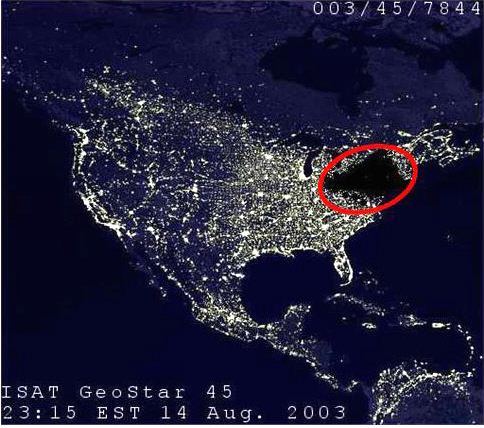
The Great Blackout of 2003 in the US and Canada

For those who found themselves on this date ten years ago located within any swath of North America ranging from Detroit to Toronto to Manhattan, here's an oft-evocative writing prompt: "How did you respond to the Great Blackout of 2003?"
I've already gotten more than 100 responses so far, forming a mosaic of tales tall and short, muted and loud. The folks trapped in an elevator when the power failed. The heat. The food sizzling on grills in backyards and alleyways. The mad dashes from place to place grand and small. Generators. Boozing. Car radios. Dancing in the streets. Bartering by flashlight. All of it and more! How about you? 


Of course, some folks ain't never even done heard of nothing like such a thing. But there ya go, that's the way of the world and all the people in it. Go ask them that's stuck in Cairo or Aleppo on this date today, in the year 2013. Or in the parlance of our day:

***What?***

Today's Rune: Journey.   

Friday, July 05, 2013

Egyptian Army: Pronunciamiento / Golpe de Estado


Another strange development in a weird world -- a popularly-backed military-managed coup d'état in Egypt (total population = 85 million) just "removed" from power Mohamed Morsi, who had been elected president of Egypt in June 2012 with about 51-52% of the popular vote. A military tribunal dissolved the Egyptian constitution and created "provisional" leadership, giving vague ideas about evolving toward a new status quo with new elections, etc.

Does democracy work? How would Americans like such a turn of events in the USA? How would anybody with any practical experience with democracy?

Today's Rune: Fertility.     

Tuesday, November 20, 2012

The First and Last Casualties


Coverage of wars and poverty, of competing ideas and political conflict is all over the map.  Attention Deficit Disorder and entropy on one hand, pre-existing ideological prejudices and Obsessive Compulsive Disorder on the other.  Avoidance on the one hand, oversaturation on the other.

Some of the most memorable wartime investigative journalism can be epitomized by the work of Seymour Hersch, who has, during his career, written a number of penetrating stories for United Press International (UPI), the Associated Press (AP), The New York Times, The New Yorker, and more. Prime examples: exposing the My Lai Massacre (1968). Investigating the context of what led to the shooting down of Korean Air Lines Flight 007 (1983). Digging into the false pretenses and cynical manipulation of public perceptions by the Bush-Cheney Administation that led to the Iraq War (2003-2011). Delving into the ghoulish facts of the Abu Ghraib POW scandal. And so forth. This is not to say that Hersch is always completely accurate in his reporting, but rather that he's done more good investigative work relating to war and abuse of power than most. Under the banner of the First Amendment, we need more people doing this kind of work.

Today's Rune: Flow.

Wednesday, November 14, 2012

Blood and Rockets


Here we go again. No negotiated settlement, endless bloodletting -- in cycles. Without the will for successful negotiations, there can be no successful negotiations. Without a live-and-let-live attitude on all sides, there cannot be a live-and-let-live reality on the ground, in the air or on the high seas. And the destruction continues.  A tit-for-ten-tats, ten eyes-for-an-eye, another slaughter in the making for the "Holy Land."  Way to go, peoples.


Today's Rune: Gateway.

Monday, October 15, 2012

Up, Up and Away with TWA: Trans World Airlines, 1925-2001

Trans World Airlines (TWA): like Pan Am, swanky. Like Pan Am, absorbed into another airline after decades of service. In this case, acquired by wobbly American Airlines, now in bankruptcy.
 
Let's face it, the airline industry is a tough one. And it's not swanky anymore, at least from my experience. Riding Via Rail (aka VIA Rail) in Canada is a lot more civilized, for sure. But still, there's no good alternative to covering long distances quickly than by jet aircraft. To move fast, you've got to pay for it -- one way or another.


Today's Rune: Journey.

Sunday, August 19, 2012

Holger-Madsen: Himmelskibet


Holger-Madsen's Himmelskibet (1918) is a Danish film about the journey of the Sky Ship Excelsior and its crew from Earth to Mars. Arriving with canned meat and weaponry, these space travelers encounter an advanced civilization peopled with beings that look remarkably like Danes, albeit dressed in loose-fitting white outfits similar to something probably worn by ancient Greeks and Romans -- with Egyptian accessories. Turns out that Martians are peaceful vegetarians, neither tempted to start the next World War nor particularly daunted by Earthlings. 


During the Great War of 1914-1918, Holger-Madsen (1878-1943) worked on films in neutral Denmark. He was, no doubt, appalled by the industrialized slaughter wrought by the adjacent conflict. Interestingly, his "real" name was Holger Madsen, to which he added the flourish of a dash. 

What else was going on at the time? Just days before American entry into the Great War in 1917, the Convention between the United States and Denmark for Cession of the Danish West Indies (1916) went into effect, allowing Denmark to remain neutral right to the end of the war. Jomfruøerne (De dansk-vestindiske øer) have been known ever since as the U.S. Virgin Islands. Meanwhile, the mysteries of Mars are still being explored in 2012.

Today's Rune: Signals.         

Wednesday, May 23, 2012

Cosmo Cyborg


In Hot Springs, Arkansas, the MOCA (Museum of Contemporary Art) is showcasing, among other exhibits, Robotic Portraits by Deena des Rioux. As the above exhibition card notes: "Following in the tradition of Man Ray's photo-montage and influences from Dada and the Surreal to science fiction, the artist engages camera and computer to rethink the portrait as a technological subject."

Indeed. How much have we become the Man Machine, the Human Machine? How wired are we?  How much do we utilize advanced technology? Can you imagine the possibilities?

Recently, I've seen the barcode in advanced action at a Korean spa: simply wear a waterproof bracelet with barcode and key, charge whatever you wish on it, and pay at checkout -- via another electronic transaction.

From Google to Wikipedia, from online banking to GPS, we're in for a penny, in for a pound, in for a barcode, in for a scan.  

QR (Quick Response) Codes are already ubiquitous. Traffic, weather, medical records, fees, shopping, food delivery, energy sensors, all of it. Check it out, we're already here.

Back in Hot Springs, the MOCA's program director is very cool and energetic. The museum and its exhibits are on display within The Ozark, a 1922 Spanish Colonial Style structure on Bathhouse Row "repurposed" from its original function to become the MOCA. It's really ideal as an art and related events space, probably much better suited for art than for saunas and baths (as it used to sport from the 1920s through 1977). Here's a link: http://museumofcontemporaryart.com/    

Today's Rune: Gateway.  

Thursday, May 17, 2012

Is That Something You Might Be Interested In?


Here: Belle de Jour/Belle Toujours, not La Reina del Sur


English language soap operas are gasping for life. The reality is that "reality TV" seems to be trumping old school broadcasting, the kind that's aimed at students and folks who used to rush or remain home to see their "stories."  Admittedly, the only such thing that ever hooked me was Dark Shadows, because it was soap opera with a twist and I was a kid.

The Yacoubian Building is Egyptian.


Nowadays, I may flip through some international channels and try to catch the drift of, say, a telenovela, something produced by or aired on Azteca México, Galavisión, Telemundo, Globo Internacional, Teléfe Internacional or Univisión. Why? I want to hear the non-English language (in this case mostly Spanish) and try to get at least some of the gist -- and "jest" -- of what people are saying. Not hard to guess what's going on, at least to a great extent. Usually high drama. Latin operatics. Women mad at men and men exasperated, afraid or clownish.  

How about you? Is that something you might be interested in?

Today's Rune: Wholeness.    

Thursday, February 09, 2012

Jean-Luc Godard: Film Socialisme (Take One)


Film Socialisme / Socialisme (2010), Jean-Luc Godard's latest movie, is out on DVD. Like most Godard films, love it or hate it. I'm in the former camp and quite happy to see Godard in strong form. I think he played a little prank on some early English language reviewers with "Navajo English" subtitles (which you can choose to see on the DVD version, too, if you wish). The Navajo version cuts out nuance, leaving lines that read as if transcribed from Kraftwerk's "Computer World" (1981): "Business, Numbers, Money, People / Computer World . . ."

The film is jarring but thoughtful, expansive and -- believe it or not -- sweet. 


P.S. No worries for Godard fans. Intercuts, intertitles and Interzone -- they're all there.

Today's Rune: Joy.

Wednesday, February 01, 2012

Pandora's Box


You don't need to be able to understand German to pick up on what's going on in G. W. Pabst's Die Büchse der Pandora / Pandora's Box (1929): just focus on Louise Brooks' Lulu and the people around her and you'll get the idea. This is one of the last of the great German silent films, and though there are intertitles, I went without English subtitles mostly out of laziness. On the Criterion Collection version, you can pick a soundtrack; I chose the piano improv, which works well.    


The depictions of social life are stylized but gritty, with the hypocrisy of the bourgeoisie well in evidence -- just as it is today in "family values" circles. In other words, there are people who live as "pillars of society" on the one hand, but who enjoy playing with Lulu and friends on the other. Hooch, cooch, gambling, comic relief and theft abound, with occasional flare ups of violence at key points.

Pandora's Box is a cool movie, especially the lighting. 

Today's Rune: Gateway.

Friday, November 25, 2011

Orange Crush: Black Pepper-spray Friday


Orange pepper-spray, Black Friday, Christmas just around the corner of time. What a world. Meanwhile, another excellent day in and around Saxapahaw capped off by Mongol (2007), an absorbing flick I'll post about soon, if all goes as planned.

Has everyone gotten a chance to see the "pepper-spray cop meme" galloping around the globe quicker than a Mongol messenger (such as the example above)? Love it.

A lot going on here, there, in Egypt and everywhere. I spent $5 on a book about Ben Franklin and his correspondents that looks pretty cool, and certainly of continued relevence, given Franklin's defense of human rights, evolving opposition to slavery, mentorship of free libraries, stewardship of the postal system and championship of free speech, freedom of assembly and civil society in general, all while remembering to have an electrifyingly good time while he was at it. To all that and more -- cheers! 

Today's Rune: Harvest.

Tuesday, October 11, 2011

Tosin Otitoju Interview, Part II


Erik's Choice (EC): You’ve lived in Nigeria, the USA, Egypt and Yemen. Your next poetry collection (Yalla! / Let’s Go) was inspired by your stay in Yemen. What is it about Yemen? Do you have any comments about the tumult that’s going on there right now?

Tosin Otitoju (TO): Yalla! has poems from several places - Nigeria, America, Arabia.

What is it about place -- place matters. Humans can move. When one place sucks, you move and guess what? End of tyranny or the particular problems of that place. It describes place, takes the reader to some places . . .

What is it about Yemen? It was the most special place I had been. It was a preserve of something pure, less average. In other countries, the copying from other cultures is so much that new experiences are rare. Here, newness was all around. Love the architecture, lessons for us about choosing functional designs, lessons in attention to beauty. Then I did really feel such happiness, such release from being somewhat depressed in California. I can't imagine not being a little depressed in California. Hot summer days were much better. I did like the food and restaurants. I once had a sunny boyfriend. I did many happy things. But in Yemen I was the complete opposite of depressed.

The tumult -- Yemenis will often fix Yemeni society. Yemen is not about the USS Cole or whatever intersection with US National Security. Sad that for now the economy must be suffering. Proud that they are fighting for something better. God let me go back, Amen.

EC: Nigeria has approximately 155 million people and is about 50-50% Muslim-Christian and also about 50-50% urban-rural. Lagos has some eight million people, fifteen million in the greater area. Nigeria’s population will probably surpass that of the USA in the second half of the 21st century. What is Nigeria’s ideal place in the world? What is your ideal place in the world?

TO: I can't verify the data; I won't be surprised if the US has better data on Nigeria than Nigeria. :) Ideal is what we want it to be and for many Nigerians it would be a return to good values (kill corruption, for instance); respect among nations (living up to the name 'giant of Africa' for instance); wealth (and it's not going to come from oil, it's going to take work, at least some large and efficient structures/organizations, attention to the minimum/the poorest, increased access to capital). I think Nigerians are irritated that we fail so much, when we think we ought to be winners.

My ideal place: I still want to travel. I still want to honeymoon in Yemen (assuming I marry that Rafa character, lol). I learned from Caltech to see work as central to a person's life. This is a little bad, perhaps, but in life I want to be where I'm doing the important work that I must do. This instant it's in Nigeria (in a writer's residency - see? we have one . . .) but I'm considering California again. Variety rocks, so yeah I want to do the Morocco/Turkey axis with its colours and spices, but also the beach -- which Nigeria has, but also the black -- in Africa, Cuba, wherever, but also the Louvre and the cold, the wealthy, the old, the run-down, the natural. I want to see my old friends, I want to hovel in my little room, I want to go on the cheap, and I want to do Monte Carlo in expensive style. Is there enough time to live all these lives? Hmm, maybe I should be an actor, lol.

EC: Can you say something about the different groups such as Yoruba, Igbo, Hausa, Edo? And the role of OPEC and oil and gas production in Nigeria?)

TO: On Oil and Gas and OPEC - Nigeria fights the so-called "resource curse." For a while now, this distorted our economy, too easy to rob the nation at the center, too easy to ignore every other possible source of income, when you have oil. Cool story: illustrates.

On ethnicity: So many languages. Three are said to be major, but is it really three? Or four?

The North, with predominantly Hausa and Fulani speakers reminds me of Arabia; it's the more Muslim half of Nigeria. I felt at home up North but many Southerners don't see the value in going to the North. I am from the South, in the Yoruba region, i.e. I speak Yoruba. We like to stereotype one another. The distinct groups are still large and important, but there is quite some traveling and inter-marrying so we're not free to really hate one another. There is a system of government in which we try to make everything equal, regionally speaking. It insures against civil war, although some would say it slows down our development.

Cool story: here on stereotypes; and a sad story on the worst of our follies: here.

That writer (former colleague, amazing work) also wrote this.

I've got to rearrange, edit and publish it someday, he's so damn lazy, but it's clear that he has a real insight into our miscommunication across tribes.

Endnote: I've dated a few Nigerians finally but never dated a straight-up Yoruba guy. The closest I've got were mixes. But most Nigerians, even in faraway countries or in mixed cities/universities/environments, seek out exclusively their own ethnic group.

Today's Rune: Movement.  For more, please also see here.

Saturday, August 20, 2011

Blood and Oil: The Middle East in World War I


Blood and Oil: The Middle East in World War I: A Film by Marty Callaghan (The Minutes of History Series, 2006) gives a rare and helpful overview of the catastrophic human disaster called variously the Great War, the First World War and World War I -- from the perspective of the "Middle East" and "Near East." With so much ground to cover, it focuses on the Turkish Ottoman Empire and its regrouping as modern Turkey; the British Empire; the Russian Empire; the Arab revolt; the geo-strategic fight over resources (Suez Canal, Dardanelles, Persian Gulf, fresh water sources, petroleum); and to a lesser extent, the French Empire, the German Empire, Persia-Iran, the Kurds, Greeks, Italians, Armenians, Jews and Indian troops.


Even a cursory watch will help viewers trace the connection of 1914-1918 and continued warring into the 1920s as set-up for today's turmoil in Iraq, Iran, Syria, Israel, Gaza, Libya, Egypt and so on, including Kurdish guerilla activity. Blood and Oil does a fine job showing why Turkey remains an important regional power, though it never directly deals with the Armenian Genocide, and it might have been expanded to include North African fighting in places like Libya. 

Today's Rune: Possessions.