Showing posts with label Clint Eastwood. Show all posts

Monday, March 13, 2017

Akira Kurosawa: 白痴 / 'The Idiot' (1951)

What we have left to see is about half of Akira Kurosawa's orginal epic cut of 白痴 / The Idiot (1951), based on the hefty novel by Fyodor Dostoevsky first published in complete book form in 1874. As is, Kurosawa's film conveys the mood, atmosphere and existential thickets of the Russian original through a Japanese scrim.   
Even cut in half, The Idiot still works, provided one is willing to employ a little imagination to help fill in the gaps. The gist remains. Here, the title character (Masayuki Mori), suffering from post traumatic stress (thanks to his wartime experiences), has the thousand yard stare; Denkichi Akama (Toshiro Mifune) burns holes into his best frenemy with an equally mystified stare.   
Enter Taeko Nasu (Setsuko Hara) and Ayako (Yoshiko Kuga) into a four-way staring contest. Note Toshiro Mifune on the left, a clear prototype for spaghetti Western characters in his look, well emulated by Clint Eastwood in the 1960s.

In the previous post, Charles asked about a biography of Kurosawa. There are these two books, neither of which I've read yet. But they look good.

Peter Cowie, Akira Kurosawa: Master of Cinema (Rizzoli, 2010).

Donald Richie, The Films of Akira Kurosawa: Third Edition, Expanded and Updated (University of California Press, 1999). 

Today's Rune: Protection. 

Monday, August 29, 2016

Akira Kurosawa: 'The Hidden Fortress' (1958)

Akira Kurosawa's 隠し砦の三悪人 / The Hidden Fortress (1958), set in the 1500s during the ferocious clan wars of Japan, combines history and mythic, primal storytelling with strong characters, setup and high stakes. 
Extra fun is seeing the "ur" version of a Sergio Leone film, set in black and white. Take Leone's Il buono, il brutto, il cattivo / The Good, The Bad and the Ugly (1966), for instance, and the central role of gold. Make two of the characters more hapless, and one more ferocious. Add three strong women -- more along the lines of Clint Eastwood's The Outlaw Josey Wales (1976). Make music an important element, and strong visuals. Pepper with playful, dark humor mixed with grim situations, such as becoming prisoner to nasty enemies. Make sure environment is a key element, and a partially obscured endgame. (Or, compare with Star Wars, which was directly inspired by The Hidden Fortress -- but let's not even go there at this juncture.)
Instead, consider the character of Makabe Rokurōta (played by Toshiro Mifune). This fierce dude may be the toughest badass you'll ever see on film. Or Princess Yuki (Misa Uehara), some of the time playing a mute, who must have inspired the Shirley MacLaine role in Don Siegel's Two Mules for Sister Sara (1970).  

The difference between The Hidden Fortress and all of the later films is in intensity -- 16th century Japan must have been a terrifying place in which to live -- an island with no exit. The two idiots (a word well-employed in this film as well as by Sergio Leone in his own films) introduced at the beginning of the movie provide a sort of comic relief, but they also underscore the harsh demeanor and derring-do of the other characters.
The Fire Song (sung twice -- once at the Fire Festival, and once by Yuki)

The life of a man
Burn it with the fire.
The life of a bug
Throw it in the fire.
Ponder and you'll see
The world is dark
And this floating world is a dream.
Burn with abandon!

Today's Rune: Journey. 

Wednesday, December 24, 2014

Charlotte Zwerin's 'Thelonious Monk: Straight, No Chaser' (1988)


Sometimes the name and the named match perfectly. Such is the case with North Carolina-born jazz pianist-composer Thelonious Sphere Monk (1917-1982). 

To gain insight into Monk's world, Charlotte Zwerin's Thelonious Monk: Straight, No Chaser (1988) is highly valuable as a record of the artist, letting us see him perform, stand still while walking in circles, mutter and sporadically interact with others in what appears to be quite an otherworldly manner. His original compositions are part of the jazz canon, complex and powerful -- "Straight, No Chaser," "Blue Monk," "Bemsha Swing," "Epistrophy," "Ruby, My Dear," "In Walked Bud" and "'Round Midnight" -- for example.   
Detroiter Charlotte Zwerin (1931-2004. Cinema verité director who worked with the Maysles' brothers on Gimme Shelter and made several other excellent documentaries) utilizes priceless archival footage in a highly effective manner. 

Zwerin, Bruce Ricker and Clint Eastwood co-produced Thelonious Monk: Straight, No Chaser (Eastwood especially helped with the financing)

Monk's son T.S. (also a jazz musician) provides insight into his father's unsettled mental states (sometimes catatonic, in fugue states of sorts, as if checked out of Earth from time to time), and we gain an appreciation for Monk's wife and sort of chief of staff Nellie as well as his "special lady friend" and patron, Pannonica "Nica" de Koenigswarter, both of whom informally shared responsibilities for keeping Monk together. Finally, let's not fail to mention his withdrawal from the music scene into quietude during the last decade of his life, combined with his affinity for cats and a silent piano. From Koenigswarter's pad in Weehawken, New Jersey, Thelonious Sphere Monk could contemplatively gaze at the Manhattan skyline to his heart's content, never having to perform on stage again.  

Today's Rune: The Mystery Rune. 

Thursday, October 23, 2014

Frederick Forsyth: The Afghan, 2006 (Part II)

The Afghan, Frederick Forsyth's 2006 novel, delivers a wild ride, filtered through the very evident scrim of the author's patriarchal, Anglocentric, conservative outlook.

It's very much a man's world that Forsyth focuses on. There are no major female characters in the book. In general terms, it's sexist, but there's no sex. It's James Bond or Clint Eastwood without their "social interests" -- certainly, there are no Bond girls on either side of this rather austere novel.

While reading, I had a strong impression that, via the near-totally omniscient narrator, Forsyth wants nothing more than a quiet return to the height of the British Empire, say between 1860 and 1900. Women seem of little importance in his grand scheme of manly things. Protesters, the general public, news outlets and international organizations are considered annoying nuisances bent on fools' errands. The most important thing to the narrator is security of country -- the United Kingdom above all -- as represented by security agencies and military and police forces.    

Back in 1997, Forsyth admitted: "These days I care only about six things. They are: belief in the Almighty, my country’s sovereignty, parliamentary democracy, the monarchy, preservation of the countryside, and protection of my family." (SagaDecember 1997).

Islamic "Sword Verse" extremists, the villains of The Afghan, dream of a return to the imagined heights of Islamic empire and culture. Turn the clock back a thousand years or more. 

So in The Afghan there are two preferences pitted against each other: go back 100 years (good) or go back 1000 years (bad). In both cases, this is the nature of deep conservatism -- a nostalgia for a past that never was quite as delightful as imagined.*

Finally, the idea of universal entropy or friction: 

"Anyone who has ever been involved in what Kipling called 'the Great Game,' and what James Jesus Angleton of the CIA referred to as the 'wilderness of mirrors,' will surely agree the greatest enemy is the UCU. . . The Unforeseen Cock-Up has probably wrecked more covert missions than treachery or brilliant counterintelligence by the other side. . ." (page 223).

Today's Rune: Possessions. 

*In reverse, the nature of progressive liberalism seems more like nostalgia for an enlightened future that may never come to full fruition. How It Never Was vs. How It Never Will Be, perhaps. 

Wednesday, May 14, 2014

A Donkey and Two Mules for Sister Sara


Two mules on a hot day in Texas -- early May 2014. Like magic, you may have to click on the image to see the second mule. 
Next, the arrival of Don Quijote -- within minutes of the approach of the mules.
Sentinel trees beyond the far side of the field, Pecan Valley. 

Today's Rune: Journey. 

Sunday, November 17, 2013

Alain Resnais: La guerre est finie (1966)

To artists and historians, at least, the Spanish Civil War remains endlessly fascinating and inspiring. Alain Resnais' La guerre est finie (1966), crisply shot in black and white, deals with the shadow war that continued after the Mussolini and Hitler-supported Franco forces overthrew the fragile democratically elected republic in 1939. 

The Spanish Civil War (1936-1939) was a key testing ground and prototype for the Second World War and did not really end until after the death of Generalissimo Francisco Franco (1892-1975). Even now in Spain, the period of rule by Franco and his Falange Española de las Juntas de Ofensiva Nacional Sindicalista / Spanish Phalanx of the Assemblies of the National Syndicalist Offensive remains highly controversial and socially unresolved. Then again, in the USA, the American Civil War 150 years after its height is not fully absorbed, either. Perhaps neither ever will be.
La guerre est finie stars such international luminaries as Yves Montand, Geneviève Bujold and Ingrid Thulin. Yves Montand has the same kind of laconic strength of presence as Sean Connery and Clint Eastwood in the mid-1960s, but his historically grounded character can't perform the same type of near-miraculous decisive victories that their more archetypal James Bond or Man with No Name characters can.  For him, there is no particular saving of the day. Instead, the shadow war must go on through decades of exile.
La guerre est finie makes a perfect companion film for Costa-Gavras' 1969 masterpiece film Z. Not only do both have the continuity of Yves Montand in the starring role, but they also both have the cohesive and intelligent, intense and witty screenwriting of Jorge Semprún (1923-2011) to unite them. 

 Today's Rune: Possessions. 

Wednesday, September 04, 2013

Jean-Pierre Melville: Un flic / A Cop / Dirty Money (Take II)

Images from Jean-Pierre Melville's Un flic / A Cop / Dirty Money (1972) keep floating around in my head, days after seeing it. That's worth noting. 

Commissaire Edouard Coleman, the protagonist (Alain Delon), is comparable to Clint Eastwood's character in Dirty Harry (1971), another cop movie that came out about the same time. Both characters are laconic to the extreme. Neither has any qualms about employing "enhanced interrogation techniques" whenever they see fit. 

In addition, Coleman is nearly identical in temper and disposition to Costello, the main character in Melville's Le Samouraï (1967), also played by Delon -- even though Coleman is a cop and Costello a contract assassin.
German title for Un flic: Der Chef
Two of the main "robbers and gangsters" in Un flic often play cops and military types. For example, think of Richard Crenna as Colonel Sam Troutman in the Rambo flicks, or of Michael Conrad as Sergeant Esterhaus in Hillstreet Blues. And because you never quite know who's throwing heads or tails, or which are the sinners, which are the day's saints, remember: "Let's be careful out there."

Today's Rune: The Mystery Rune. 

Wednesday, June 26, 2013

Jean-Pierre Melville: Les enfants terribles (Take II)

Again while trying to absorb Jean-Pierre Melville (and Jean Cocteau's) Les enfants terribles (1950), live events keep rolling in. Today's big Supreme Court rulings in the USA were victories for the legitmacy of gay marriages, including recognition of federal benefits. This is a touchstone issue around the world and will certainly circulate in due time around the other states here. Overall, these rulings and similar developments represent a big shift since a time-marking event as recent as the 2004 presidential election, when so-and-so's pastor told people not to vote for John Kerry because he wouldn't stifle gay rights. A Pyrrhic victory for social conservatives, it turns out. One of many such in hindsight, I suspect.  
Michigan Daily, October 15, 1975
In any case, Les enfants terribles is a peculiar movie (based on the equally peculiar Cocteau novel), definitely memorable in part because it's so weird and different from more "typical" fare. It does remind me of a few other works, but of each in a different way. It utilizes classical music akin to how Stanley Kubrick later did in completing A Clockwork Orange (1971), for instance. It has social relationships in the same emotional realm as found in Flannery O'Connor's Wise Blood (1952) -- which is cool, because she may have seen the film at the time; certainly, given her interest in French literature, she would have been aware of the 1929 Cocteau novel. And there's a thematic connection taken up by Bernardo Bertolucci (Last Tango in Paris, Little Buddha) in The Dreamers (2003), a film also set in Paris, only updated to revolutionary year 1968. All in all for these comparisons and on its own merits, it's worth an extended look.
   
The image here reminds me off the top of my head of Ingmar Bergman's Det sjunde inseglet / The Seventh Seal (1957), Roman Polanski's Rosemary's Baby (1968) and Clint Eastwood's Midnight in the Garden of Good and Evil (1997). What do you think?

Today's Rune: The Mystery Rune.


Thursday, May 09, 2013

The Claim


Take Thomas Hardy's The Mayor of Casterbridge: The Life and Death of a Man of Character (1885/1886) and relocate the setting from 19th century England to a mountanous region in the American (actually Canadian) West after the American Civil War, just when the railroad is about to come through. Season with touches of C'era una volta il West / Once Upon a Time in the West (1968), High Plains Drifter (1973) and Deadwood (2004-2006), and voila -- there you have a gilded glimmer of Michael Winterbottom's The Claim. Wintry, mountainous backdrop, warm bordellos and other interior spaces, harshness versus comfort, health versus sickness, choice versus luck.

The ensemble cast of The Claim works well together, but three actors in  particular make it worth the whole kit and caboodle: Nastassja Kinski, Milla Jovovich and Sarah Polley.

I love some of the international variations in the title, giving their own slant, as it were.  In Québécois French: Le maître de Kingdom Come; in "regular" French, Rédemption; and in German, Das Reich und die Herrlichkeit. 

Today's Rune: The Mystery Rune.   

Saturday, September 01, 2012

Chuck Berry: Movin' Through the Traffic Like a Mounted Cavalier


Starting just before 9 p.m. local time, Chuck Berry and his band began a gloriously ragged show -- sometimes sounding off scale and courting disaster, sometimes interweaving near-perfect doses of raw guitar power -- and even finely wrought beauty during "You Never Can Tell." Coming just two nights after Clint Eastwood's "Empty Chair" act, Chuck Berry's performance was often just as wild, but delivered with more grace. Wonderful. I was imagining Johnny Thunders, Sid Vicious and Keith Richards playing along with him in spirit. This was the real thing, uncorked.

Apparently the band was a little late coming from the airport, and so in between them and a warm-up performance by Andi Laree & Cory Elrod and crew, some strange old cowboy gave a bizarre standup improv -- he reminded me of Man Mountain Mike, the professional wrestler famous in the 1970s. 

When they did show up, Chuck Berry and crew played for a solid hour and change. This intimate concert was held in the Ballroom of the Fort Worth Convention Center. I'd say there were about 300 Spartans in attendance. Lucky for me! I'd always wanted to see Chuck, and now I have done so.

The backing band included Charles Edward Berry, Jr., on guitar, a keyboardist, harmonica player/backup vocalist, drummer and bass player. Chuck is skinny and was wearing in part a shiny red shirt and Greek fisherman's cap. His thin singing voice sounds the same as it must have sounded fifty plus years ago. And, as he noted: "I'm 85 -- I know what it means to stand." Now when he sings "I didn't know if I was dead or alive," he may mean that literally, upon waking. Still, believe it or not, he managed to do the "Duck Walk" for the finale. At his invitation, a score of women came up to the stage and danced -- security and organizers looked aghast. It was the perfect crescendo ending to a raucous performance. As Chuck said earlier in the show, "When it's over, it's over, Ladies and Gentlemen." 

Some of the songs covered in whole or in part:
"School Days"
"Carol"
"Rock and Roll Music"
"Let It Rock"
"You Never Can Tell"
"Maybellene"
"Honest I Do"
"My Ding-a-Ling"
"Johnny B. Goode"
"Nadine" (opening fragment)
"Reelin' and Rockin'"

Today's Rune: Harvest.  
      

Monday, March 19, 2012

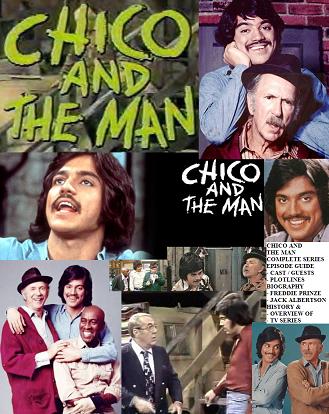
The 1970s: Chico and the Man/All That Glitters


So by the early-to-mid 1970s, there were all these mass-culture TV shows exploring socio-economic class, race, ethnicity, and gender. In the wake of the US-Vietnam War and the upheavals of the 1960s, this was a pensive time, with a mix of experimentation and philosophizing. Could people get along beyond the confines of their culturally driven self-identities?

Two shows I caught but didn't watch religiously: Chico and the Man (1974-1978), starring Freddie Prinze (1954-1977) and Jack Albertson (1907-1981); and All That Glitters (1977).  The first was a spiritual cousin to All in the Family, Sanford and Son, and early Sesame Street (1969-present), only with a young Latino dude building a connection with an older dispeptic Anglo in East L.A., supplemented by various other antics. By about fifteen years, it prefigured the Rodney King plea, "Can't we all just get along?"  All That Glitters was a soap opera-ish romp that inverted maintstream gender roles, so that it was a Woman's Woman's Woman's World. In other words, a mix of science fiction, fantasy and satire. The idea was to point out how generally patriarchal and one-sided the accepted status quo was up to that time -- the "double standard."

What's the legacy today? Apparently Rick Santorum, Newt Gingrich and Mitt Romney -- among others who might have been aware of these series -- missed the boat, the train, the car and the plane. Apparently they've rejected all of it. On the other hand, Clint Eastwood brought a sort of updated version of these 70s cultural awakenings back to market in 2008, with Gran Torino. And thanks to the 2008 election in the USA, Barack Obama is president and Hillary Clinton, Secretary of State. Where there's a will, there's a way; where there's no will, no way.

Today's Rune: Signals.      

Saturday, January 21, 2012

Richard C. Sarafian: Vanishing Point


Richard C. Sarafian's masterful road movie Vanishing Point (1971) brings many attributes to the screen, including primal excitement. It plays out like something from ancient mythology, with cerebral, mystical and existential touches featuring a souped up Dodge Challenger driven by Kowalski (Barry Newman), a Vietnam vet and ex-cop on a speed-fueled working joy ride pursued by highway patrolmen in three Western states. It's beautifully shot and an exuberent trip. 


The UK version includes Charlotte Rampling as a hitchhiker and harbinger of death.

The name Kowalski brings to mind Clint Eastwood's character, a Korean War vet also named Kowalski, in Gran Torino (2008), and Stanley Kowalski in Tennessee Williams' A Streetcar Named Desire (1947).

Today's Rune: Fertility.

Friday, January 21, 2011

Walk on the Wild Side: La Gata Negra


Despite an absurd plot, ridiculous conflict, little character development and stilted acting with horrible attempts at Southern accents, Edward Dmytryk's Walk on the Wild Side (1962) can be fun to watch. It could have been a lot better. 

Part of the problem in its creation was the lingering Motion Picture Production Code that had lasted from the early 1930s and would not be dropped (via the "rating system") until 1968. Walk on the Wild Side takes a few puzzle pieces from the gritty 1956 novel by Detroit-born Nelson Algren and leaves the rest out; these pieces are rearranged to fit a lame formula, focusing on Texan Dove Linkhorn's (played by Laurence Harvey) attempt to find and woo back an old flame, Hallie Gerard (Capucine), who is now working in a New Orleans French Quarter bordello compound centered around "The Doll House," the compound's bar and meeting area. That would be okay given different actors -- but these two don't work. Capucine's movements are glacial, and Harvey's Dove seems more like a naive simpleton than, say, if Clint Eastwood retroactively had gotten the role (similar to Walt "Tex" Coogan, the character he plays in Coogan's Bluff, 1968).

On the other hand, in Walk on the Wild Side Jane Fonda plays hot pepper Kitty Twist with charisma, Anne Baxter hams it up well as Teresina Vidaverri, a Mexican café owner, and Barbara Stanwyck seems delighted playing mean lesbian mama bordello owner Jo. A nice lurid touch has Jo's legless husband Schmidt (Karl Swenson) scooting himself around on some kind of low-to-the-ground homemade device, throwing punches at one point.

The whole thing comes across like a B movie version of a short Tennessee Williams play -- it reminds me a little of This Property Is Condemned (1966), come to think of it, only that one feautures a vibrant Natalie Wood in the wooden Capucine slot. Overall, nowadays the Coen brothers could make something much better out of it -- they'd probably stay truer to the novel.


Still from the opening sequence, featuring a sauntering black cat (hence the Spanish version title, La Gata Negra).


I can imagine the corniness/camp angle brought Walk on the Wild Side to Andy Warhol's attention. The Factory, it so happens, began operations the same year the movie came out, a nifty linkage that may segue into the next post.

Friday, October 15, 2010

Paradox


Orthodox. Makes me think of rigidly conservative. This is a good thing with styles of food preparation and champagne. Truth in labeling. But in social mores and expectations, out of touch, living in the idealized past. Orthodox religion and politics = built-in conflict, no compromise, no acceptance of change.

Unorthodox. Flexible, eclectic. To me, a good connotation. The James Bond and Clint Eastwood style. Understands orthodox, but gets around it. Whatever it takes, make it happen. Whatever works. Dissidence, overt or covert.  Bohemians usually fall under this aegis and ethos.

Heterodox. A rarer name for unorthodox, really. Which reminds me of a cool but still little-known group in NYC that formed even before the Great War and lasted until World War II, Heterdoxy. I'd like to find Judith Schwarz' Radical Feminists of Heterodoxy: Greenwich Village, 1912-1940 (Revised, 1986).

Paradox. Tricky. Counterintuitive stuff. "I always lie." "I never tell the truth." Its cousin is the anomaly, that which subverts the dominant and most widely accepted paradigm.  

At top: G. W. Pabst's Die Büchse der Pandora / Pandora's Box (1929), starring Louise Brooks.

Today's Rune: Possessions.

Sunday, October 10, 2010

Kim Ji-woon's The Good, the Bad, the Weird


Kim Ji-woon's The Good, the Bad, the Weird / 좋은 놈, 나쁜 놈, 이상한 놈 / Joheun-nom, Nabbeun-nom, Isanghan-nom (2008-2010) is great fun! Literally, "the good fellow and the bad fellow, the fellow who is strange," this action flick pays homage to a range of Sergio Leone films while maintaining its own (Korean) spirit.

The inspired setting: lawless and violently contested Manchuria during the late 1930s -- a place even crazier than the American Wild West or Mexico during the Revolution. Exotic touches include the Tri-Nation gang, the Ghost Market and an apparent opium den at a border crossing. One massive chase section has five different elements: Manchurians; Japanese horse cavalry, trucks and artillery; the Bad and his mounted gang; the Good on horseback; and, being pursued by all because of a map in his possession, the Weird. There is a lot of violence and wreckage, but it's stylized and reminds me, in addition to Sergio Leone, of Clint Eastwood, James Bond, Mad Max and Conan the Barbarian all blended together.


The Good is more like Mr. Self-interest with a sure shot; the Bad is sensitive to insult and quick to kill; the Weird (Song Kang-ho) seems the most human and has attributes of Sergio Leone's Clint Eastwood character(s), as well as a touch of Tuco Benedicto Pacífico Juan María Ramírez (Eli Wallach).

Finally, one picks up a little of the historical backdrop involving Korea, China, Japan and Russia.  The film was shot on location in the Gobi Desert.


Today's Rune: Movement.

Sunday, August 01, 2010

Clint Eastwood: Letters from Iwo Jima / Iōtō Kara no Tegami


Finally checked out Clint Eastwood's Letters from Iwo Jima (2006).  It's excellent and has the primary ingredient found in all the best war movies: empathy for more than one point of view.  This one's almost entirely in Japanese and shows the doomed defenders of Iwo Jima before and during the 1945 battle. Only a couple hundred Japanese soldiers survived -- out of about 18,000 men. Ken Watanabe is superb as the thoroughly professional commander, Lieutenant General Tadamichi Kuribayashi; the entire cast is terrific.  The world needs something like this from the Vietnamese point of view for the US-Vietnam War.

In addition to Letters from Iwo Jima, these are among my choices for best non-documentary war films, in no particular order:

Oliver Hirschbiegel: Der Untergang (2004) / Downfall  (2005)
Richard Fleischer, Kinji Fukasaku and Toshio Masuda: Tora! Tora! Tora! (1970)

Sergei Bondarchuk: Waterloo / Ватерлоо (1970)
Francis Ford Coppola: Apocalypse Now! (1979)
Jean Renoir: La Grande Illusion  / Grand Illusion (1937)
Aleksandr Askoldov: Комиссар / Commissar (1967)
David Lean: Lawrence of Arabia (1962)  
Ken Annakin, Andrew Marton, Bernhard Wicki, Gerd Oswald: The Longest Day (1962) 
Richard Attenborough: A Bridge Too Far (1977)
Lewis Milestone: All Quiet on the Western Front (1930)
Stanley Kubrick: Paths of Glory (1957) 
Sam Peckinpah: Cross of Iron (1977)
John Guillermin: The Blue Max (1966)
Kathryn Bigelow: The Hurt Locker (2008/2009)
Wolfgang Petersen: Das Boot (1981)
Peter Weir: Gallipoli (1981) 
Let's not forget Gillo Pontecorvo's  La battaglia di Algeri (1966) /Battle of Algiers (1967) and Queimada (1969) / Burn! (1970)

What did I miss? 

Today's Rune: Journey.

Sunday, May 17, 2009

Eli Wallach: Life as an Actor


Finally read Eli Wallach's The Good, the Bad, and Me: In My Anecdotage (2005), a charming and wryly observant memoir. We learn a lot about Eli's life and arc, but we also come to a better understanding of Method acting, the synergies and differences between stage, TV and movie work, and the colorful nature of many other actor personalities (including Marilyn Monroe, Clark Gable and Clint Eastwood).

Eli's was the only Jewish family in an otherwise Italian neighborhood in Brooklyn, so he understands the outsider's perspective well. And given his age (born 12/7/1915), he recalls deliveries of ice and other goodies by horse drawn carts.

Once we reach the 1960s, Eli hits the silver screen. Though he effectively plays Mexican outlaw Calvera in The Magnificent Seven (1960) and the outlaw Charlie Gant in How the West Was Won (1962), it's his turn as Tuco Benedicto Pacifico Juan Maria Ramirez, known as The Rat (or in Italian, known as The Pig) in Sergio Leone's The Good, the Bad and the Ugly / Il Buono, il Brutto, il Cattivo (1966/1967) that immortalizes him as an actor. Certainly it's for his performance as Tuco that I picked up this book in the first place.

In all, Eli Wallach's memoir is really good, well-worth reading. Aside from the above, we also learn much about his marriage to fellow actor Anne Jackson. Unlike most actors and despite sometimes being months apart during play productions and film shoots over the years, they've been married for quite a little while -- since 1948!

Today's Rune: Signals/Blessings.

Monday, May 11, 2009

Every Temporary Measure of Grace: Whatever Works


Whatever Works, Woody Allen's latest film, is due out next month. Here's the official trailer, a little over two minutes long. It stars Larry David, love him or hate him (I think he's wickedly hilarious). Other stars include Evan Rachel Wood, originally from North Carolina (The Wrestler, Running With Scissors, The Upside of Anger, Thirteen), Patricia Clarkson of New Orleans (Six Feet Under, Vicky Cristina Barcelona), and Ed Begley, Jr. (Six Feet Under, Blue Collar).

Vicky Cristina Barcelona, Woody's last film, has grossed about twenty-three million bucks in the USA last I checked. Add another seven million or so in DVD sales; fifteen million in France and Francophone nations; ten million in Spain; eight million in Italy; and five million in Germany. In all, nearly seventy million outside the USA -- no wonder several of his latest movies were made "in exile." As Ronald Reagan used to say about opponents, "he's so far left, he's left America." But not quite. Woody has rarely been overtly political at all. He is, however, an astute observer, and a little unconventional as most artists are. He is also be one of the oldest and hardest working filmmakers currently working (along with Clint Eastwood). And he's back in the USA for now. So indeed -- whatever works!

Today's Rune: The Mystery Rune.

Friday, April 17, 2009

That Obscure Object of Desire


Been watching a lot of international films lately, and after many years of pondering, I still find them sobering, wondering about the great pie in the sky. What does one want in life, what does one need? What do we value, in the end? Aside from Buñuel, Antonioni, Fellini, Bergman, there are Americans now old school, like Clint Eastwood and Woody Allen, who seem to be asking the same questions even in their seventies. What is our basic desire in life, once we've survived well into adulthood?


One thing I do know: there doesn't seem to be one silver bullet, one defining moment, but rather many smaller steps of soldiering through. Assuming Woody Allen is right in that "eighty percent of success is showing up," what about the other twenty percent? The answer just might involve the person (or people) on the other end of the line. Your guess, dear readers, is every bit as good as mine.

Today's Rune: Fertility.

Wednesday, February 18, 2009

Academy Awards Choices: You Gotta Give 'Em Hope


Movies: one of the great distractions and hopeful consolations in times of recession, during the Great Depression, and throughout this past year. The Academy Awards provide continuity all the way back to 1929. Sunday's 81st Academy Awards include many good selections, from which I'll select my own winners. Make your bets and debate away.

Best picture: Milk. A progressive, important film, not shown in various pockets of the Bible Belt out of fear and homophobia, I suppose. It's not to be feared, but is best when actually seen.

Best Actress: Kate Winslet, The Reader (and for Revolutionary Road).

Best Actor: Mickey Rourke, The Wrestler; or Frank Langella, Frost/Nixon. Sean Penn is remarkable in Milk, but Mickey and Frank could use a happy nod right about now.

Best Supporting Actor, Josh Brolin, Milk; or Michael Shannon, Revolutionary Road. The others are worthy, too, but these are concisely packed performances in generally stronger movies.

Best Supporting Actress: Marisa Tomei, The Wrestler; or Penélope Cruz, Vicky Cristina Barcelona.

Best Director: Gus Van Sant, Milk. (His Drugstore Cowboy still kicks up the sand twenty years later, too).

Best Adapted Screenplay: Peter Morgan, Frost/Nixon.

Best Original Screenplay: Dustin Lance Black, Milk; or Martin McDonagh, In Bruges.

Honorable Mentions: Clint Eastwood, Gran Torino; Joel and Ethan Coen, Burn After Reading (more enjoyable than No Country for Old Men, which won Best Picture last year).

Today's Rune: Strength.