Showing posts with label Maya Lin. Show all posts

Sunday, April 29, 2018

Maya Lin: 'Boundaries' (2000), Part II

Maya Lin, Boundaries. New York: Simon & Schuster, 2000.

I admire the people who've discovered ways to circumvent narrow-mindedness, silos, and local-turf-thinking. Maya Lin is one of those people. 

Maya Lin: "For years the art world saw me as an architect and architects often referred to me as an artist. One professor actually told me I had to make a choice between art and architecture. My fear was that I would become schizophrenic and that my work as a whole would be disjointed and confused . . . the best advice I was given was from Frank Gehry . . . who said I shouldn't worry about the distinctions and just make the work." (4:45)

A tilt toward the mystical, yet practical: "I do not think that we can fully understand how one makes a specific mark upon a page -- at some point one has to trust one's eye, one's intuition, I do not think that that implies a lack of rational thought. I just think that one cannot understand why one makes a specific move, that the creative act is a combination of conscious and subconscious thoughts that cannot or should not be deciphered." (3:09) 

Maya Lin on writing: "I think writing is the purest of art forms. When your thoughts and intentions are conveyed as directly as possible to another person. Words can be the most direct means of sharing your thoughts." (2:05) 

Today's Rune: Defense. 

Monday, March 12, 2018

Maya Lin: 'Boundaries' (2000)

Maya Lin, Boundaries. New York: Simon & Schuster, 2000.

Anyone aware of the Vietnam Veterans Memorial in Washington, D.C., is aware of Maya Lin's work. Boundaries explores her poetic and philosophical approach to memorials, monuments and architecture in general.

Given ongoing fights over the purpose and placement of memorials and monuments, Lin's thoughts retain their relevance.

With the Vietnam Veterans Memorial, I needed to ask myself the question "What is the purpose of a war memorial at the close of the twentieth century?" My question led me to a study of war memorials, from the earliest funereal stelae to the monuments of the great world wars. I felt that the design should focus on the individuals who died and not on the politics surrounding that war. I sought a design that would bring the viewer to an honest acceptance of the deaths of those individuals. (Boundaries, 3:05).

First World War (1914-1918) memorials resonate with Lin (born October 5, 1959). "The images of these monuments were extremely moving. They captured emotionally what I felt memorials should be: honest about the reality of war, about the loss of life in war, and about remembering those who served and especially those who died." (Boundaries, 4:09).

A monument dedicated to 100,000 missing and unidentified dead from the Battle of the Somme in Thiepval, France, designed by Sir Edwin Lutyens, influenced her approach to the Vietnam Memorial (1982). "This memorial acknowledged those lives without . . . creating a political statement of victory or loss. This apolitical approach became the essential aim of my design; I did not want to civilize war by glorifying it or by forgetting the sacrifices involved. The price of human life in war should always be clearly remembered." (Ibid.)

Lin asks, what is the purpose of this memorial? Her answer helps create the design.

When we look at monuments and memorials and placement, and reasons behind their placement and design, we can decide whether they belong where they are or need to be moved. 

If you had to design a memorial for the next major war involving your nation, what elements would you want to include? 

I would emphasize all war deaths, not just military deaths. It's rare to think of any 20th or 21st century war in which overall casualties are not or have not been far higher than strictly military ones.

Much more to consider with Maya Lin's Boundaries -- at some point.

Today's Rune: Initiation

Tuesday, August 22, 2017

Maya Lin: A Strong Clear Vision

Maya Lin: A Strong Clear Vision.

The story of the Vietnam Veterans Memorial and its creator is movingly charted by Freida Lee Mock in her Academy Award winning documentary film, Maya Lin: A Strong Clear Vision (1995), available in digital format. 

The scenes of veterans and vet families at the wall can't help but elicit sympathy and sadness; interviews with various vets involved in the creation of the memorial are also indicative of how deep the wounds left by the Vietnam War remain. Though there is much talk about healing, it's clear from viewing this film that for many involved, the wounds will never heal in this lifetime. Maya Lin's achievement is to have created a place where people can weep and release some of their grief, at least for a time.

Maya Lin (born October 5, 1959) was a Yale undergrad when she entered a 1980 competition to design the memorial, and almost miraculously, her radically brilliant but controversial design won. She was 21 years old at the time. At Yale, she had studied funereal architecture and wondered, as she says on film, "What is a memorial's purpose?" How has the world shifted since the great World War One memorials were designed and erected? How did they relate to their natural setting? In support of her very simple but powerful vision, she spent two months composing an essay explaining how it "focused on the individual losses" of war and steered away from the overtly political. It was to be neither a glorification of war and nation, nor a barbed condemnation of flawed policies. Still, some took it the latter way and fought ferociously to change the design from sunken, low and black to raised, above ground and white, with a giant U.S. flag at its apex. Some called it a "boomerang" design and read that as a critique of U.S. foreign policy. She imagined the concept as "taking a knife and cutting into the Earth," whereas one vet fumes on film that it is "a black scar" on all who served.

Maya Lin was attacked for being a woman, for being Chinese American (her parents, born in China, were professors at the University of Ohio in Athens, Ohio), and for being too young. But, after a pragmatic compromise was reached, her vision prevailed. The main monument area was constructed as she intended, and a more traditional "combat figures" statue was set to one side, with a large flag at the side entrance.

The result, unveiled in 1982, is stunning. It is worth the journey to Washington, DC to see and experience in person. It is very much a living memorial. People leave notes, photographs, letters, posies, dog tags, uniforms, teddy bears, and anything else you might imagine there every day.
The film follows Maya Lin's success after the Vietnam memorial, too. We see her Memphis civil rights memorial and her peace chapel at Juniata College.

Maya Lin also designed the Wave Field swales pictured above at the University of Michigan. She is very attuned to natural setting and context, and was a selection jurist for the World Trade Center Site Memorial competition. She owns and runs a studio in New York City and has a retreat in Colorado. I read somewhere that she loves the energies of Manhattan but also needs a remote place for more relaxed contemplation. Seems like the best of both worlds.

Near the end of the film, she raises the interesting question of whether there is a significant gender difference between what she calls the male eye and the female eye, and concludes, "we can only wait and see." Architecture, like engineering, has long been a male-dominated field, but as in most fields, women are making significant inroads over time, however slowly it seems.

Freida Lee Mock is to be commended for this fine documentary. She subsequently produced the excellent 1999 documentary Bird by Bird: A Film Portrait of Writer Anne Lamott.

[Note: This post was originally published on May 15, 2006.]

Today's Rune: Partnership.  

Monday, May 15, 2006

Maya Lin: A Strong Clear Vision

The story of the Vietnam Veterans Memorial and its creator is movingly charted by Freida Lee Mock in her Academy Award winning documentary film, Maya Lin: A Strong Clear Vision (1995), now available in digital format. The scenes of veterans and vet families at the wall can't help but elicit sympathy and sadness; interviews with various vets involved in the creation of the memorial are also indicative of how deep the wounds left by the Vietnam War remain. Though there is much talk about healing, it's clear from viewing this film that for many involved, the wounds will never heal in this lifetime. Maya Lin's achievement is to have created a place where people can weep and release some of their grief, at least for a time.

Maya Lin (10/5/1959-) was a Yale undergrad when she entered a 1980 competition to design the memorial, and almost miraculously, her radically brilliant but controversial design won. She was 21 years old at the time. At Yale, she had studied funereal architecture and wondered, as she says on film, "What is a memorial's purpose?" How has the world shifted since the great World War One memorials were designed and erected? How did they relate to their natural setting? In support of her very simple but powerful vision, she spent two months composing an essay explaining how it "focused on the individual losses" of war and steered away from the overtly political. It was to be neither a glorification of war and nation, nor a barbed condemnation of flawed policies. Still, some took it the latter way and fought ferociously to change the design from sunken, low and black to raised, above ground and white, with a giant U.S. flag at its apex. Some called it a "boomerang" design and read that as a critique of U.S. foreign policy. She imagined the concept as "taking a knife and cutting into the Earth," whereas one vet fumes on film that it is "a black scar" on all who served.

Maya Lin was attacked for being a woman, for being Chinese American (her parents, born in China, were professors at the University of Ohio in Athens, Ohio), and for being too young. But, after a pragmatic compromise was reached, her vision prevailed. The main monument area was constructed as she intended, and a more traditional "combat figures" statue was set to one side, with a large flag at the side entrance.

The result, unveiled in 1982, is stunning. It is worth the journey to Washington, DC to see and experience in person. It is very much a living memorial. People leave notes, photographs, letters, posies, dog tags, uniforms, teddy bears, and anything else you might imagine there every day.
The film follows Maya Lin's success after the Vietnam memorial, too. We see her Memphis civil rights memorial and her peace chapel at Juniata College.

Maya Lin also designed the Wave Field swales pictured above. She is very attuned to natural setting and context, and was a selection jurist for the World Trade Center Site Memorial competition. She owns and runs a studio in New York City and has a retreat in Colorado. I read somewhere that she loves the energies of Manhattan but also needs a remote place for more relaxed contemplation. Seems like the best of both worlds.

Near the end of the film, she raises the interesting question of whether there is a significant gender difference between what she calls the male eye and the female eye, and concludes, "we can only wait and see." Architecture, like engineering, has long been a male-dominated field, but as in most fields, women are making significant inroads over time, however slowly it seems.

Freida Lee Mock is to be comended for this fine documentary. She subsequently produced the excellent 1999 documentary Bird by Bird: A Film Portrait of Writer Anne Lamott.

Sunday, May 14, 2006


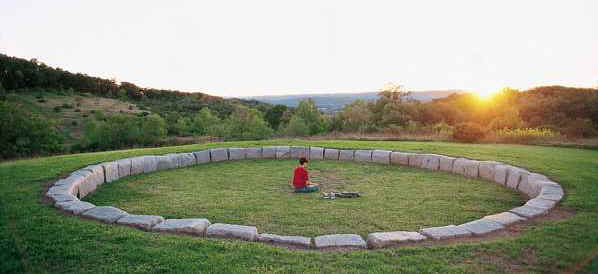
Maya Lin's Juniata Peace Chapel

Juniata College, Huntington, Pennsylvania.

www.juniata.edu