Showing posts with label Madrid. Show all posts

Wednesday, June 13, 2018

María Paz Moreno's 'Madrid: A Culinary History' (2018)

María Paz Moreno, Madrid: A Culinary History (Big City Food Biography Series). Lanham, Maryland: Rowman & Littlefield, 2018.

"Matrice, Mayrit, Magerit, Madrid. The city's many names over the centuries bear witness to its long history and rich cultural heritage. Madrid has seen a fascinating succession of peoples come and go, from prehistoric inhabitants to Iberians, Celts, Greeks, Romans, Visigoths, Moors, and Christians." (page 7).


"'[M]uch of what we think of today as being typically Spanish were, in fact, the staples of the Roman diet. Bread, cheese, olives, and olive oil, wine, and roasted meat . . . were the standard fare of the Roman soldiers in Hispania.'" (page 13).


Jewish and Islamic cuisine has survived, also, despite the expulsions from 1492 onward. "[T]he use of mint and spices such as saffron - an essential ingredient to paella, the iconic Spanish dish -- cinnamon, cumin, coriander, and caraway is common in many Spanish recipes and reflects a distinctly Arab touch." (page 22).


Moreno's progression through Madrid's food history is fascinating and hunger-inducing. She discusses cookbooks written over the centuries, tabernas, fondas, tapas, the impact of war, mercados, recipes and various eateries and marketplaces that are still operating after one or two hundred years - astonishing. 


The Big City Food Biography Series looks to be rewarding in the spirit of Anthony Bourdain. There's already a baker's dozen of these either already available or soon to be published, ranging from food biographies of New Orleans, San Francisco, New York City and Paris to upcoming tomes on Tapei and Seattle. 


P.S. "María Paz Moreno es poeta, ensayista y crítica literaria." See her website here.

Today's Rune: Strength. 

Saturday, April 28, 2018

Federico García Lorca, 'Poet in Spain' (2017): Part II

The center of Granada, Spain: Plaza de la Trinidad, summer of 2015
Continuing with Sarah Arvio's new Spanish-to-English translations in the bilingual Federico García Lorca, Poet in Spain (New York: Alfred A. Knopf, 2017). Part I can be found by this link.

From "Falseta:"

"Gente con el corazón / en la cabeza,"    (page 150)

"Folks with their hearts / in their heads" (page 151)

From "San Miguel / Granada:"

"Vienen manolas comiendo / semillas de girasloes, 
los culos grandes y ocultos / como planetas de cobre." (page 210)

"Flashy gals from Madrid / munch flower seeds
their big secret rumps / like coppery planets"   (page 211)

[Nota bene: "culos" = "asses"].

From "San Rafael / Córdoba:"

"vendedores de tabaco / huyen por el  roto muro."    (page 212)

"All the tobacco hawkers / flee through the broken wall" (page 213)

From "El poeta pide a su amor que le escriba" / "The Poet Asks His Love to Write to Him:"

"Corazón interior no necesita / la miel helada que la luna vierte." (page 338)

"An inner heart does not need / the icy honey spilled by the moon (page 339)

I also dig Arvio's translation of Lorca's play, Bodas de sangre / Blood Wedding (1932) which helped me better grok the Moon (pages 452-453) and the "Mendiga / Beggar" (pages 454+).

Repeating from Part I about this book: Fun and fascinating in the sun, under the moon or even by electric light, it is. 

Today's Rune: Protection.

Wednesday, October 18, 2017

Russell Martin: 'Picasso's War' (2002)

Russell Martin, Picasso's War: The Destruction of Guernica, and the Masterpiece That Changed the World. New York: Dutton, 2002.

The way it's organized:
Prologue
The Spanish Dead
Remembering the Bullring
Images Spilling from Fingers
Save Spain!
A Wearable Pair of Boots
Exiles
The Last Refugee
Guernica in Gernika
Epilogue

Highly absorbing book, providing background, context, a detailed account of artistic creation, setting, display, impact, rescue, and ongoing installation.

We see why Picasso was moved to perform his artistic duties on behalf of the Spanish Republic, then under attack by Nazi and fascist-backed brutes from 1936 until 1939. Martin shows how Picasso's response to the German-Italian air assault against Guernica on April 26, 1937 led to the creation of his Guernica masterpiece.  

A vivid account of the bombing, how word of it spread (and was also denied by the usual suspects), and how Picasso's work was displayed at the Spanish Pavilion at the Paris Expo, the Exposition Internationale des Arts et Techniques dans la Vie Moderne (International Exposition of Art and Technology in Modern Life) that ran later in 1937. At this utterly surreal expo, giant German Nazi architecture ranged against Soviet symbols, even as German and Italian military forces and equipment faced off against Soviet equipment and advisers in the ongoing Spanish Civil War. 

Most of Europe would be engulfed in the Second World War before the decade of the 1930s was out, but only after Spain was left to burn to the ground.     

Picasso's War includes still-current debates over modern Spanish life, identity and policy. The aspirations of people in the Basque region and Catalonia are notably included. 

Since 1992, Madrid has been hosting Guernica in the Museo Nacional Centro de Arte Reina Sofía; but not without a fight and the creation of a proposed alternate venue at the Guggenheim Museum Bilbao in Basque country. 

I've seen the original Guernica at the Reina Sofía in Madrid and the huge tapestry copy at United Nations headquarters in New York City.  Now I'd like to visit Balboa and, of course, sacred Guernica (Gernika), both in Euskadi, Basque country. 

Here is the author's tribute to his teacher-friend and mentor Angel Vilalta: "Angel continually demonstrated that the best kinds of men were inquisitive and energetic, courageous yet compassionate, attuned to the breadth of the world's worries and pleasures but also equally focused on family and friends." (page 187). 

Today's Rune: Growth. 

Monday, October 02, 2017

Joris Ivens: 'The Spanish Earth' (1937)

The film footage alone makes The Spanish Earth (1937), Joris Ivens' 52 minute film shot during the Spanish Civil War (1936-1939), a priceless work. Ivens (1898-1989) was assisted by film editor Helen van Dongen (1909-2006); both were Dutch.

The intent of this charged documentary was to garner American support for the Spanish Republic, then under violent assault by Nazi (Hitler and German) and fascist (Mussolini and Italian) forces fighting alongside Francisco Franco's Spanish rebels.

Several prominent American writers assisted with writing, narration and distribution. These included: Archibald Macleish (who became the Librarian of Congress in 1939), Lillian Hellman, John Dos Passos, Ernest Hemingway and Orson Welles.

There are multiple versions of The Spanish Earth, each with a different narrator. I've only seen the one narrated by Orson Welles. Because Welles' voice was considered "too cultured" for the average American, Hemingway did another, gruffer version. In French, Jean Renoir delivered yet another variation. 

The script for the narration is so-so, and the music intrusive and horrid about 80% of the time, but overall the film is wild and absorbing.
The defenses of Madrid. Doors from blasted buildings are put to use as support for trenches and earthworks.
Battle for Madrid. Fierce fighting right inside the city. Similarly stark imagery will reappear in Stanley Kubrick's Paths of Glory (1957) and Full Metal Jacket (1987) as "the Anthill" and Huế.

In 1937, the majority of the people of Barcelona and Madrid fought on the same side against fascism. It's sad to see, eighty years later and more than forty years after Franco's death, Catalonia and Madrid at loggerheads. But such is life.  

Today's Rune: Gateway. 

Monday, September 18, 2017

Richard Rhodes: 'Hell and Good Company' (2015)

Richard Rhodes, Hell and Good Company: The Spanish Civil War and the World It Made (New York: Simon & Schuster, 2015).  

This is another well-written book about the endlessly absorbing Spanish Civil War (1936-1939). Rhodes interweaves personal accounts (of nurses, doctors, artists, officers) with technical observations (types of equipment, processes, construction of air raid shelters) in a winning combination, because he also manages to keep the book fairly short.

"War is chaotic. People come and go. I decided to pin my narrative not to the people but to the chronology of the war itself, starting at the beginning and marching through to the end." (page xvii).

Lots of people make their way in and out of and then back into the narrative as the war moves along. Many have poignant arcs, such as that of Patience Darton and Robert Aaquist: "Love made a space for them, but love doesn't conquer all." (page 221).
There are tales of Pablo Picasso, Ernest Hemingway, Martha Gellhorn, John Dos Passos, André Malraux, Joan Miró, and much about medical efforts and hospitals. Nearly one in five doctors in the anti-fascist International Brigades were women (page 187).

Rhodes favors the side of the Republic defending against the fascist and Nazi-backed Nationalists, and he shows greatest sympathy where it seems most appropriate. The Spanish people are given their due, but this is mostly a collective story told from the outside in, mostly through the words of international participants or semi-omnisciently.

I like the specificity of detail that Rhodes delves into from time to time. I've learned new things about the war. Not only about the heroism of the various medical corps, but more about the Germans sent by Hitler, too: "The Condor Legion deployed to Spain by ship . . . consisted initially of thirty-seven officers, 3,786 men, and ninety-two factory-new aircraft, including three squadrons of Junkers-52 bombers, three squadrons of Heinkel 51 biplane fighters, two squadrons of Heinkel 45 and Heinkel 70 reconnaissance bombers, and a seaplane squadron . . . Hitler also sent tank companies, antitank platoons, signals units, and submarines to bolster Franco's forces. Mussolini contributed not only planes, tanks, and submarines but also tens of thousands of infantry." (page 29).

One of the legacies of the Spanish Civil War is in the use of air power to bomb civilian targets en masse, with ruthless repetition -- a terrible legacy, indeed, especially when one side gains air supremacy against a virtually helpless enemy stuck on or under the ground. 

Today's Rune: Movement.  

Tuesday, February 23, 2016

Washington Irving: Take II

Washington Irving was by turns imaginative, intrepid, lazy, sly, and perhaps most drivingly of all, strongly imbued with what some psychologists, poets and philosophers call "the gift of curiosity." 

When he got down to it, Irving could bust a move on his writing activities. Mostly, though, he loved to explore places, while always maintaining a far-flung social network that included family, friends and fellow writers. 


As related in  Brian Jay Jones' Washington Irving: The Definitive Biography of America's First Bestselling Author (New York: Arcade Publishing, 2011; originally published in 2008 as Washington Irving: An American Original), Irving's early adventures embraced his friends "the Lads of Kilkenny," originally the Nine Worthies, including, by moniker, the Doctor, Sinbad, Nuncle, Billy Taylor, the Patroon, Petronius, Captain Great-heart, the Membrane, Oorombates & "the Supercargo." Let's not forget Dusky Davy. 


Jones notes: there was "an anonymity Washington Irving used increasingly, as it allowed him to take on different personas and write in different voices (p. 59). And so, with Salmagundi; or The Whim-whams and Opinions of Launcelot Langstaff, Esq. & Others (1807-1808), Irving wrote reviews as Will Wizard, Esq., and about fashion and pop culture as Anthony Evergreen, Gent. -- which reminds me that one of his brothers briefly published two newspapers, one supporting Aaron Burr and the other passionately defending the sometimes outrageous positions of the first one!

Washington Irving often promoted his writing in clever ways. For instance, he created the character of Diedrich Knickerbocker, and then wrote about Knickerbocker under the guise of another pen name, Geoffrey Crayon. He spent a good deal of time exploring Spain, most notably Madrid, Granada, Cordoba and Sevilla -- exactly the same places I've been scampering around in recent summers!

Today's Rune: Warrior. 

Wednesday, February 17, 2016

Brian Jay Jones: 'Washington Irving' (2008, 2011), Take I

In the mid-1990s, I had to give a little twenty minute background talk on American author Washington Irving (1783-1859) to a class in Virginia. Their reading assignment for that day was "Rip Van Winkle" (1819). 

I hadn't given a whole lot of additional thought to Washington Irving until last year, when traveling in Granada, Spain, I saw several of his books for sale, some in English and some in Spanish, at the Alhambra. This piqued my interest again, and it was with great pleasure that I found a copy of Brian Jay Jones' Washington Irving: The Definitive Biography of America's First Bestselling Author (New York: Arcade Publishing, 2011; originally published in 2008 as Washington Irving: An American Original). 

It was with even greater pleasure that I read it - just finished it this week, in fact. Based mostly on letters and other primary sources, it's an engaging biography. 
One of the grandest episodes of Irving's life was his time as United States Envoy Extraordinary and Minister Plenipotentiary to the Court of Spain from 1842 to 1846. But more on that another time, I suspect. For now, let me salute Jones' excellent biography. 

Today's Rune: Strength

Sunday, November 22, 2015

Roy Lichtenstein: New Orleans and Madrid

When you first come across this, you might think, "Aliens!"  At least I did -- looks like some kind of gigantic artifact from outer space. The setting is inside the vast covered courtyard (Nouvel Patio) connecting the old and new wings of the Museo Nacional Centro de Arte Reina Sofía in Madrid. Snapped this in the summer of 2014. It's a gigantic Roy Lichtenstein (1923-1997) sculpture called Brushstroke.

In New Orleans, there's a tall marauding demon creature carrying the exact same vibe -- or is that but a masked man striding around on stilts? Your choice. Go and see.
Last month, came across this sculpture and made the Madrid connection immediately. Here, Five Brushstrokes presides in front of the New Orleans Museum of Art (NOMA) -- as it has since December 8, 2013. 

Today's Rune: Fertility.  

Tuesday, November 17, 2015

France and Spain in New Orleans: Part II

La Nouvelle-Orléans, founded in 1718, formally remained part of the Empire of France until near the end of the Seven Years War, in 1762; from 1762 until 1803, it became Nueva Orleans of the Empire of Spain. New Orleans was briefly ceded back to France under Napoleon I, at which point it was sold to the USA.

Whether under French, Spanish or American control, New Orleans never fell to the British Empire. 
Cathédrale Saint-Louis, Roi-de-France / Cathedral-Basilica of Saint Louis, King of France / Basílica de San Luis. Pictured here circa 1838 in the Spanish Colonial style (flanked by turrets). Since the beginning, there has been a Catholic Church on this site.
Same cathedral in October 2015, with accentuated spires, significantly modified. (Photo courtesy of SAB).  
In the Cabildo: portrait of Antoine Jacques Philippe de Marigny de Mandeville.
Butterscotch house in the Quarter.
Portrait of Napoleon I (1769-1821) at the New Orleans Museum of Art (NOMA).
Mosaic in front of the Napoleon House, 500 Chartres Street -- in the Quarter.

To me, after traveling between Madrid, San Francisco and New Orleans, the Spanish, French and Catholic flourishes became very evident and interconnected. All of these cities are tributes to architecture and design, and all (in their centers) are quite walkable.

Today's Rune: Fertility.  


Monday, November 16, 2015

France and Spain in New Orleans: Part I

Joan of Arc: A Gift of the People of France. Present location: by the French Market, Peters and Decatur. Joan of Arc served with the victorious French forces defending "Old" Orléans (in 1428–1429) against English attackers during the Hundred Years War, which France ultimately won as well.
Fleurs-de-lis can be seen all over the Vieux Carré, the "old square" or French and Spanish Quarter.
A little map of the Quarter put out by the US National Park Service.
Barefoot bride in a wedding procession in the Quarter, close to the Place d'Armes, / Plaza de Armas / Jackson Square, October 2015. (Photo courtesy of SAB).
The jaunty primary colors of another house in the Quarter.

Today's Rune: Harvest. 

Saturday, April 11, 2015

'Madrid, 1987' (2011)

David Trueba's Madrid, 1987 (2011): in simple settings ranging from a café to an artist's apartment with atelier (studio room), the two main characters chatter away like dueling typewriter vs. computer keyboard. Nudity and sexual energy keep things down to earth as needed. 

With an age difference of fifty years, veteran journalist Miguel () and beginner Ángela () are able to cover a lot of ground, roving from the effects of the Spanish Civil War to American writers and, inescapably, on to the socio-political Pandora's Box opened up at the end of the Franco dictatorship: a period of four decades of repression followed by many years of exploring new-found social freedoms (still on-going in the 21st century). Ángela's fascistic father and Miguel's wife remain off-stage. 
Madrid, 1987: Miguel snapping away at a typewriter, making his living as a writer.  
Ángela, seemingly a bit naïve, is subtly more subversive than Miguel. 

By way of synchronicity, I was reading Françoise Gilot and Carlton Lake's Life with Picasso (1964) at the same time as watching Madrid, 1987, so it doesn't seem at all far-fetched even as a realistic movie. Gilot and Picasso (another Spaniard, by the way) were forty years apart in age and there are a couple of scenes in Madrid, 1987 that are reminiscent of their early interactions. The main setting is -- coincidence? -- the inside of an artist's apartment. If an artist's space can't be free of ordinary convention, where's the fun in being there?

Today's Rune: Defense. 

Wednesday, December 31, 2014

Farewell, 2014!

Did a fair amount of walking the Earth in 2014, plus travel by air, rail and four-wheeled automobile. No ships this year, no bus, but one horse and buggy team. Madrid was a highlight, plus around Spain by rail and via London and New York City by jet. Walked Center City Philadelphia in cold weather in January (including Northern Liberties -- great name), plus visits to New Britain and Stroudsburg, Pennsylvania; afterwards, Memphis and Shiloh, Tennessee; Corinth, Mississippi; Hot Springs, Arkansas; North Carolina's Research Triangle area (where I began the first day of the year), plus Greensboro and Fayetteville; and New Orleans for quick sorties (much easier to fly in and take a taxi than drive, I've learned). Wanting to get to back to Detroit and Spain and also on to Cuba for the first time, maybe even Portugal. Interesting year, for sure. Got to spend time with lots of family and friends along the way, another benefit of traveling.
Saw many things while walking, and took photographs from time to time. One of the gifts of pictures is being able to see details that may have been missed or overlooked in person. The little red and gold hammer and sickle symbol embedded in this scene, for instance: it must have caught my eye, but if so, I would have forgotten were it not for this image. Turns out that it's the logo for ePartido Comunista de los Pueblos de España (PCPE). Probably wouldn't see that in Kansas -- which is just another excellent reason to see places far from home base. Finally, people and places change with time, so return visits are equally eye-popping.
Happy trails, y'all! A salute to 2014!

Today's Rune: Fertility. 

Sunday, October 12, 2014

Journey to Sevilla / Seville: Part I (2014)

From Madrid, you can take an AVE train (Alta Velocidad Española) to Sevilla / Seville -- a distance of about 500 kilometers / 300 miles -- in two hours and twenty minutes, via the Nuevo Acceso Ferroviario an Andalucía line. You climb aboard at Atocha Station, disembark at Santa Justa station, and from there trudge to the Cathedral and Alcázar area on foot -- or take a short taxi ride.
Spanish train stations tend to have interesting features. Here at Santa Justa, the slanted elevators make a lot of sense when you're carrying luggage. 
If you want to walk around the older parts of Sevilla, some of the streets are wiggly and zigzag. Here, an upslope way goes by the Hostel Picasso.
One of the main points of visitation on this journey was La Catedral de Santa María de la Sede de Sevilla. The Catholic architecture dates from the 1400s onward; Islamic vestiges (including La Giradla, with minaret-tower core) go back to around 1200 A.D.    

The remains of Cristóbal Colón / Christopher Columbus (circa 1450-1505 A.D,) reside here -- moved from Cuba to this location after the Spanish-American War of 1898.  
El Real Alcázar de Sevilla -- the Alcázar -- is stunning in its beauty and intricacy. Parts of this glorious Islamic-style complex date to the 700s A.D., with additional tweaking and maze-like construction continuing for many centuries. Fortunately for the universal legacy of the human spirit, Catholic leaders who inherited the site (through conquest) chose to maintain it. (This -- as we should know well even in 2014 A.D. -- is not always the case).

Today's Rune: Warrior.   

Sunday, October 05, 2014

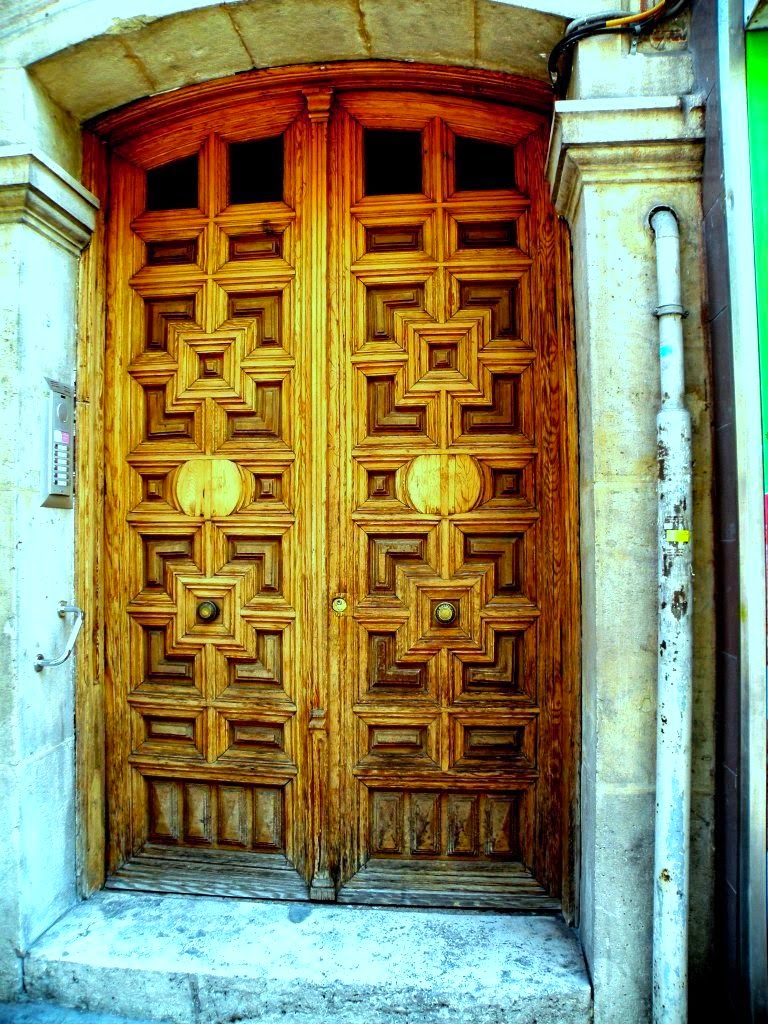
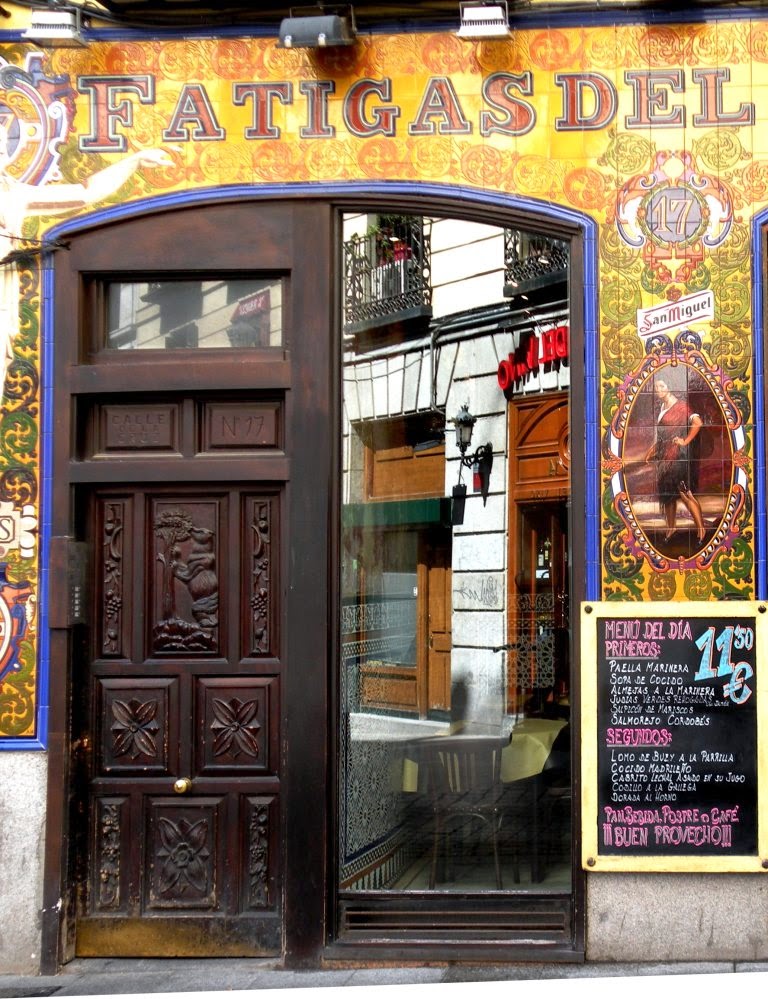
Madrid: Doors, Signs and Wonders (2014)

Interior connecting courtyard, Museo Nacional Centro de Arte Reina Sofía (The Sofía). Look at the little people -- the scale is fantastic! Click on "the approaching thing" for larger image.
Sofia -- interior stairway.
Doorway to mystery.
Cozy entrance to Central de Cine. Link to website here
Door, signs and wonders. There are many cool doors, signs, entranceways, stairways and courtyards in Madrid and throughout Spain -- and there's always more to see.  

Today's Rune: Harvest.

Thursday, October 02, 2014

Pedro Almodóvar: La mala educación / Bad Education (2004)

The plot structure of Pedro Almodóvar's La mala educación / Bad Education (2004) is tricky, including a film within a film based on a story that is based on actual (or are they fictional?) events. The film-within-a-film trope doesn't always work very well, but Almodóvar is good at it. The story-within-a-story based on another story allows time travel, promoting occasional disorientation as to what makes a person a person, while asking: what makes people change in time? Or do people change? That's ultimately the complex gist of persona and identity. These insistent questions are themes constantly explored by Almodóvar.   
If  a picture is worth a thousand words, what's this one saying?
Closeup of Diego Velázquez' Las Meninas (1656), on display in Madrid's Prado. This painting is very similar to what Almodóvar is doing on film.  

Today's Rune: Partnership. 

Monday, September 29, 2014

The Spanish Civil War: A Documentary (Part II)

The Spanish Civil War (Brother Against Brother) Written, Produced, Directed and Narrated by Mike Leighton; Cromwell Productions, 1995 (2001 DVD). The Last Great Cause. Continued.

This documentary cites four poets, all of them fatalities as a direct result of the war.

Antonio Machado (1875-1939)'s “El crimen fue en Granada / The Crime Took Place in Granada” is an homage to Federico García Lorca (1898-1936), murdered with apparent relish by a Francoist goon squad because he was gay as well as pro-Republic. 
From John Cornford's (1915-1936) “Poem” (to Margot Heinemann):

And if bad luck should lay my strength
Into the shallow grave,
Remember all the good you can;

Don't forget my love.

In the course of the film, Cornford's “Full Moon at the Tierz” is also recited.
Two poems by Miguel Hernández are featured: “Recoged esta voz  / Hear This Voice” and “Vientos del pueblo me llevan/ The Winds of the People” It's all very sad, the human condition.  

Today's Rune: Wholeness. 

Sunday, September 28, 2014

The Spanish Civil War: A Documentary (Part I)

The Spanish Civil War (Brother Against Brother).  Written, Produced, Directed and Narrated by Mike Leighton; Cromwell Productions, 1995 (2001 DVD). With informal subtitle: The Last Great Cause.

This is another good documentary on the conflict that's packed with archival footage. Includes interviews with British survivors of the International Brigades, and historical context by Richard Robinson, author of Origins of Franco's Spain: The Right, the Republic and the Revolution, 1931-36 (1970). An additional slant is in the use of poetry to accompany war images. As in many complementary documentaries, there is an absence of pro-Franco interview footage, something that would be equally fascinating to ponder.  
Pictured here: defenders of the Republic in Madrid, 1936. Franco's side was far more conservative in its approach to the "proper role of women in society." As of 2014 -- with the victorious Franco dead for 39 years -- one can again see in Madrid significant numbers of women in uniform: police, museum guards, transit workers and so on. Franco must be turning in his grave!

Here's a chapter breakdown for The Spanish Civil War, which runs just under an hour:


1. Introduction
2. The International Brigades
3. The Anarchist Movement
4. Franco Declares Martial Law
5. Siege of the Alcázar in Toledo
6. The Battle of Madrid
7. Las Pasionaria [Dolores Ibárruri]
8. Italian and German Air Strikes
9. The Non-Intervention Policy
10. Terrible Conditions of the War
11. The Bombing of Guernica
12. The Battle of Brunete
13. Dispelled Idealism
14. The Republican Attack on Teruel
15. The Italian Bombing of Barcelona
16. The Battle of the River Ebro
17. The Munich Agreement
18. Ernest Hemingway’s Role in the War
19. Republican Defeat
20. Credits

Today's Rune: Growth.