Showing posts with label Zoë Heller. Show all posts

Sunday, March 04, 2012

Three by Zoë Heller


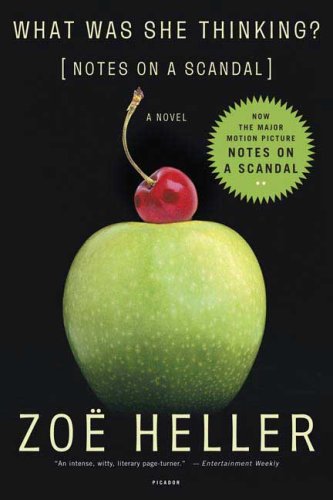
Zoë Heller's first three novels come dressed in different packages and languages: Everything You Know (1999), Notes on a Scandal and its US variant, What Was She Thinking?: Notes on a Scandal: A Novel (2003), and The Believers (2008). The second novel was adapted into a financially successful 2006 movie starring Judi Dench and Cate Blanchett.


I could extol Heller's "trenchant observations," "unflinching explorations of the human psyche" and "acerbic style," but will save it -- how many blurbs and reviews have to fall back on such prattle? In brief, these novels are fun to read. Not everyone will think so. No biggie. Vive la différence!


Next order of business. How do you start in on a writer (or anything, for that matter)?  Where to dive in? Any which way, sort of like noughts and crosses, tic-tac-toe. I happened to read Notes on a Scandal first, shortly after it came out. The novel is a lot more interesting than the movie, which seemed intent on putting more of a particular spin on things. I don't automatically rate books over movies. In any case, this is the one I read first; next, The Believers, and finally, Everything You Know. I enjoyed all three of them -- you might, too. If you've already read one or all of these, what was your take?


What comes after The Believers? More shall be revealed, time will tell, nothing is at it seems.


Tagebuch einer Verführung.

Today's Rune: The Mystery Rune.

Tuesday, February 28, 2012

Everything You Know You Want


Another prompt garnered from Zoë Heller's first novel, Everything You Know (New York: Alfred A. Knopf, 2000, first edition, page 32):

"Don't you want to look at the menu?" Penny asked.
"I know what I want," I said without looking up. "I'm having a pastrami on rye."

At any place that even has menus, do you look at one?  How much? How long does it take you to decide to choose something?  And how often do you rotate your types of choices, places, routines and cuisines? 

I've got plenty to observe about this kind of thing, but just now am more interested in your take, dear reader.

Today's Rune: Partnership.  

Monday, February 27, 2012

Everything You Know


Am now thoroughly enjoying Zoë Heller's first novel, Everything You Know (2000). All three of her novels perform double duty as insightful studies in human psychology and manners.

A sample sentence: "I nodded again and smiled, wondering how to get away."*

Dear reader, how many times have you found yourself in this situation?  How do you get away?

*(Everything You Know, New York: Alfred A. Knopf, 2000, first edition, page 114).

Today's Rune: Harvest.

Saturday, February 04, 2012

Zoë Heller: The Believers


Zoë Heller understands people exceedingly well. It's almost eerie how she can see the world from various points of view, with telling detail. In The Believers (2008), the plot revolves around the immediate family of Joel Litvinoff, a high-powered civil rights lawyer mostly at the point where things go awry: Audrey (his English wife), daughters Rosa and Karla, adopted son Lenny, and Joel's mother Hannah. There are others. The main backdrop is post-9/11 New York City, on the verge of the Iraq War.    


As in What Was She Thinking? Notes on a Scandal (2003), Zoë Heller masterfully delves into her characters and milieu. Everything works in tandem as sentences become paragraphs, paragraphs become chapters and chapters become a novel. Heller can set the scene in a single sentence. Here's a married couple on an important day: "When Karla woke at six, Mike was already up and creeping about the room in his underpants." (p. 316). Here's another one: "Audrey looked around, wondering how long Jean was going to talk about nature." (p. 273). Another thing to note about Heller is her lexicon, a compelling mix of British and American English, slang and all. I find her a complete joy to read.

Today's Rune: Wholeness.   

Sunday, November 12, 2006

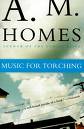
Music for Torching


We've come a long way since Grace Metalious' Peyton Place (1956) and Tom T. Hall's "Harper Valley PTA" (1968), or have we? Has the writing/arts world made any strides in exposing the seedy underbelly of white American suburbia since John Updike's Rabbit, Run (1960)?

Maybe not, but there's still great entertainment value in novels like A.M. Homes' Music for Torching (1999) and Tom Perrotta's Little Children (2004). Homes' version is so amped up and over-the-top that we may not see a movie version, although such a thing would probably feel more coherent than the film adaptation (2001) of her 1990 short story collection The Safety of Objects.

Given the post-9/11/2001 milieu, we may be in greater need of modernized equivalents to Sloan Wilson's The Man in the Grey Flannel Suit (1955) and Joseph Heller's Catch-22 (1961), tales set within a global context, tales with a stronger sense of urgency.

Luckily, there's room for everything, and some things call for repeated satirization with each new generation. Music for Torching is darkly hilarious, and Little Children questions social attitudes and judgments.

Perhaps new novels and story collections are in the works that take Wilson and Heller in stride, adding Don DeLillo's White Noise (1985) and Chuck Palahniuk's Fight Club (1996) as newer signposts for a post-post-modern world.

Photo of A. M. (Amy Michael) Homes.

Today's Rune: Journey.

Bon Voyage!

Wednesday, November 01, 2006

Notes on a Scandal


Stories that mix education and scandal always make for a wild ride -- in real life and in art. I'm happy to report the imminent arrival of Notes on a Scandal (2006), based on the superbly rendered 2003 Zoë Heller novel (in the USA, also called What Was She Thinking? Notes on a Scandal). Starring Cate Blanchett as Sheba Hart and Judi Dench as Barbara Covett, its limited American release date is set for December 25, 2006. Richard Eyre directed, screenplay by Patrick Marber, and soundtrack by Philip Glass. The book skewers the elite school system in England; Heller's wickedly sardonic take could easily be made on a very similar private school culture in the USA.


Another withering look at social interaction in a secondary school setting is Tom Perrota's 1998 novel, Election, and the 1999 movie version that came hard on its heels -- both excellent, if cringe-worthy for educators.

School for scandal, college level, can be found in J. M. Coetzee's Disgrace (1999). The movie version is slated for a 2007 release.

For truly old school style, there's Der Blaue Engel / The Blue Angel (1930), with none other than Marlene Dietrich in the title role as Lola Lola; it's based on a novel by Heinrich Mann. A remake was made in 1958. A fantastic variation of the original story, which it incorporates, is Blue Angel, the 2000 novel by Francine Prose. I read somewhere that Randy and Evi Quaid had optioned the movie rights. Evi directed The Debtors (1999), which has been blocked from release for legal and financial reasons but was well-received in Toronto. Hopefully they'll have better luck with Blue Angel, if the option stories are true.

One more film mixing students and scandal: To Die For (1995), directed by Gus Van Sant with excellent performances by Nicole Kidman, Matt Dillon, and Joaquin Phoenix.


Today's Rune: Partnership.

Cheers, then!

Wednesday, August 30, 2006

Gina Frangello: My Sister's Continent


In the past two years, only a handful of newly published literary novels have grabbed my attention. The latest, My Sister's Continent: A Novel by Gina Frangello (Portland: Chiasmus Press, 2005), thoroughly enchanted me. Why?

First, here are some of the others I've enjoyed reading and pondering: Zoe Heller, What Was She Thinking? Notes on a Scandal: A Novel (2003); T. Coraghessan Boyle, The Inner Circle: A Novel (2004); Mary Gaitskill, Veronica (2005); and, as supplemental reading, Hitomi Kanehara, Snakes and Earrings / Hebi ni piasu, translated by David Karashima (2005) and Marcy Dermansky, Twins: A Novel (2005).

What do they all have in common? All are entertaining and well written; more interestingly, they all explore identity, social boundaries and existential choices with vigor and excitement. They uniformly tread where many fear to go -- into unconventional (and often taboo) social interactions and notions of self. Indeed, they all delve into edgy psycho-sexual relationships (i.e. mature readers preferred) that develop into something deeper.

To compare Frangello's narrative approach in My Sister's Continent with filmmakers, imagine a blend of Woody Allen drama, David Lynch imagery, and character development a la Audrey Wells' Guinevere (1999) and Ingmar Bergman's Persona (1966).

When exploring identity, what could be more intriguing than identical twins? Especially two "women in trouble" who are beautiful and identical in some ways, vastly different in others? Set them (Kirby and Kendra) in the interwined, completely enmeshed milieu of the Braun and Kelsey families, frame them with Freud's "Dora" (Fragment of an Analysis of a Case of Hysteria, 1905), and set them (mostly) in Chicago, with flashbacks and other time shifts, give the father AIDS, follow several transgressions of the status quo, and there you have it, one gripping psychological journey. My Sister's Continent also reminds me of Sue Kaufman's Diary of a Mad Housewife (1967) -- but from the perspective of Bettina Balser's daughters Sylvie and Liz, in their twenties, and with more elaborated detail.

For more on Chiasmus Press, here's a link to their website.

Today's Rune: The Blank Rune.

Bon voyage!