Showing posts with label Flannery O'Connor. Show all posts

Friday, May 04, 2018

Jan Němec: 'A Report on the Party and the Guests' (1966)

Jan Němec's O slavnosti a hostech  / A Report on the Party and [the] Guests / The Party and the Guests (1966).  Banned in Czechoslovakia! Director exiled! Such facts make this film all the more compelling. In 2018, brutish leaders are in style again, randomness rules, and all bets are off. In short, this film breathes surrealism with a touch of parable concerning social expectations, management, fear and control. 
A small group of friends are enjoying a picnic in the country. They see a wedding party pass by. Then, a group of men led by an apparent psychopath arrive and make them do absurd things, until a higher up appears and next directs them to a lakeside celebration. However, one of the guests prefers not to stay. He escapes, and is then hunted by a mob while some guests remain at table, putting out candles. 

There's an eerie, unsettling feeling watching this film, the kind you might get reading Flannery O'Connor's "A Good Man Is Hard to Find." Jan Klusák as Rudolf (pictured above) is the most effective actor, projecting volatile menace through buffoonery. He reminds me of the Rip Torn character in Sweet Bird of Youth (1962), an adaption of the Tennessee Williams play, as well as "The Misfit."

Today's Rune: The Self. 

Monday, July 10, 2017

Dan Trachtenberg: '10 Cloverfield Lane' (2016)

Jack be nimble,
Jack be quick.
Jack jumped over
The candlestick.

Jack jumped high,
Jack jumped low,
Jack jumped over
And burned his toe.

Dan Trachtenberg's 10 Cloverfield Lane (2016) buzzes along with Mary Elizabeth Winstead as protagonist and John Goodman as antagonist in a cool, intelligent indie-style film, just my cup of coffee. Situated somewhere in the same universe as those crazy tales from the Coen Brothers as well as that of The Americans, Breaking Bad/Better Call Saul, the first season of True Detective and even Twin Peaks, it considers the kaleidoscopic possibilities of good, evil and also, from a human perspective, dimensions that may be indecipherable. 

"Sometimes you eat the bear, and sometimes the bear eats you." (The Big Lebowski). 
10 Cloverfield Lane has more than a passing connection to the Coen Brothers: Mary Elizabeth Winstead stars in the latest season of Fargo and John Goodman has appeared in five Coen films (six including his voice as an announcer).

There is a distinction in magnitude between premeditated mass evil, seemingly random evil, and situational evil. However, for anyone on the receiving end of evil (or even just a hungry bear), these distinctions may be moot. The key is in how one responds -- having to make existential choices, large or small, in the face of it. See Flannery O'Connor for more on that score. In all such cases, this is compelling stuff.

Today's Rune: Protection.  

Wednesday, January 01, 2014

Béatrix Beck: Léon Morin, prêtre / The Passionate Heart

In Béatrix Beck: Léon Morin, prêtre (Paris: Gallimard, 1952) / The Passionate Heart, translated from the French by Constantine Fitz Gibbon (New York: Julian Messner, 1953), we follow Barny (based on the author), living in Occupied France during the Second World War as she cares for her daughter France (based on Bernadette Szapiro). The novel, written in a sparse but absorbing style, provides a fascinating window into the time, place and people.

A good part of the novel revolves around the intellectual and social relationship that develops between Barny and Léon Morin, a priest. There's a lot of back and forth as Barny seeks to both stay alive during wartime, protect her daughter, and develop existentially as a human being. At first she's furtive with Morin, who early on responds: "'Do you never feel the need to exchange ideas with your equals? What a savage!'" (Gibbon translation, page 65). 
A little later, we learn what happened to Barny's (Jewish) husband: "Without being asked, I . . . told him that my husband had died in the war, probably through suicide. I anticipated that the priest would show shocked horror or would express pity. He did neither, simply saying: 'Yes, there have been many marriages broken.'" 

Barny likes Morin, certainly, but initially wonders why he takes the time to chat with her at all: "'How can you include me, spiritually, among your sisters, since they're presumably Christian and I'm not?'

'What's that got to do with it? Nothing, nothing at all.'" (Gibbon translation, pages 74-75).

Given the wartime setting, there's a lot of background as well as internal energy that drives the novel. Not incidentally, Léon Morin, prêtre was adapted into a very fine black and white movie by Jean-Pierre Melville (released in 1961) as well as a French TV version in 1991.

I tend to like stories that focus on women or priests living through a time of crisis, so this was a double winner for me. 

Today's Rune: Journey.    

Saturday, August 10, 2013

Bill Maher in Durham

Saw & heard Bill Maher tonight at the Durham Performing Arts Center (capacity about 2700 people).  He's sharp and wicked, more relaxed than on TV, clearly enjoying every minute of his performance - and it was a generous one, pushing two hours straight. Looked like he was wearing a Cuban style shirt, more casual than on HBO's Real Time with Bill Maher. The audience was eclectic and appreciative. I loved it!
Bill Maher's stand-up topics in Durham ranged through all the impolite, telling topics like politics (including North Carolina's politics), religion, sex and social mores. It's a way fun job, but somebody's got to do it.
From Mormons to Catholics, Bill Maher does not spare the rod, yet when it comes down to it a la Flannery O'Connor's way of seeing and not unlike the great Voltaire, he's still pretty Catholic.

Last time I visited Tar Heel Land, the Tibetan Buddhists were in Saxapahaw. This time, Bill Maher in Durham -- and the Durham Bulls right next door, complete with fireworks and a victory.

Today's Rune: Joy.   

Friday, December 14, 2012

Robert Bresson: Diary of a Country Priest


In Robert Bresson's adaptation of Georges Bernanos' 1936 novel, Journal d'un curé de campagne / Diary of a Country Priest (1951), we are dealt a deep, heavy and slow-paced tale suffused with Catholic faith. That is, it's not for everyone, but I usually enjoy stories about the complexities of being a priest or nun or ordinary Catholic, and Diary of a Country Priest is no exception.

This is a beautifully shot film, with a lead (Claude Laydu) who looks and seems right out of the Silent Era, or from an early sound epic like Lewis Milestone's All Quiet on the Western Front. Thematically, Diary of a Country Priest reminds me of a Flannery O'Connor work, so it's no surprise to remember that her novel Wise Blood came out in 1952.


My heart goes out to all those people whose lives have been shattered by today's horrible massacre in Newtown, Connecticut.

Today's Rune: Signals.

Tuesday, May 01, 2012

Emilio Fernández: Los Islas Marías, Take One


'Outsanding melodrama' is my initial response to Emilio Fernández' Los Islas Marías (1951). The over-the-top soundtrack befits it as with other early 1950s movies, especially film noir or science fiction types, but it is also akin to something equally melodramatic such as The Lost Weekend (1945). We are treated to sultry women. Honor. Family. An eclectic mix of labor, celebration and crime. A federal penal colony. Redemption.

Emilio "El Indio"/"The Indian" Fernández fashions a story that revolves around a dysfunctional family in a manner resembling a tale by Fyodor Dostoyevsky seasoned by Flannery O'Connor and filtered through Mexican culture. Fantastic! 

I'll just give the basic set up. First, we follow Doña Rosa Suárez (Rosaura Revueltas) as she proudly, joyously goes around town making arrangements for the celebration of her youngest son's graduation from the Military Academy. She invites all sorts of people to the event, which will be held at the family villa. It's only a little later that we see things are not at all ideal under the surface, however. Her husband, an officer in the Mexican Army, is dead, pehaps killed during the Mexican Revolution or in more recent disturbances. She can't really afford to maintain the family household, even though she retains servants. Her beautiful daughter Alejandra (Esther Luquín) is either a courtesan or otherwise involved in some shady business, with shady men. Her oldest son Felipe (Pedro Infante) hangs out at nightclubs, sings love songs, drinks heavily, has several women admirers, yet acts (and feels inside) like an abject failure. This is why all of Doña Rosa's hopes are now pinned on Felipe's younger brother Ricardo (Jaime Fernández), set to enter the Army as a second lieutenant, in the footsteps of their father. He is her pride and joy. But things will not go as planned -- that's the set up.

Today's Rune: Defense.      

Thursday, July 14, 2011

Bastille Day: Les Carabiniers


War is a trick on most of its participants.

Et le printemps m'a apporté l'affreux rire de l'idiot / And Spring brought to me the dreadful laughter of an idiot. -- Arthur Rimbaud, Une Saison en enfer / A Season in Hell (1873).

In Jean-Luc Godard's Les Carabiniers / The Riflemen (1963), two recruited volunteer soldiers send postcards back to the home front; later, they bring back a stash of them in person, sorted and bundled by genre. One veteran is missing an eye, and they have no money. 

What had they been promised going in?

"Each soldier can do as he wants in the name of the King."

"If we want, can we massacre innocent folks?"

"Yes, that's war." 

Postcards in the film carry the text of actual soldierly correspondence going back hundreds of years.

"We landed in Italy and lined our path with a thousand bodies."

"The day of glory is at hand!"

"We're sowing death in the families and fulfilling our bloody mission."

"We were trucked into Silesia to be firing squads and check on hangings."

"Ten hostages were shot today."

The Balkans, Chad, Congo, Somalia, Libya, Syria, Iraq, Afghanistan: sequel scenes from Flannery O'Connor's "A Good Man Is Hard to Find" . . . and that's just some of the wars of the last twenty years . . .

"The King and his people commemorate forever our sons' heroic combat in Europe and Oceania."

"There is no victory . . . only flags and fallen . . ."

And so the movie ends fittingly. Consider the following statements:

War is a quarrel between . . . thieves too cowardly to fight their own battle; therefore they take boys from one village and another village, stick them into uniforms, equip them with guns, and let them loose like wild beasts against each other. -- Thomas Carlyle, as quoted in 1911 by Emma Goldman.

"Only the dead have seen the end of war." -- George Santayana, 1922.

Today's Rune: The Mystery.

Sunday, February 27, 2011

Wim Wenders: Falsche Bewegung / Wrong Move


Falsche Bewegung (1975), as with all of the Wim Wenders works I've seen, plays out like a quintessentially independent film. Here, a small and finely acted ensemble cast of characters roams through city and country by rail, foot and car over the period of less than a week. Wilhelm, a self-styled struggling writer in his thirties, is pushed out of the nest by his mother. It's unclear, but I suspect his father was killed in the Second World War. In any case, Wilhelm takes a train for Bonn and soon two vagabonds hitch up with him, seeing he has some money to spare. They are a German father, World War II veteran who'd been a runner during the 1936 Olympics, and his young mute daughter Mignon (French for "cute" or "dainty"). Down the line they are joined by Therese, a stage actress, and Bernhard, a young monied Austrian who dallies in poetry. These disparate characters look to Wilhelm for guidance or leadership, but he seems capable of neither. "It Ain't Me, Babe," he might as well reference, but he's no Bob Dylan. Bernhard takes them to his rich uncle's estate -- when they arrive, it is unclear if the man really is his uncle. Slow antics ensue, angst pervades the air, they move on. Wilhelm eventually goes to the top of a mountain and wonders if he's made the "wrong movement" of the title. Perhaps they all have.

Loosely based on (more inspired by) Johann Wolfgang von Goethe's 1795/6 novel Wilhelm Meisters Lehrjahre / Wilhelm Meister's Apprenticeship, Falsche Bewegung has the tonal feel of Carson McCullers' The Heart is a Lonely Hunter (1940) and Flannery O'Connor's Wise Blood (1952).

Main actors on the road: Rüdiger Vogler (Wilhelm); Hans Christian Blech -- my favorite in this film -- as Mignon's father, Laertes; Hanna Schygulla (Therese); Nastassja Kinski (Mignon), barely in her teens, in her film debut;  Peter Kern (Bernhard); and Ivan Desny as the latter's "uncle."

Robby Müller's cinematography is superb, setting buildings and background scenery in more "real" context -- as in life -- than is typical in flashier films.  I also like the way sounds come off, as well as the accompanying music, all important elements in a Wenders film, especially given the relatively sporadic nature of dialogue and action.

Today's Rune: Warrior. 

Monday, July 14, 2008

Shiloh and Other Stories


[September 1982: My sister Linda and I proceeded from Corinth, Mississippi, to Shiloh, Tennessee:]

Shiloh battlefield. Small Indian burial and temple mounds . . .

Steaming with sweat by 11 a.m. -- worked all of Samuel [France]'s lines [great great grandfather, Company E, 31st Indiana Volunteer Infantry Regiment, 1861-1865]. Saw white tailed deer in Hornet's Nest. Found 31st Indiana after circling it forty times on foot by different approaches.

[I recently mentioned Bobbie Ann Mason's Elvis Presley as a good read. Her story "Shiloh" is discussed in many writing classes, including at Macomb Community College. It's very accessible. Norma Jean and Leroy Moffit and Norma Jean's meddling Flannery O'Connorish mother Mabel Beasley existentially battle over marriage, gender issues, personal identity, and the stresses of modern life -- what's not to love? "Shiloh" first came out in The New Yorker (October 20, 1980) and again in 1982 -- about the same time Linda and I were hiking around the battlefield -- with Mason's collection, Shiloh and Other Stories.]

Today's Rune: Flow.

Sunday, March 25, 2007

Glitter In The Pavement: New Orleans Lives!


New Orleans lives on, come on down! I've had a snap chance to zip into the city and ended up spending most of my time in the French Quarter -- no surprise there. By any means necessary, if you have any Bohemian blood at all and the chance to do so, New Orleans is ready for y'all. The scary news is mostly bullshit -- the French Quarter is basically as I remembered it pre-Katrina, and then some. Well worth the visit. Sin and the sacred side by side, as I well remember. All sorts of music and fun -- and a great blues artist, Rooster.

More to come tomorrow, God willing. If all goes as planned, I should be back in Detroit by tomorrow night.

Today's rune: The Blank Rune.

Birthday: Flannery O'Connor.

Adieu!

Sunday, February 04, 2007

Wise Blood


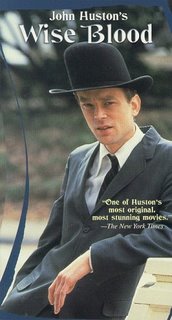
First, a big thank you to Ms. Robin for pointing out Thomas Video, which has a heap of in stock VHS versions of movies not yet available in digital format. I haven’t even gotten to their DVDs yet. For the first round, I picked up four videos, including a copy of Wise Blood (1979/1980), which I hadn’t seen in more than twenty years.

Wise Blood is a comic-spiritual adventure, The Dukes of Hazzard meets The New Testament. The soundtrack is terrible, worthy of 70s TV fair, something out of Little House on the Prairie. But the characters are riveting – in fact, this could easily be set in Metro Detroit today, given the people I’ve met along the way here -- probably best set above Eight Mile, though, given the callous use of the hateful “N” word.

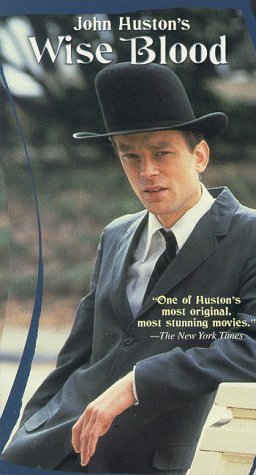
Wise Blood was made in and around Macon, Georgia, and has a weird feel, like mixed eras (1970s and 1930s) jumbled together; the viewer is not sure if this is dark comedy or just plain mockery of eccentrics a la the equally brilliant and equally unsettling Tobacco Road by Erskine Caldwell (1932). This latter uncertainty is exactly as Flannery O’Connor intended in her short novel Wise Blood (1952), and director John Huston is faithful to the spirit and general details of the Flannery text in his film adaptation.


The cast includes Brad Dourif (Hazel Motes), Amy Wright (Sabbath Lily), Harry Dean Stanton (Asa Hawks), Dan Schor (Enoch Emory), Ned Beatty (Hoover Shoates), and John Huston in flashback as Hazel’s fire-and-brimstone preacher grandfather.

Harry Dean Stanton is true to form, and can now be seen on HBO’s Big Love playing another religious character. Ned Beatty plays a goofy two penny charlatan (while over on the set of The Guyana Tragedy, he was playing Congressman Leo Ryan). Dan Schor has the feckless Enoch down perfectly. But the standouts in Wise Blood are Brad Dourif – haunted eyes, driven ways – in the lead role, and Amy Wright as the blind preacher’s daughter. In The Guyana Tragedy, Dourif’s character (David Langtree) is personally saved by none other than Jim Jones himself (Powers Boothe in the role of a lifetime); he later helps dispense the poisoned Flavor Aid at Jonestown. More recently, Dourif has appeared with Powers Boothe again, as Doc in HBO’s Deadwood.

Amy Wright is elfin and a real treat as Sabbath Lily. “I have this personality that makes boys follow me. . .,” she says while trying to seduce Hazel. Wright also appears in Woody Allen’s Stardust Memories (1980), as a groupie. A wonderful actor, she’s married to another wonderful actor, Rip Torn.


From Flannery O'Connor's note to the second edition of Wise Blood (1962): . . . [A]ll comic novels that are any good must be about matters of life and death. . . free will does not mean one will, but many wills conflicting in one man [person]. Freedom cannot be conceived simply. It is a mystery and one which a novel, even a comic novel, can only be asked to deepen. In that sense, both the novel and the film succeed. Warning: the movie takes about ten minutes to kick into gear. Keep the faith.

Today’s Rune: Possessions.

Happy birthday, Betty Friedan.

Happy Super Bowl Sunday! I don’t really care who wins, but favor the Chicago Bears. I liked the Colts more as a kid – when they were in Baltimore. Johnny Unitas rocked! I got to meet him once in Philadelphia when he was an announcer. As for the Bears, I’ve always been a fan of the Black and Blue Division. Go Bears!

Thursday, November 02, 2006

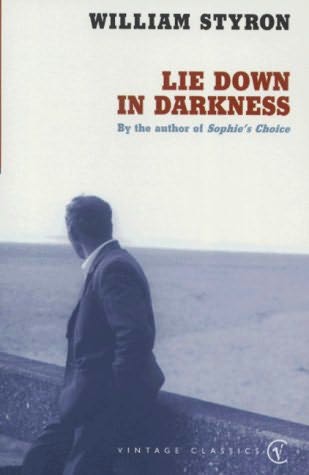
William Styron: Lie Down in Darkness


The death of William Styron (b. Newport News, Virginia, 6/11/1925-d. 11/1/2006, Martha's Vineyard, Massachusetts) throws my mind back to my high school years in Durham, North Carolina.

Given that every English teacher I've ever taken classes with has ranged from eccentric to outlandish and sometimes outrageous, Mrs. V. stands out as a moody mix of them all, only with a very Southern twist. Hailing from Mississippi, she taught an outstanding class called "Southern Writers." Mrs. V. loved her people and championed their work, had met Faulkner, the master, and had us read his novels, plus Tennessee Williams' plays, Flannery O'Connor's writings, Carson McCullers, Walker Percy, and also her friends Eudora Welty and Reynolds Price (who came to class once). Anne Tyler was in the mix somehow, too. For a special research paper, I was given William Styron's The Confessions of Nat Turner (1967), which I found alternately absorbing and nauseating, and certainly memorable.

Styron was an intense guy, masking depression with various addictions I suppose, but also, perhaps, because of his sensitivity, perceptiveness and depth. After attending Davidson College, he graduated from Duke, with stints in the Marine Corps before and after. Before he died yesterday, he completed five novels (including Sophie's Choice, 1979) and three other books, including Darkness Visible: A Memoir of Madness (1990).

I thank Mrs. V for making me read Styron early. I don't remember a Mr. V, but she had a son who suffered from a wasting disease. In class, she alternated between fussy propriety to whispered enthusiasm at "Freudian symbolism" like cigars, hot lava, Cat on a Hot Tin Roof.

Mrs V. refused to ever mention General William Tecumseh Sherman's name ("that awful man") because of Vicksburg and Atlanta, and always referred to the American Civil War as "The War of Northern Aggression" or "The War for Southern Independence." Since I was born in Yankee Pennsylvania, I found her observations highly entertaining and a bit Mississippi crazy. In her mind, very little of importance happened in the world since "The Night They Drove Old Dixie Down." Except, of course, for Southern writers -- America's saving grace in the twentieth century.

Today's Rune: Journey.

Adieu, William Styron.

Tuesday, October 31, 2006

The Lathe of Heaven


There's a cluster of films that capture something about modern times -- maybe the "malaise" of the Jimmy Carter years, maybe also the spiritual yearning still in evidence today. Four of them are dreamy, quirky, low rent and thoughtful by Hollywood standards. They are also entertaining, interesting, memorable, and it's time to bring them forth again:

Wise Blood (1979, based on the 1952 Flannery O'Connor novel); Brave New World (1980, based on the 1932 Aldous Huxley novel); Guyana Tragedy (1980, based on the life of Jim Jones); and The Lathe of Heaven (1980, based on the 1971 novel by Ursula K. Le Guin).

The Lathe of Heaven revolves around George Orr, who seems to be crawling in ruins caused by an atomic war, slowly dying of radiation poisoning. He dreams his way back into life -- is he truly dreaming or is this really happening?

The plot thickens as he receives psychiatric treatment from Dr. William Haber for sleep disorders. Together they discover he can change reality through his dreams, and Haber tries to make "improvements" to the world, resulting in a series of unexpected twists.

If you could change three things in the world, what would they be? A Miss America contestant might say, "I want to bring peace to the world, end starvation and help old people."

Haber opts for trying to end racism, for one -- but when Orr dreams it away, he wakes up to find everyone has turned gray. And then there are the aliens, and the ice cream stands. And that stubborn apocalypse. What's going on?

Remember the Gypsy Curse: May you get exactly what you wish for.

Dr. Haber: You know what they say, neurotics build castles in the sky, psychotics live in them.

Heather: Psychiatrists collect the rent.

Besides death, bills, trouble and taxes, what is reality?

Today's Rune: Fertility.

Happy Halloween Dreaming!

Tuesday, August 22, 2006

Civil Society and the Containment of Violence


Luz de Luma is asking for people to write some thoughts about social violence and what to do about it.

One of the major problems with anarchy, ineffective government, and insufficient social resources is that violent people (usually of the male variety) feel free to roam around with evil intent, commiting atrocious acts right out of A Clockwork Orange (1971) as they go. The problem is global, with certain especially virulent pockets -- turf wars, gang, ethnic, political, religious, tribal and economic rivalries in densely populated urban areas and in small towns and villages alike. Some places are safer than others -- take a look at neutral Switzerland and neutral Sweden, for instance. New York City is safer overall than São Paulo or New Orleans. Why? Stronger civil societies -- courts that work, codes that function, a tilt toward justice and fairness, and a mass refusal to accept violence as a norm -- these point the way out for places like Baghdad that have become hellholes of internecine murder and public assassination.

On the international level, collective bargaining groups like the United Nations may be the best hope for the future; as the global population continues to grow, we must promote rational compromise and forethought, basic planning. Otherwise, we're lost, everyone against everyone and God against all. Evil obviously exists everywhere, and is the ultimate existential challenge for all of us -- how does one deal with evil acts? How does one deal with people who use violence as a way of life without descending into a dystopian society like the one depicted in Brazil (1985)? I know not, but we've got to keep the faith -- and keep trying. Even the end of something as bleak and uncompromising as Flannery O'Connor's "A Good Man is Hard to Find" offers spiritual hope for all of us, even for someone like the Misfit, a man committed to evil acts. As a Catholic convert, I believe dear Flannery is right.

Monday, August 14, 2006

HBO's Deadwood


The visceral nature of HBO's Deadwood (2004-2006), created by David Milch and crew, may shock at first, but its strong character development, story line, and inherently numerous conflicts make it the best Western I've ever seen. The series ends in August, 2006, but there will be at least two follow-up movies to tie up loose ends and follow the surviving characters into new realms (slated for 2007).

The strong language stands out -- in fact, I've never seen any series or movie with so much foul talk, made all the starker when intertwined with flowery nineteenth century phrasings. There's little doubt that it's a realistic mix. It was, after all, the Wild West.

The mix of primary and secondary characters is compelling, too. Because of the serial nature of Deadwood, we can enjoy a range of characters and plot developments.

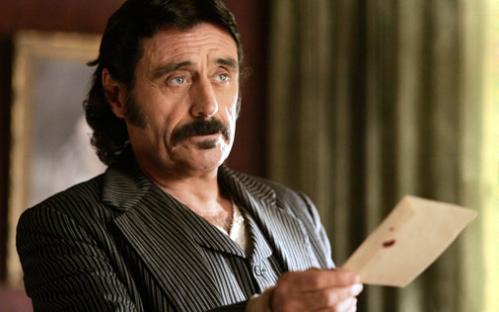
Al Swearengen (Ian McShane) is the kingpin, the equivalent of Tony Soprano from that other killer HBO series. McShane is spectacular. His sidekicks are strong, too, especially Dan Dority (W. Earl Brown), who would be a stock character in traditional Westerns but who is nuanced and interesting in Deadwood. Likewise, Trixie (Paula Malcomson) is compelling as she moves between Swearengen and Sol Star (John Hawkes), yet another good character.

I find the Seth Bullock (Timothy Olyphant) and Alma Garrett (Molly Parker) characters less interesting and their attempts to be "good" in such a dreadful place as Deadwood almost funny in its earnestness. There's something about Parker I don't like (it could just be her Alma character that annoys), though she is interesting playing opposite Peter Sarsgaard in Center of the World (2001).

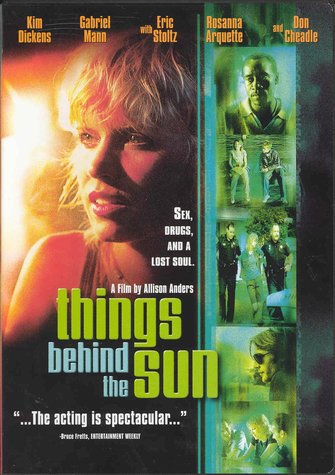
Mr. Wu (Keone Young) is a strong player, and then there's Joanie Stubbs (Kim Dickens), especially worth checking out in Things Behind the Sun (2001), directed by Allison Anders.

Let's not forget Doc Cochran (Brad Dourif) and Cy Tolliver (Powers Boothe), both veterans of a film that should be released in digital format -- Guyana Tragedy: The Story of Jim Jones (1980). Powers Boothe is perfect as Jim Jones, of course, with his "touch of the jungle fever." Dourif is equally good as Hazel Motes in the Flannery O'Connor/John Huston film Wise Blood (1979), along with the always interesting Harry Dean Stanton. This is another flick that should be released in digital.


Viva Deadwood!

Today's Rune: Defense.

Sunday, April 09, 2006

Palm Sunday

John Huston's Wise Blood (1980) is a prime candidate for release on DVD and in other digital formats. It's true to the spirit and basics of the Flannery O'Connor 1952 novel of the same name, and features Brad Dourif, Harry Dean Stanton, and an eeriliy cool ensemble cast. Why it has not been released is hard to fathom. Sure it's serious and droll, a hard mix for Hollywood. But so are the times. Bring it back, please!

We're coming to the end of the Lenten season, with Easter one week from today. It seems like yesterday that I converted to Catholicism even though it's already been three years. I don't feel any more saintly, exactly, but it is a comfort and a consolation, and perhaps I'm a little kinder and more patient than I used to be. I hope so.

I'd like to thank the many people who've helped along the way. I'd also like to thank some key people for helping me stay steady and optimistic through thick and thin over the years. I thank my family, of course, my mother Barbara Marie Shaffer France and my father Donald Delbert France; my sisters Vickie Charabati and Linda Stine; and my brother Jamie France; their significant others; and scores more friends and acqaintances, as well.

Today, though, I'll focus on some of the men besides my wonderful father who've been of great help and guidance.

Thanks to Nick Morrow and Wallace Fowlie, Catholic converts who spoke to me at great length about religion, art, philosophy, travel and life in general. Wallace died many years ago; his papers and art collection are now housed at Duke University. Nick is very much alive in New York City, with a house in Connecticut. I used to mock his faith, and he always responded patiently and with a great sense of humor.

Thanks to four guys in particular for their moral support, advice, generosity, hospitality, and comraderie:

It's always fun to mull over various issues with my younger brother Jamie D. France. I am sorry to report that I traumatized him with my movie choices when charged with babysitting Jamie as a kid (he's nine years younger than me). I would take him to see such child-friendly movies as Apocalypse Now!, The Kids Are Alright and Wise Blood. We had a number of memorable misadventures after each of them, too. In adulthood, he's been a steady and reliable brother, always. After Philadelphia and Brooklyn, he now lives with his Canadian-born wife Suzanne (a fellow librarian) in Cary, North Carolina.

I've known Evan Michael Farris since the seventh grade. We've talked about a million things over the years, attended each other's numerous weddings, traveled to Europe and around the States with one pair of ex'es, advised one another when needed, and talked a lot of politics. We once drove out to Colorado together in our early twenties, where I revealed to him that I had $1 in cash to get all the way back. He was very gracious (and bemused). He lives in the DC area with his lovely wife Susan Farris and their lively boys Austin and Sean.

Kenneth Dale Randall, or Kenny Randall as I've always known him, became friends with me and Evan in the ninth grade. We played on the football team and have gone on many interesting road trips and various adventures. When I was down and out with no way to get back to North Carolina, he provided a sumptuous Thanksgiving dinner that I'll never forget. He's been a great friend and help in all sorts of ways. In New Hampshire during one of our road trips, Nishan "Baba" Toumajan, an old Armenian friend of my father's, dubbed us "the firebugs" and inspired us to go out and see the world at every opportunity. The idea stuck -- so did the nickname. Kenny -- also known as Ken Randall -- got to Michigan way before I did, and now resides in Midland by the shores of the Chippewa River.

Thanks finally to William Donald Caughlin. We first met as undergraduates in Chapel Hill studying under Jim Leutze, with whom we traveled around Europe for six weeks under the aegis of a summer history program. What a trip! I recently found my class journal and will send it to UNC for safe keeping at some point; Bill plans to do the same with his. We've had many adventures together (including Mardi Gras New Orleans), many excellent conversations, and he's always been most gracious and supportive -- with a wicked sense of humor. Another of the North Carolina diaspora, Bill Caughlin now lives in Texas.

One more time for the back seats -- thanks, all! Happy Easter!

Peace be with you, and more soon.