Showing posts with label Criterion. Show all posts

Wednesday, November 22, 2017

Jim Jarmusch: 'Mystery Train' (1989)

We'll let The History of Tom Jones, a Foundling, rest a bit, and turn to Jim Jarmusch's indie style film, Mystery Train (1989). Set in Memphis, Tennessee, Mystery Train is composed of three connected "fish out of water" stories. 

The pacing is deliberative, letting us hang out with the characters long enough to understand them, at least to a point of empathy -- how and why they arrived and where they may be going. Cleverly, Jarmusch helps us "defamiliarize" ourselves with the USA, looking at aspects of American culture with fresh perspectives.*

Two Japanese music fans arrive in Memphis via Amtrak, needling each other about their preferences and wandering around.

An Italian widow has a layover at the airport, so decides to explore the city. She has adventures along the way and even a little supernatural visitation.

A laid-off and jilted Englishman is drunk, angry, and carrying a loaded pistol in a bar. Buddies and a brother-in-law (who turns out to be only his would-be brother-in-law) try to calm him down and keep him out of trouble. Once outside of the bar, he asks to stop somewhere to get more bounce. What could go wrong? 
Strategic points in the urban landscape (like the patchy hotel and a particular view of the city skyline) combine with time and energy to lightly brush the stories together. 

Joe Strummer (1952-2002) of The Clash plays the surly Englishman with charisma. His sidekicks include characters played by Steve Buscemi (The Sopranos, &c.), comedian Rick Aviles (1952-1995), and Detroit's own Vondie Curtis-Hall. 

Nicoletta Braschi (who is also featured in an earlier Jarmusch film, Down by Law) plays the Italian widow and Elizabeth Bracco (The Sopranos), her temporary roommate. 

Youki Kudoh (Snow Falling on Cedars) and Masatoshi Nagase (Funuke Show Some Love, You Losers!) play the needling Japanese visitants.

The hotel guys are played by Screamin' Jay Hawkins (1929-2000) -- "I Put a Spell on You" (1956) and Cinqué Lee (Spike Lee's younger brother).

Good stuff! More recently, Jarmusch directed Gimme Danger (2016), on Iggy & The Stooges. I posted on it here.

*See Russian Formalism for more on this groovy scrim.

Today's Rune: Joy. 

Tuesday, July 25, 2017

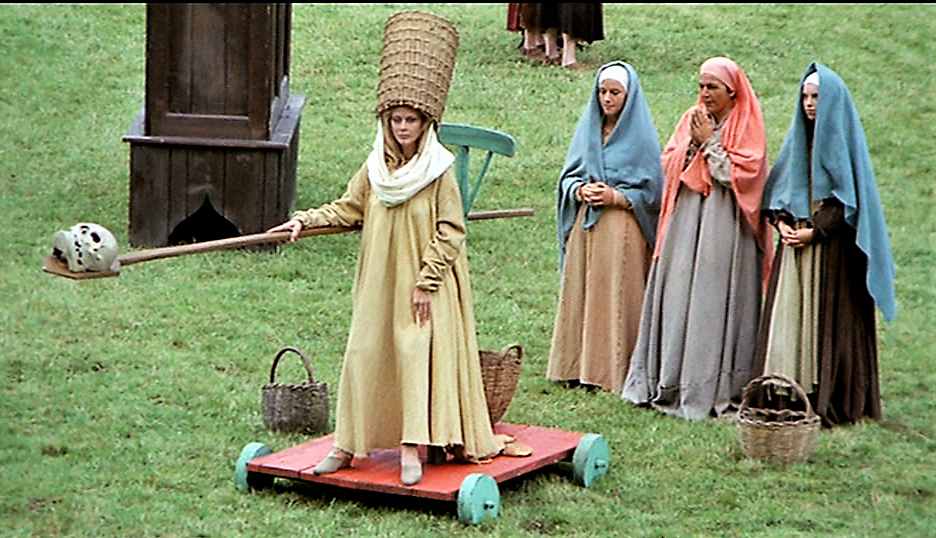
Pier Paolo Pasolini's 'The Canterbury Tales' (1972)

Pier Paolo Pasolini's 1972 cinematic sampling of Geoffrey Chaucer's The Canterbury Tales (1387-1400) forms the second part of Pasolini's "Trilogy of Life." You're not likely to see in many other 20th century directors anything quite like the way Pasolini mixes earthy and mystical, sacred and profane. 
Warning: if nudity offends you, if a scabrous image of the Gates of Hell might offend you, if the blending (true to Chaucer's original) of Catholicism and pre-Christian elements (such as Proserpina and Pluto) might blow your mind, you might consider seeing this in some kind of altered state, or not at all. Given that I'm open-minded about such visionary approaches, I know that many are more prudish in their preferences, so be fairly cautioned. 
I first saw Pasolini's version of The Canterbury Tales when I was in college (one of the subversive dangers of a liberal arts education is consciousness raising), and man, it really did have quite an impact. Still does -- wild stuff. 

Today's Rune: Flow. 

Sunday, July 16, 2017

Pier Paolo Pasolini: Il Decameron / The Decameron (1971)

Pier Paolo Pasolini's Il Decameron / The Decameron (1971) presents a choice selection from the massive 100-story tome of the same title written by Giovanni Boccaccio (1313–1375) between 1348 and 1353. I came to The Decameron via Geoffrey Chaucer's The Canterbury Tales (1387-1400), which appears to have been influenced by it in several tales. Not only are these not obscure texts, both are enduring world-class cultural treasures. 
Pasolini dives in, creating a vibrant movie version that combines the visuals of painters (as noted in an accompanying documentary in the Criterion Collection DVD set, especially Giotto and Bruegel), regional folk music and local actors. This is the first part of Pasolini's Trilogy of Life. 

Pasolini (1922-1975) is described in the same Criterion documentary as a "gay Catholic Marxist artist" with an interesting worldview, indeed. 

With his version of The Decameron, Pasolini selects a representative mix of Boccaccio's comical and tragic tales, some ribald and bawdy, a few scary and all both medieval and timeless. They range from grave-robbing, seduction, hypocrisy and ill intent to the most life affirming of activities, working within and around the social mores of the day. There's much to learn from this consciousness-raising film, and a lot more to write about. 

Today's Rune: The Mystery Rune. 

Thursday, March 09, 2017

Akira Kurosawa: わが青春に悔なし / 'No Regrets for Our Youth' (1946)

Blend one portion of Jane Austen with two of Fyodor Dostoevsky, season with a little Gone with the Wind. Sit down for a Japanese meal during the Second World War period and voila, you have tasted of  Akira Kurosawa's わが青春に悔なし / No Regrets for Our Youth (1946).  Bon appétit!

Let's look briefly at three aspects of this early post-war film.

1. Love triangle, beginning in 1933. Yukie (played by the astonishing Setsuko Hara) is wooed by Noge and Itokawa (all pictured above).

At one point, Yukie matter-of-factly spells things out for Itokawa:

"If I follow you, my life will be peaceful.  But, if I may say, it'll be boring . . . If I follow [Noge], something dazzling will await me. My life will be stormy . . . It terrifies me and fascinates me."  
2. Family. We learn important things about the connections between Yukie, Noge, Itokawa and their family systems, how they help inform their existential decision-making -- even in rebellion. 

3. Society under pressure. Japanese fascism and nationalism begin to squash socialist and even the most moderate dissent. At first, the students and faculty fight for free speech and against militarism, but eventually, many of the students are absorbed into the war machine and most of the faculty either removed or cowed into silence.

Noge goes to prison and is seemingly rehabilitated by the time of his release, though he still remains, in actuality, a member of the resistance. Itokawa becomes a government prosecutor and is seemingly sympathetic, though in actuality, he has become part of the new status quo. 

Yukie is the character who changes the most, and, existentially, for the better.

No Regrets for Our Youth has additional facets worth exploring -- including fine matters of technique and craft -- but three are enough for one post!

Today's Rune: The Mystery Rune.  


Wednesday, February 08, 2017

Gaius Petronius Arbiter: 'The Satyricon' (circa 65 A.D.) / 'Fellini Satyricon' (1969 A.D.)

With The Satyricon, what we have available to read as of early 2017 A.D. is a fragment of a longer work completed about 65 A.D. by Gaius Petronius Arbiter (circa 25-65 A.D.) who lived and died in the time of the deranged Roman emperor Nero (37-68 A.D.), a moment not unlike our own. Federico Fellini, one of the word's great filmmakers, adapted the Roman text into a movie, with new scenes added and some of the original scenes kept off screen, calling his adaptation Fellini Satyricon (1969 A.D.). Both versions are in turn colorful, grotesque, philosophical, poetic, garish, freakish, lurid, ghastly and a little on the demented side, as befits those -- and our -- times. Stunning visuals, but overall not for the squeamish.
In both versions, the aging poet Eumolpus is a major character. He tends to break into recitations of poetry, much to the annoyance of most of the people who can hear him. A running joke has his audiences throwing food or rocks at him, such is their fear and loathing of poetry! When not pining after teenaged boys, he's either mocking the ultra-rich and powerful or philosophizing about the human condition.  
Foil to Eumolpus is Trimalchio, a man far too rich for anyone's good. Even worse, he fancies himself a great poet, plagiarizing freely. When Eumolpus calls him out on this, Trimalchio orders the old man to be hounded and thrown into the street (and in the Fellini version, threatens to throw him into the flames of a large furnace). Eumolpus has a Trumpian personality, abusive yet always seeking unfettered adoration. He builds great monuments to himself and stages a mock funeral for himself, so that he can witness his servants and sycophants weeping and mourning for him, even though everyone involved knows it's a great theatrical sham.

Fellini brings a lot of energy and dazzling visuals to his film version but even so, Fellini Satyricon is certainly not for many besides the adventurous.

Today's Rune: Initiation. 

Saturday, December 31, 2016

Akira Kurosawa's 赤ひげ / 'Red Beard' (1966)

Akira Kurosawa's 赤ひげ / Red Beard (1966) is a meticulously crafted film, an example of cinema as a masterful art form in its own right that includes elements of fiction, poetry, visual art and architecture but is also distinctive. The aesthetics of black and white film (this was Kurosawa's last before shifting to color) allow one to focus on shadow and form as well as sound. Kurosawa is a master filmmaker and one need not understand Japanese to appreciate his works. Indeed, as in the most moving silent films, many of Kurosawa's shot compositions illuminate the power of facial expressions and, in particular, the look of a person's eyes. Kurosawa's work is very satisfying aesthetically and I'm learning a great deal about technique in reviewing his films.
I have never really understood modern medical doctors, their motivation or disposition, but Red Beard makes me wish we had in the everyday now many more such as these doctors from 200 years ago, working hard at a Japanese medical clinic. 

The title character, Dr. Kyojō Niide (played by the always memorable Toshiro Mifune), frequently strokes his beard which is, though we see him in black and white film only, red. One can readily compare his character with Atticus Finch, as played by Gregory Peck in To Kill a Mockingbird, an American film made in the same decade as Red Beard, though the good doctor is a bit gruffer than the lawyer. Just as Atticus takes up a rifle to shoot a threatening rabid dog, Red Beard has a scene in which he opens up a can of whoop-ass on a threatening group of hooligans in a courtyard outside a brothel.

Red Beard approaches his patients, most of them poor, in a holistic manner, strengthening the body, mind and spirit of each when it's still possible to help. He works patiently and effectively with people afflicted by fevers, alcoholism, mental illness, "spiritual scalding," and physical wounds. His holistic approach could be put to good service in the 21st century.
Blanket airing on left is of the same pattern as the one in the top image
Red Beard is based on Shūgorō Yamamoto's The Tales of Dr. Redbeard (1958), plus an additional thread from Fyodor Dostoevsky's Humiliated and Insulted (1861).
Red Beard has heft as well as breadth. In flashback sequences (which sometimes remind me of surrealistic Luis Buñuel flashbacks), there is a landslide and the aftermath of an earthquake. In one sequence, we can see a character stumbling around in the foreground while at the top of the screen a line of people exit the "stage." Having experienced firsthand the nightmarish devastation of the Pacific War that ended with Hiroshima and Nagasaki, and having earlier lived through a massive earthquake, Kurosawa is deep diving through these scenes.
There's another sequence that begins with a strange chanting, a beckoning to the underworld to spare an imperiled young boy's life, that ends with a visual shot from the perspective of the bottom of a well, a water-reflection of the people shimmering above -- a mind-blowing achievement. 

Today's Rune: Harvest.

Monday, December 12, 2016

Akira Kurosawa: 'The Bad Sleep Well' / 悪い奴ほどよく眠る (1960)

In The Bad Sleep Well / 悪い奴ほどよく眠る (1960), Akira Kurosawa tackles a still very contemporary theme: institutional greed and corruption, cover-up. and behind-the-scenes machinations.

Shot in black and white (with elements of silent films -- like special emphasis on faces and gestures), the movie's basic set-up is thus: Nishi (Toshiro Mifune) plans to take revenge on his corporate father's tormentors. 
The film is developed in waves, with a grand wedding, reporters asking questions, corruption investigations, and much unspooling intrigue. 

The Bad Sleep Well twists along to include an attempted suicide at the mouth of a (real) live volcano, clandestine night meetings, and semi-hostages secreted in the ruins of a (real) munitions factory bombed by the Allies during World War II.  

Admirers of Alfred Hitchcock and the Coen brothers will especially dig this production. 
Those even barely attuned to what's going on today, from Trumpian America to Brazil to South Korea, from Fukushima Japan to around the globe, will surely grok the enduring connections across time and space between egotistical organizational chess pieces bound up in graft, greed and sheer folly, so well-depicted in this film.

The Criterion Collection includes added bonus materials with its DVDs, including a relevant chunk of Akira Kurosawa: It is Wonderful to Create (2002). 

Today's Rune: Harvest.

Monday, August 29, 2016

Akira Kurosawa: 'The Hidden Fortress' (1958)

Akira Kurosawa's 隠し砦の三悪人 / The Hidden Fortress (1958), set in the 1500s during the ferocious clan wars of Japan, combines history and mythic, primal storytelling with strong characters, setup and high stakes. 
Extra fun is seeing the "ur" version of a Sergio Leone film, set in black and white. Take Leone's Il buono, il brutto, il cattivo / The Good, The Bad and the Ugly (1966), for instance, and the central role of gold. Make two of the characters more hapless, and one more ferocious. Add three strong women -- more along the lines of Clint Eastwood's The Outlaw Josey Wales (1976). Make music an important element, and strong visuals. Pepper with playful, dark humor mixed with grim situations, such as becoming prisoner to nasty enemies. Make sure environment is a key element, and a partially obscured endgame. (Or, compare with Star Wars, which was directly inspired by The Hidden Fortress -- but let's not even go there at this juncture.)
Instead, consider the character of Makabe Rokurōta (played by Toshiro Mifune). This fierce dude may be the toughest badass you'll ever see on film. Or Princess Yuki (Misa Uehara), some of the time playing a mute, who must have inspired the Shirley MacLaine role in Don Siegel's Two Mules for Sister Sara (1970).  

The difference between The Hidden Fortress and all of the later films is in intensity -- 16th century Japan must have been a terrifying place in which to live -- an island with no exit. The two idiots (a word well-employed in this film as well as by Sergio Leone in his own films) introduced at the beginning of the movie provide a sort of comic relief, but they also underscore the harsh demeanor and derring-do of the other characters.
The Fire Song (sung twice -- once at the Fire Festival, and once by Yuki)

The life of a man
Burn it with the fire.
The life of a bug
Throw it in the fire.
Ponder and you'll see
The world is dark
And this floating world is a dream.
Burn with abandon!

Today's Rune: Journey. 

Wednesday, January 06, 2016

Volker Schlöndorff: 'Die Blechtrommel' / 'The Tin Drum' (1979)

It took many years, but I finally consented to re-watch Volker Schlöndorff's Die Blechtrommel / The Tin Drum (1979) -- Schlöndorff's movie adaptation of the 1959 Günter Graß novel. Given the vivid imagery, dark humor, horror and memorably dramatic events depicted in Danzig (Gdańsk) and elsewhere in Europa during the periods before, during and immediately after the Second World War, I found that my memory of the film was in close alignment with how it unfolds during a second look, albeit with the added bonus of a longer director's cut. I can also say more confidently now thanks to more life experience and additional comparison to many other works of art in the intervening years that this is a Schlöndorff masterwork.  
An excellent reason to see The Tin Drum is that it was banned in Oklahoma for many years. Pretty funny considering the film's obvious anti-Nazi illuminations. 
The Tin Drum makes me think of The Pied Piper of Hamelin (Der Rattenfänger von Hameln). You may recall that in the legend, survivors of the Pied Piper's work include a crippled rat and a crippled child, both of whom bear witness to what has happened to their peers. In The Tin Drum, Otto Matzerath, who has decided to stop growing at age three, plays a succession of tin drums until they break and who also likes to shatter glass with a hideous shrieking, is one such character. Another is Musiker Meyn, a trumpet player. Both are themselves part Pied Pipers and part survivors. There is also a madman, a holy fool sort of half-wit, known as Schugger-Leo. In addition, there are observant little people in a circus troupe, particularly Roswitha Raguna and Bebra, their ringleader. All of these fringe characters give much of the story an outsider's perspective that helps spotlight the tribal core's mass psychology -- and mass delusion. 

Finally, let me note the excellent effect on The Tin Drum made by the background music created by Maurice Jarre (1924-2009). Every time I hear wind chimes, I hear echoes of Jarre's work. Hardly an obscure musician, Jarre won three Oscars for original music scores during his career.

Today's Rune: Defense.    

Friday, December 18, 2015

The Lost Honor of Katharina Blum (1975)

Volker Schlöndorff and Margarethe von Trotta's Die verlorene Ehre der Katharina Blum / The Lost Honour of Katharina Blum (1975), spotlights the main character, Katharina Blum, in a way that underscores the exuberance of mid-70s feminism. 
Found chart courtesy of the internet. 
Combine global male resistance to independent women with fear and panic over security and terrorism, and voila, you've got a film ready-made for the 21st century. 
The movie is based on Heinrich Böll's darkly satirical 1974 novel, Die verlorene Ehre der Katharina Blum oder: Wie Gewalt entstehen und wohin sie führen kann /  The Lost Honour of Katharina Blum, or: How Violence Develops and Where it can Lead. 
The almost absurdly intrusive surveillance and media system depicted in the film might seem beyond belief were it not for a series of similarly themed dystopian science fiction works -- and actual historical developments still being played out. 
Angela Winkler is key to the success of The Lost Honor of Katharina Blum. As she would later do playing "the eel-eating woman" in Volker Schlöndorff's Academy Award winning The Tin Drum (1979), she delivers here with total commitment.

Today's Rune: Breakthrough.  


Thursday, December 10, 2015

Volker Schlöndorff: 'Der junge Törless' / 'Young Törless' (1966)

Volker Schlöndorff's first movie, in stark black and white -- Der junge Törless / Young Törless (1966) -- is set in and around the Prinz Eugen military school in the Austro-Hungarian Empire before the First World War (1914-1918). It's an excellent film in every detail. Perhaps most importantly, it serves as a kind of parable for the rise of fascism and, indeed, provides insight into contemporary phenomena like the increased popularity of the National Front in France and Donald Trump and Ted Cruz in the United States. In this way and more, Young Törless is concerned with how social psychology works as a psychic battleground between mass contagion and individual choice. 
Here we have Törless (seated), the rather twisted Beineberg (smoking) and Bozena, their amorous acquaintance. 
A good deal of the plot of Young Törless involves the scapegoating of Basini, another, weaker student, for sadistic fun. Here, three of the cadets plot further amusement in "the Attic," a secret night meeting place. Think Lord of the Flies.  
Young Törless is grounded in a 1906 novel, Die Verwirrungen des Zöglings Törleß / The Confusions of Young Törless, by Robert Musil (1880-1942), "the Austrian Proust." 

In the arc of the story, the title character sees how people can be drawn into increasingly depraved acts without any apparent brakes on their conduct. In his case, he is able to depart freely, after seeing more than enough. Here, Törless may be a stand-in for exiles and refugees; certainly he is someone who bears witness to human nastiness, coming away with some dirt on his own hands.

Such deep explorations of human psychology in action continue in Volker Schlöndorff's later work, in films such as Der Fangschuß / Coup de Grâce (1976), Die Blechtrommel / The Tin Drum (1979), Un amour de Swann / Swann in Love (1984), The Handmaid's Tale (1990), and others. 

Today's Rune: Partnership. 

Sunday, August 30, 2015

Andrei Tarkovsky's 'Солярис' / 'Solaris' (1972): Take I

To date, there are multiple versions of Solaris, starting with Stanislaw Lem's 1961 novel and proceeding through movies, plays, radio programs, albums and operas as recently as 2012. It's a compelling story.
In this case, let's consider Andrei Tarkovsky's 1972 movie version, Солярис / Solaris. This is a very cool film. The basic setup is this: a research station, mostly depopulated due to Earth-bound decision making, hovers above Solaris, a planet with super consciousness by way of Ocean. Ocean can create human beings out of cosmonauts' memories, and put them on the space station. How the different beings relate to each other is the nexus of the story. Spectacular! 
Today's Rune: The  Mystery Rune.

Tuesday, August 18, 2015

Volker Schlöndorff's 'Der Fangschuß' / 'Coup de grâce' (1976): Take II

Volker Schlöndorff's Der Fangschuß / Coup de grâce (1976) works on several levels. Visually, it's strong yet low-key, shot in black and white. Dramatically, conflict drives plot, albeit in a somewhat eerie way because it seems so matter-of-fact. There is intense but shifting tension between German Freikorps officer Erich von Lhomond (Matthias Habich) and Sophie de Reval (Margarethe von Trotta); and there are matters of war and revolution. The latter combo is starkly brought out by showing the German-Latvian "nationalists" based in a fortified estate vs. their Latvian-Bolshevik-allied challengers, traditionally the poorer workers and crafts-people based in and around Kratovice, the nearby village. The estate or chateau compound seems much like a Mexican or Spanish villa, with an almost Medieval social system being rent apart at the time of the story, post the Great War of 1914-1918 and into the 1920s.
Coup de grâce is based on a 1939 novel by Franco-Belgian writer Marguerite Yourcenar (1903-1987), but the movie is considerably more detailed in its depiction of warfare and daily life. 

What we see is a strange and disconcerting mix of protocol, decorum, regimentation, and gallows humor punctuated by bursts of emotion and violence -- the latter, however, is often carried out with what seems like no emotion at all, such as the routine killing of prisoners on both sides.
Valeska Gert as Tante Praskovia -- a bizarre character, as you may imagine by this image. Gert actually performed in the 1920s, so the time period covered by the film is something she'd personally experienced. Her role is as a sort of Cassandra, or slightly barmy yet keen observer.
The fate of Sophie's dog "Texas." 
Schlöndorff has made a series of intense, heavy-hitting films, ranging from Die Blechtrommel / The Tin Drum (1979) to Un amour de Swann / Swann in Love (1984), The Handmaid's Tale (1990) to Diplomatie / Diplomacy (2014). 

Today's Rune: Breakthrough.   

Friday, August 14, 2015

Volker Schlöndorff's 'Der Fangschuß' / 'Coup de grâce' (1976): Take I

Volker Schlöndorff's 1976 film Der Fangschuß / Coup de grâce (1976) is outstanding, a solid A bit of work. I just saw a crisp Criterion Collection DVD version of this great movie. Yes, there are subtitles -- the language spoken is mostly German, with some French tossed in. Learn something new -- not a big deal (especially if you're already German).

Take five other similarly-themed films, mix them together in a black & white cocktail and boom, there you have an idea of Schlöndorff's vision. The other films?

Jean-Luc Godard's Les carabiniers (1963).

David Lean's Doctor Zhivago (1965).  

Aleksandr Askoldov's Комиссар / Komissar / Commissar / The Commissar (1967/1988). 

Luchino Victoni's La caduta deglis dei / The Damned (1969).

Olivier Hisschbregel's Der Untergand / Downfall (2004).


Come on, now: how many films are you going to get to see that deal with the Latvian Wars of Independence, or any of the wars that convulsed the Baltic States after the Great War of 1914-1918? Bolsheviks! Germans! Latvians! 

(It could just as easily stand in for the Syrian Civil War today, or the nasty bit of business going in in Ukraine as of this post, or Somalia and Yemen). 

And there are strong women characters! 
But what could be more (almost comically) serious and stern as these two German officers? 

What a film! More details to follow.

Today's Rune: Initiation. 

Tuesday, July 14, 2015

Albert Maysles, David Maysles, Charlotte Zwerin: 'Salesman' (1968, 1969): Take Two

Albert Maysles, David Maysles, Charlotte Zwerin: Salesman (1968, 1969). The Maysles Brothers had previous experience at being door-to-door salesmen. They understood the lifestyle, and the stakes.   
Criterion Collection DVD. Chapter listing, including "Lost in Opa Locka," Florida. 
Much of the film spotlights Paul "The Badger" Brennan, who is in decline as a salesman from better years. "An orchestral version of 'This Land Is Your Land' is heard on Brennan's radio as he drives through the snow to a series of appointments with clients who are not home. The irony could not be clearer . . ."  ~ Joe McElhaney's Albert Maysles. Contemporary Film Directors series. University of Illinois Press, 2009, page 46.  

Today's Rune: Defense.