Showing posts with label Almodóvar. Show all posts

Friday, May 11, 2018

Mary Harron: 'I Shot Andy Warhol' (1996)

I Shot Andy Warhol  (1996), director Mary Harron's (b. 1953) first film, centers on Valerie Solanas and her fringe relationship with Warhol. Harron's prior experience as a punk rock journalist probably gave her an insider's perspective -- certainly she recreates the Factory milieu with precision of detail. She orginally envisioned a documentary on Solanas and her infamous works, The SCUM Manifesto, Up Your Ass , and her attempted assassination of French publisher Maurice Girodias (she tried to shoot him at the Hotel Chelsea, but he was out) and Andy Warhol, but after discovering that there wasn't enough archival Solanas footage and few who would speak for her, opted for a dramatic account.
Lili Taylor portrays Solanas as a damaged soul. She's been abused and neglected growing up, and is on her own in the world for the most part, street hustling. But she's smart, and very frustrated. A lesbian turning tricks with men, she is drawn into the Warhol crowd through meeting transvestite Candy Darling (played sympathetically by Stephen Dorff), and tries to interest Andy in her writing. His open door policy lets all sorts of weird people into an already weird Factory scene -- open until she later shoots him, which changes everything.

I Shot Andy Warhol  is an interesting exploration of how commercially successful artists and aspiring artists interrelate. Solanas' feminism plays an important role, too -- her SCUM Manifesto cries foul at men and men's power. A la James Brown's 1966 song "It's a Man's Man's Man's World," Solanas believes it, and thinks the world needs a reverse shakeup. Ideally to her, all men should die. 

Though demented in many ways, Solanas has a point. Why are there so few high profile women equivalents of Andy Warhol? Indeed, even by 2018, why have there been no women presidents in the USA? Why is such a crude and brutish man the current American president, beloved (and also hated) by millions? 

Harron herself, as a woman filmmaker and writer, is rare -- only something like seven percent of directors are women.
The actors put in good performances. Taylor (HBO stalwart on Six Feet Under  and The Notorious Betty Page ) is edgy, scary, mouthy and believable. Jared Harris (Mad Men, &c.) plays Warhol with appropriate cool and nervousness. Donovan Leitch (son of the singer) is fun as Gerard Malanga, and Michael Imperioli serves up Warhol's sidekick Ondine with bitchy camp -- and strong hints of his Sopranos' character, Christopher. Mark the scruffy Revolutionary is played by Justin Theroux in his first movie (Joe from Six Feet Under; Mulholland Drive ): it's his Beretta that Solanas uses to shoot Andy.
After I Shot Andy Warhol, Harron went on to write the screenplay for American Psycho (2000), which she also directed. She also worked on HBO's Six Feet Under  ("The Rainbow of Her Reasons," 2005) and made The Notorious Betty Page (2005). She did The Anna Nicole Story (2013), too. There is continuity in all of her work so far -- exploration of gender issues, fame and notoriety. All interesting stuff. And unsettling. Some of it's funny, some of it's gravely serious, not unlike Spanish filmmaker Pedro Almodóvar, with whom she clearly feels an affinity for women and mystery.

Today's Rune: Gateway. 

Thursday, October 02, 2014

Pedro Almodóvar: La mala educación / Bad Education (2004)

The plot structure of Pedro Almodóvar's La mala educación / Bad Education (2004) is tricky, including a film within a film based on a story that is based on actual (or are they fictional?) events. The film-within-a-film trope doesn't always work very well, but Almodóvar is good at it. The story-within-a-story based on another story allows time travel, promoting occasional disorientation as to what makes a person a person, while asking: what makes people change in time? Or do people change? That's ultimately the complex gist of persona and identity. These insistent questions are themes constantly explored by Almodóvar.   
If  a picture is worth a thousand words, what's this one saying?
Closeup of Diego Velázquez' Las Meninas (1656), on display in Madrid's Prado. This painting is very similar to what Almodóvar is doing on film.  

Today's Rune: Partnership. 

Saturday, September 27, 2014

Pedro Almodóvar: Todo sobre mi madre / All About My Mother (1999)

Pedro Almodóvar's Todo sobre mi madre / All About My Mother (1999) won top film awards in Spain, France, the UK and the USA, and it was a financial success, too, with a relatively small budget and big payout.

It's mostly about women, gender identification, motherhood and existential choices. Set primarily in Madrid and Barcelona, with nods to earlier movies, plays (Tennessee Williams' A Streetcar Named Desire in particular), and other cultural touchstones. Very colorful in all senses of the word.
In All About My Mother (1999), taking a train back and forth between Madrid and Barcelona is a major plot point --  a "geographic." 

In the synchronicity department, a key date -- the only calendar date shown during the film -- is September 26. Without having any idea of this beforehand, I happened to watch it on September 26, 2014. The odds of this occurrence -- unless someone can better determine such things -- are one in 365.2425.

Today's Rune: The Mystery Rune. 

Sunday, September 21, 2014

Pedro Almodóvar: Los abrazos rotos / Broken Embraces (2009)

Pedro Almodóvar's Los abrazos rotos / Broken Embraces (2009): stars Penélope Cruz and is set partly in Madrid and partly on the spectacular Canary Islands / Islas Canarias, off the northwest coast of Africa. 
In this film, Almodóvar uses flashbacks and the present, bits of a documentary about another movie that is like but not exactly Mujeres al borde de un ataque de nervios / Women on the Edge of a Nervous Breakdown (1988), and that film itself, as if Mujeres was re-shot in a parallel universe and now called Chicas y maletas. 
Broken Embraces: Lena (Cruz) and her obsessive, bad-tempered sugar daddy (a Howard Hughes type) about to exchange words -- among other things. 
Lena prepares soon-to-be-spiked gazpacho for Ivan during a scene made for Chicas y maletas -- a sight as colorful and sharp as the full arc of the rest of the story.  

Today's Rune: Movement.  

Wednesday, September 17, 2014

Julio Medem: Lucía y el sexo / Sex and Lucia (2001)

Set mostly in Madrid and on the little Balearic Island of Formentera off the Mediterranean coast of Spain, Julio Medem's Lucía y el sexo / Sex and Lucia (2001) has an offbeat David Lynch vibe and a cool lead with Paz Vega playing Lucía. 
Because Sex and Lucia seems to revolve around not only Lucía but also her paramour Lorenzo (Tristán Ulloa), a writer, it can be tricky figuring out what exactly is "real" in the plot and what is imagined -- or happening in a parallel world.  Lorenzo is working on a novel, or two novels, on a computer in Madrid, but he's also corresponding with a woman on Formentera via the same computer.  Do all of the characters even exist? It's worth noting that Pepe, Lorenzo's literary agent, is played by Javier Cámara -- the same guy who plays "the weirdo" in Pedro Almodóvar's Hable con ella / Talk to Her (2002).   

I come away from this wondering: is the island really "hollow" or "floating?" How many rock holes are there, for God's sake?

Sex and Lucia looks good -- nice work by cinematographer Kiko de la Rica. The music (by Alberto Iglesias -- another direct link to Almodóvar) fits in well, too.

Today's Rune: Signals.  


Sunday, September 14, 2014

Pedro Almodóvar: Hable con ella / Talk to Her (2002)

Pedro Almodóvar's Hable con ella / Talk to Her (2002) gives us a vivid, offbeat tale revolving around four main characters -- a matadora, a travel writer, a ballet dancer and a male nurse. It's a strange one. Lydia González (played by Rosario Flores) is the bullfighter (reflecting reality: there have been several, for example Conchita Cintrón, 1922-2009, and Cristina Sánchez, b. 1972). Marco (Darío Grandinetti), the writer, develops a romantic relationship with her and a friendship with Benigno (Javier Cámara), the male nurse who also happens to be a sort of "weirdo" and is now caring for Alicia (Leonor Watling), who in turn had already been "that obscure object of (his) desire," as Luis Buñuel donned such fetish-making for the title of his final film in 1977.   
What I particularly like about Talk to Her is its incisive demonstration of Spanish manners and social relationships; that and a memorable visit to Córdoba, during which Almodóvar pays meticulous attention to Lydia as she suits up for her final bullfight. All in all, it's a wild journey through time and place, roaming right into a plazas de toros of not always quite predictable results. 

Today's Rune: Gateway. 


Tuesday, August 12, 2014

Pedro Almodóvar: La flor de mi secreto / The Flower of My Secret (1995)

Pedro Almodóvar's La flor de mi secreto / The Flower of My Secret (1995) revolves around Leo Macías, who writes under the pseudonym Amanda Gris. Her marriage with Paco is an emotional train wreck: Leo's neediness combined with his distance form a wretched dynamic, one so awful that he prefers serving with NATO in Brussels and Bosnia during wartime rather than remain with her in Madrid -- whereas she (just almost) wants to die rather than be without him. 
Leo (as Amanda Gris) is a successful writer of "pink" romance novels, but her growing affinity is for "black" (as in the mood) writing. She loves "anxious" and "lunatic" writers such as  Djuna Barnes, Jane Bowles, Janet Frame, Virginia Woolf, Anaïs Nin, and so on.  And indeed, The Flower of My Secret touches quite a bit on identity, persona, pseudonym and a heady creative spirit. Even the choice of "Amanda Gris" as pen name seems to derive from the Spanish visual artist Juan Gris, formerly known as José González, a fellow traveler in stage-shifting. Then there's the matter of stealth, theft and the so-called "writer's [or writers'] well" -- there are only so many ideas to be reworked. Leo's "black" work is to be made into a film (and actually was later made into Almodóvar's own Volver ~ whoah), while her "pink" work is taken over by a temporarily secret admirer/ghost writer. Ah, life!   
Almodóvar's La flor de mi secreto / The Flower of My Secret (1995): Plaza Mayor, Madrid. Ángel and Leo after dark. Red is the color. 
Almodóvar's La flor de mi secreto / The Flower of My Secret (1995): Blanca (Manuela Vargas), Leo (Marisa Paredes) and Rosa (Rossy de Palma).

A few lines for the future: 

"Except for drinking, everything is difficult for me" (Leo).

"Jealousy is a needle that keeps me from living" (from a song in Almagro, Castile-La Mancha).

From Leo's madre (played by Chus Lampreave, always memorable):

"She hides things like a magpie" and "Like a cow without a cowbell." 

Let's not forget phosphorus supplements for "memory." Who knew?

Today's Rune: Partnership.

Sunday, August 10, 2014

Pedro Almodóvar: Entre Tinieblas / Dark Habits (1983)

Zooming in to the goings on inside a small convent, Pedro Almodóvar's Entre Tinieblas / Dark Habits (1983) shows that people often opt to become (or remain) more interesting than the limitations of their social functions. In other words, nuns may be rebels, artists, romantics, gardeners or addicts as well as servants to their order -- just like anyone else. 
I tend to enjoy movies (and any other kind of stories) about nuns and priests and so forth, and I dig Almodóvar, so this one works well for me. As a Catholic, I don't find Entre Tinieblas sacrilegious at all. So what if the Mother Superior is a romantic with a fondness for drugs and "bad girls?" If you substitute good food and drink or sports or smoking or whatever else you wish into the equation, doesn't everybody who can enjoy such pleasures?

Dark Habits isn't a comedy, exactly, nor is it a satire, nor a drama -- though it has touches of all; nor does it have wacky pacing. Rather, we have time to meet all the main characters, discovering what drives them but also what keeps them in place. Above all, though, change is in the air coming from multiple directions, so none of them can remain in their present station forever. Life is exactly like that, over time.
Here's my attempt to chart out the various social connections embedded in the Dark Habits storyline. Three of the characters are spectral presences only (Yolanda's boyfriend, the Marquis and Virginia, his daughter). Three types of written documents tighten the plot: a diary, a letter and several popular fact-based novels ghost-written by one of the nuns. 
Today's Rune: Wholeness. 

Tuesday, July 15, 2014

Pedro Almodóvar's ¿Qué he hecho yo para merecer esto? (1984)

Pedro Almodóvar's ¿Qué he hecho yo para merecer esto? / What Have I Done to Deserve This? (1984) is as wacky and incisive as anything else I can think of. Almodóvar gets at people's underlying realities -- the ways in which people may feel trapped, left out, bummed out, desirous of something beyond the status quo, or aiming for escape. Aspirations for greater freedom and autonomy abound; sometimes they even suddenly and unexpectedly come to be realized.  
Mother and son -- apple, tree. Chus Lampreave's character (on left) is particularly funny in her "ways."
Is sisterhood powerful? Wait and see. Here, Verónica Forqué as Cristal and Carmen Maura as Gloria. 
If you have yet to check out a Pedro Almodóvar movie, ¿Qué he hecho yo para merecer esto? may be a good second one to see. (Note: There are "risqué elements" peppered throughout the film). You may first want to give this one a try: Mujeres al borde de un ataque de nervios / Women on the Verge of a Nervous Breakdown (1988). Oh, yes.

Today's Rune: Journey. 

Thursday, February 17, 2011

Life Remote Control: The Sample


Life Remote Control is quite coherent and well-edited, contrary to the jokes made at its expense in Exit Through the Gift Shop (with which it is bundled on the DVD version, at least a portion of it). It includes nifty musings by Pedro Almodóvar and the now-deceased Malcolm McLaren of Sex Pistols infamy/celebrity, the man who reportedly muttered while dying at age 64, "Free Leonard Peltier!" In Life Remote Control, he expresses what seems like genuine sadness and remorse about the early death of Sid Vicious, and reflects on his own life: "I was very wild." As an arbiter of taste and "anti-culture," he really was.

In addition to celebrity quakers and shakers (including Shepard Fairey, who had to have been involved in its production), Life Remote Control features short bursts of wisdom about life from various people, many who seem to be living on the margins. These are much better than Hallmark bromides but are not quite zen koans. The whole sample -- Life Remote Control: Lawyer's Edit -- takes under the Warholian fifteen minutes to watch.

Today's Rune: The Mystery Rune.

Thursday, August 14, 2008

Barcelona Bound


Tomorrow, American release: Woody Allen's Vicky Cristina Barcelona (2008). Really looking forward to this one. With Scarlett Johansson, Javier Bardem, Penélope Cruz, Patricia Clarkson, Rebecca Hall, et al., it's gonna be a real treat! Looks like as much of a ride as a Pedro Almodóvar film a la, say, Mujeres al borde de un ataque de nervios / Women on the Verge of a Nervous Breakdown (1988).


Penélope Cruz alone is worth the price of admission. . . . .

Today's Rune: Breakthrough.

Tuesday, September 25, 2007

Flags in the Dust


Woke up this morning, what did I see?
A big black cloud hanging over me
I switched on the radio and nearly dropped dead
The news was so bad that I fell out of bed
There was a gas strike, oil strike, lorry strike, bread strike
Got to be a superman to survive

Gas bills, rent bills, tax bills, phone bills
I'm such a wreck but I'm staying alive . . . . .

(The Kinks, "Superman," 1979)


Heather Locklear. Amanda Woodward, her character in Melrose Place, shares the same name as one of my great grandmothers. That always makes me chuckle. These blondes did have more fun. Advice: unless you want a world of hurt, never marry a rock star.


Michael Madsen -- Reservoir Dogs (1992), Kill Bill: Volume 2 (2004), etc.


Catherine Zeta-Jones -- not only is she married to Michael Douglas (same birthday, different year); apparently she is also a "woman with a past." Ha!

Today's Rune: Defense.

Birthdays: Fletcher Christian, C. K. Scott-Moncrieff, William Faulkner, Robert Bresson, Mark Rothko, Silvana Pampanini, Aldo Ray, Barbara Walters, Shel Silverstein, Michael Douglas, Cheryl Tiegs, Pedro Almodóvar Caballero, Michael Madsen, Heather Lcoklear, Aida Turturro, Will Smith, Catherine Zeta-Jones, Bridgette Wilson, Chauncey Billups.

Saturday, February 03, 2007

The Women of La Mancha


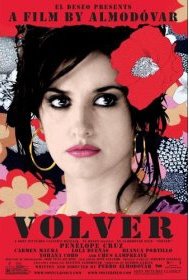
Pedro Almodóvar has created another masterwork with Volver (2006, "Return"). Set in crazy windy La Mancha and in working class Madrid, it weaves the colorful tale of an ensemble of women. Between strong characters, unfolding plot twists, brilliant moving camera angles, varying hues and tones, Spanish-dramatic music and any number of other deft touches, Volver is well worth experiencing theatrically, big screen and all. And more than once.


Raimunda (Penélope Cruz) and Sole (Lola Dueñas), Paula (Yohana Cobo), Irene (Carmen Maura), Agustina (Blanca Portillo), Aunt Paula (Chus Lampreave) and the entire supporting cast are superb.


Volver is not a film to be pigeon-holed to specific genre. Almodóvar's vision is dazzling -- as dazzling as, say, Fellini's. At the film's conclusion, I thought, Wow, that was something. I am glad to be alive!


Almodóvar loves women and the intricacies of social relationships, no question. His art transcends worldly travesty.

Which reminds me that Penélope Cruz has reportedly signed on for Woody Allen's "Barcelona project," to be completed sometime in 2007.

Today's Rune: Defense. Dangerously cold in Detroit.

Happy birthday to Gertrude Stein and also to Joseph E. Johnston (his 200th birthday!), general in both the U.S. and C.S. armies and the primary subject of my doctoral thesis ("Joseph E. Johnston and the Family List," Temple University, 2001). He shall return.

Viva Volver!

Saturday, July 22, 2006

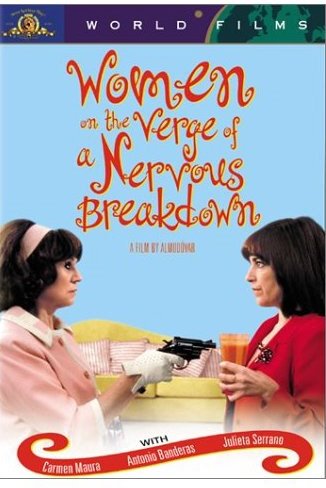
Pedro Almodóvar: Women on the Verge of a Nervous Breakdown


Mujeres al borde de un ataque de nervios / Women on the Verge of a Nervous Breakdown (1988), directed by Pedro Almodóvar. A wonderful, colorful film, shot with wit and style. The story, inspired by Jean Cocteau's short play La voix humaine (1958), concerns miscommunication in relationships, among other things. The role of technology is obvious: telephones, dub machines, TV, and vehicles; but more important are the differences between what we tell each other and what we tell oursleves.

We follow Carmen Maura as Pepa just after she's spurned by her longtime married boyfriend/lover, dapper ladies' man Iván, made especially complicated because they both work as professional movie/TV dialogue dubbers (a nice touch) at the same studio where she also shoots commercials. Iván has made the mistake of leaving personal belongings at Pepa's which he needs for a mysterious trip; much hilarity ensues as everyone tries to figure out what's going on.

In a surreal homage to Fellini's 8 1/2, Iván walks along musing about his previous escapades with women, chatting fondly as he passes them in sequence. New complication: Pepa is pregnant with Iván's child, but she only finds out after he has announced that he's leaving her. This is the situation that sets Pepa on edge, with more to follow.

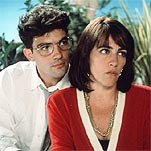
The plot gets more complicated (but not so much that the viewer ever feels lost): Iván's estranged wife gets involved, and decides that the only way she can be free of him is to shoot him. Meanwhile, Pepa is conflicted about everything: she loves/hates Iván, and loves/hates herself, too. At one point, trying to be civilized about the whole matter, she decides: "I'm sick of being good." The plot thickens. Her friend Candela realizes that her most recent boyfriend is a Shiite terrorist who wants to hijack a Stockholm-bound plane from Madrid to Beirut, and she is frantic for help and guidance. On top of this, Iván's son Carlos (an excellent comic role for young Antonio Banderas) and his virgin fiancée have arrived at Pepa's beautiful flat to see if they can buy it once they're married. As it turns out, the family lawyer, "a feminist," Paulina Morales, is the woman planning to fly with Iván -- to Stockholm.

Besides colorful interior shots, domestic animals on Pepa's balcony, imaginative angles, and a tinge of surrealism, we are treated to domestic chase scenes involving "Mambo Taxi" and an "ancient" motorcycle. Carmen Maura is impeccable and carries the movie through with her excellent performance (and intense eyes and presence like Irene Papas). Of all the women on the verge of a nervous breakdown, her character Pepa is the one best able to hold things together, even after everything seems to careen out of control. Her motto: "Young people don't know how to fight for things." She is also the one whose character strengthens amid adversity and sometimes comic chaos.

Almodóvar's most recent film, Volver, has yet to reach Metro Detroit, but it looks quite good, too, and has already won awards in Europe.


Today's rune: Partnership.


Hasta La Vista!